



Back to series



C.S. Lewis on Authentic Discipleship
Click here to open a Print - Friendly PDF
| Walter Hooper has on several occasions stated that C.S. Lewis was the most thoroughly converted person he had ever met. If I were to put what Hooper was saying into biblical language, it would go something like this: “From the time Lewis came to faith in Jesus Christ to the day he died, he desired, worked, and struggled, sometimes succeeding and sometimes failing, to bring all of his life captive to Christ.” An evangelical would simply have said that Lewis was a model disciple of Christ. I agree with both assertions. I also believe Lewis understood the nature and purpose of Christian discipleship better than most and communicated as clearly as anyone in the English speaking world.1
Because my primary aim is to demonstrate the enormous significance of what Lewis has to teach us about Christian discipleship, it is important that I make clear at the outset that Lewis did in fact struggle all his life to embody what he knew to be true of a disciple of Christ. Two examples will suffice. The first comes from a letter Lewis wrote on June 21, 1950, to his friend and former student, George Sayer. Lewis was fifty-one years old. Much of his most important and celebrated work defending and explicating the faith had been published. He was, one might say, mature and well established in his faith. But on this day he penned the following: “My Dear George, I shall be completely alone at the Kilns… from Aug 11 to Aug 19th and am like to fall into a whoreson melancholy. Can you come and spend all or any of this time with me?”2 Now this is a rather amazing and illuminating statement. Surprising in that a somewhat reserved Lewis should unburden himself in this way to a friend and illuminating inasmuch as it demonstrates that even at this period in his life, he was still wrestling with personal demons, still struggling to keep his way pure. It is also illuminating in that it demonstrates the depth of his commitment to following Christ.
The second example is found in the last sermon Lewis preached. He delivered it on January 29, 1956, and it was titled “A Slip of the Tongue.” Once again, it is worth noting that Lewis is now fifty-seven years old; once again we might be tempted to safely assume that while he is far from perfect, he surely has all the big issues well in hand. “A Slip of the Tongue,” however, gives us reason to pause. He begins the sermon recounting how, during his morning devotions, he misread the collect for the fourth Sunday after Trinity. Instead of praying “that I might so pass through things temporal that I finally lost not the things eternal,” he prayed, “so to pass through things eternal that I finally lost not the things temporal.”3 Now we might view this as quite innocent. Lewis did not. For what it alerted him to was that, after all this time, his oldest nemesis to discipleship was still alive and well; namely, his desire for limited liabilities, manifested in that persistent voice in his head that told him to be “careful, to keep his head, not to go too far, not to burn my boats.” Lest the sinister nature be missed, he goes on to make perfectly clear the meaning of these precautions. I come into the presence of God with a great fear lest anything should happen to me within that presence which will prove too intolerably inconvenient when I have come out again into “ordinary” life. I don’t want to be carried away into any resolution which I shall afterwards regret. For I know I shall be feeling quite different after breakfast; I don’t want anything to happen to me at the altar which will run up too big a bill to pay then.4
Speaking of his pre-Christian understanding of the faith in his book Surprised by Joy, he stated that “The horror of the Christian universe was that it had no door marked Exit.” The Christian way, in others words, was made horrifying precisely because of its demands. “No word in my vocabulary,” he went on to say, “expressed deeper hatred than the word Interference. But Christianity placed at the center what then seemed to me a transcendental Interferer.” What Lewis already knew was that at the center of what it meant to be a Christian was the call to complete surrender and obedience to Christ. But Lewis wasn’t finished yet. So great was his aversion to this Christian doctrine that he was compelled to further describe what becoming a Christian would mean for him personally. If its picture was true then no sort of “treaty with reality” could ever be possible. There was no region even in the innermost depth of one’s soul (nay, there least of all) which one could surround with a barbed wire fence and guard with a notice No Admittance. And that was what I wanted; some area, however small, of which I could say to all other beings, “This is my business and mine only.”5 It is no surprise that Lewis titled the chapter in which he tells of his conversion “Checkmate.” It is also no surprise that the epigraph that heads the chapter reads, “The one principle of hell is—‘I am my own.’” For what becomes clear as he nears the point of believing is that the intellectual difficulties had all been addressed; there were no longer any rational barriers to belief. What remained was the barrier of the will. One is reminded of G.K. Chesterton’s poignant observation: “The Christian ideal has not been tried and found wanting. It has been found difficult; and left untried.”6 Lewis had come face to face with the reality of Chesterton’s point. All his attempts to find Christianity “wanting” had failed. He was now left with the “horrible” prospect of willingly allowing himself to become someone else’s; and that someone else was the one who had both the power and the right to hold him accountable to complete and absolute submission—the Transcendental Interferer. Now before moving on, I should like to make a few observations. First, these examples reinforce both Lewis’s understanding of the call to discipleship and his commitment to it. Second, they make it quite clear that Lewis, like all human beings, was haunted with temptations and conscientiously worked at doing what he could to avoid them. Over the years he made notable progress both in the sanctity of his personal life and in his understanding of the faith. Among the most recognizable change in his character over time was a growing humility and compassion in his daily life. Third, they bear witness, particularly in what he says in “A Slip of the Tongue,” that he took seriously the personal commitments and promises he made before God. And last, rather than undermining the truth of what he taught, these examples add integrity and a large measure of authenticity to what he had to say about the nature and cost of being a disciple of Christ. In short, he modeled the life of a disciple. Lewis was helped in his ability to grasp and accept this all-encompassing vision of discipleship by what he had been exposed to in his reading of the Greek and Latin classics—the idea of the absolute right of God to expect complete obedience.
What had previously been viewed as the great terror and an unwelcome intrusion in his life, he now accepted as God’s right. The suddenness of this change Lewis attributed to the fact that he came to accept the right of divine sovereignty before the power of divine sovereignty: the right before the might. Looking back, he recognized this as a great good because it settled for him once and for all where the true good of humanity lay. Union with God and obedience to his commands, he stated, is “bliss and separation from it horror.” Ironically, what had once been his deepest desire and only comfort—to be his own—was now the horror, and what was once the horror had become his ultimate comfort. Reflecting on this, he counseled that it would be good for us to remind ourselves that “God is such that if (per impossible) his power could vanish and His other attributes remain, so that the supreme right were forever robbed of the supreme might, we should still owe Him precisely the same kind and degree of allegiance as we now do.”8 True Christian discipleship, Lewis would have us understand, is first a matter of the heart—the inner life: the recognition, acceptance, and surrender to God’s absolute authority over all the affairs of one’s life in a way that leaves no place to which one may call one’s own. But the surrendered heart, Lewis taught, must also express itself in active obedience to the claims placed upon the believer by the New Covenant. The heart and will of a disciple are, in fact, inextricably bound together. Lewis’s most poignant commentary on these matters, particularly the purpose of discipleship and the demands it presupposes, are found near the end of Book 4 of Mere Christianity. Here Lewis made unavoidably clear that the ultimate purpose or aim of discipleship is to become perfectly Christlike. The Bible uses such phrases as “putting on Christ,” “becoming a partaker of the divine nature,” and “becoming a son or daughter of God,” to flesh out this idea. It is also embodied, Lewis pointed out, in the call to “be perfect as your heavenly Father is perfect,” a command he took quite literally. In fact he stated that it “is the whole of Christianity” and that “God became Man for no other purpose. It is even doubtful… whether the whole universe was created for any other purpose.”9 God is not about the business of making nice people but rather new men and women perfected in the likeness of Christ. Consequently, Lewis went on to say, that the only help we can expect from the Lord is help in becoming perfect. We may want something less, but the Lord is committed to nothing less. Lewis was convinced that this was the very heart of the gospel and, therefore, was also the heart of the call to discipleship. It was the primary reason for which the Son of God came and suffered and died and rose from the grave. This he made unavoidably clear in the chapter “Counting the Cost.” That is why He warned people to “count the cost” before becoming Christians. “Make no mistake,” He says, “if you let me, I will make you perfect. The moment you put yourself in My hands, that is what you are in for. Nothing less, or other, than that. You have the free will, and if you choose, you can push Me away. But if you do not push Me away, understand that I am going to see this job through. Whatever suffering it may cost you in your earthly life, whatever inconceivable purification it may cost you after death, whatever it costs Me, I will never rest, nor let you rest, until you are literally perfect—until my Father can say without reservation that He is well pleased with you, as He said He was well pleased with me. This I can do and will do. But I will not do anything less.”10
He had, himself, a well-developed sense and awareness that the New Covenant mandate to make disciples had a particular claim upon his own life and career. I do not believe I need to take time here to demonstrate Lewis’s lifetime commitment to helping make disciples. One need only look at the enormous number of letters he wrote in answer to people’s requests for doctrinal clarification or spiritual direction, or the seemingly endless list of articles, essays, and books he wrote for the same purpose. What is perhaps worth observing is that Lewis was keenly aware that he had received the best education the British university system could offer, that he held an academic post at arguably the most significantly placed English university of his day, that he was highly skilled in the art of argumentation and possessed unusual literary gifts, and he was under orders to bring these things into the service of Christ and his church, at whatever cost to himself.11 What I hope is now quite evident is that Lewis possessed a remarkably, perhaps for some alarmingly, robust sense of what it means to be a disciple: robust in its awareness of its costliness in its temporal aspect and gloriously robust in its awareness of its ultimate fulfillment in the eternal state. Nowhere did Lewis give expression to both these aspects as concisely as in the concluding paragraph of Mere Christianity. But there must be a real giving up of the self… The principle runs through all life from top to bottom. Give up yourself, and you will find your real self. Lose your life and you will save it. Submit to death, death of your ambitions and favorite wishes every day and death of your whole body in the end: submit with every fiber of your being, and you will find eternal life. Keep back nothing. Nothing that you have not given away will ever be really yours. Nothing in you that has not died will ever be raised from the dead. Look for yourself, and you will find in the long run only hatred, loneliness, despair, rage, ruin, and decay. But look for Christ and you will find Him, and with Him everything else thrown in.
|
|
| Notes 1. Although Lewis seldom used the words disciple or discipleship, the biblical idea was present when speaking of the believer’s call to a holy life. 2. C.S. Lewis, Collected Letters, ed. Walter Hooper (New York: HarperCollins, 2006), 3:39. In this context the word whoreson may be understood to mean wretched or hateful. 3. C.S. Lewis, “A Slip of the Tongue,” in The Weight of Glory and Other Addresses (New York: Simon & Schuster, Touchstone, 1996), 137ff. 4. Ibid., 138. 5. C.S. Lewis, Surprised by Joy: The Shape of My Early Life (New York: Harcourt Brace, 1984), 171, 172. 6. G.K. Chesterton, “The Unfinished Temple,” in What’s Wrong with the World, Collected Works (San Francisco: Ignatius Press, 1987), 4:61. 7. Lewis, Surprised by Joy, 231–32. 8. Ibid., 232. 9. C.S. Lewis, Mere Christianity (New York: Macmillan, 1952), 152–55. 10. Ibid., 158. 11. For a treatment of Lewis’s sense of stewardship of his gift and academic position and the particular cost to his own life of discipleship, see my chapter, “Bearing the Weight of Glory: The Cost of C.S. Lewis’s Witness,” in The Pilgrim’s Guide: C.S. Lewis and the Art of Witness, ed. David Mills (Grand Rapids: Eerdmans, 1998), 3–14. |
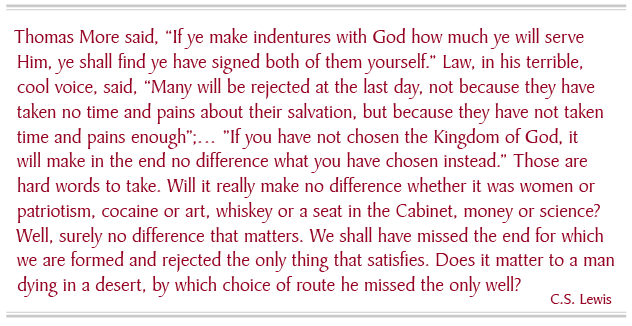
 The root of the matter, said Lewis, was the impulse to “guard the things temporal.” Now what makes this example so full of significance is that the demon he identified and faced off with in this sermon was the most pervasive and powerful obstacle to his coming to faith in Jesus Christ.
 That this was the ultimate purpose God had in mind for the sending of his Son, Lewis believed, and it accordingly obligated every believer to do what he or she could to assist others in the way of Christlikeness.
 Christopher Mitchell
Christopher Mitchell, Theologian, (1951 – 2014) was the third director of the Marion E. Wade Center from 1994 to 2013, and the first holder of the Marion E. Wade Chair of Christian Thought at Wheaton College, Wheaton, Illinois. Mitchell was also the Consulting Editor for VII: An Anglo-American Literary Review (now VII: Journal of the Marion E. Wade Center). Prior to coming to Wheaton College he served as a missionary and pastor. He has published several articles including “C.S. Lewis and Authentic Discipleship,” Knowing and Doing (C.S. Lewis Institute, Spring 2011 Issue.) Mitchell received his M.A. from Wheaton College, and a Ph.D. from the University of St. Andrews, Scotland, where his concentration was Historical Theology with a focus on Jonathan Edwards.
 COPYRIGHT: This publication is published by C.S. Lewis Institute; 8001 Braddock Road, Suite 301; Springfield, VA 22151. Portions of the publication may be reproduced for noncommercial, local church or ministry use without prior permission. Electronic copies of the PDF files may be duplicated and transmitted via e-mail for personal and church use. Articles may not be modified without prior written permission of the Institute. For questions, contact the Institute: 703.914.5602 or email us.
-
Recent Podcasts

Almost Heretical – Deconstructing Christian Finds His Way Back – Nate Hanson’s Story
Influenced by voices like Francis Chan and immersed...Read More
- The Faith of Malcom Muggeridge
- The Scientific Evidence He Couldn’t Ignore: Dr. Brian Miller’s Journey
-
Recent Publications

Is It Really That Important to Pay Attention to Others?
The Gospels paint a vivid picture of Jesus...Read More
- Should My Children Have Robot Friends?
- Stranded in Space, Grounded in Faith
Grow Your Faith with a New Online Course: