



Back to series


CHAPTER 6
Committing to Jesus
And calling the crowd to him with his disciples, he said to them,
“If anyone would come after me, let him deny himself
and take up his cross and follow me.
Mark 8:34
The obedience to Jesus that we have just considered, rooted in grace and love, concretely expresses our commitment to Jesus. And wholehearted commitment to Jesus is essential for growing as His disciple.
The world saw a clear illustration of the cost of commitment to Christ in 2015, when the Islamic State terrorist group lined up twenty-one Christians on the shores of the Mediterranean Sea in Libya. Twenty of them were Egyptian Copts, and one was an African from Chad. Their captors gave them an ultimatum: reject Jesus Christ or be beheaded.
None of the Egyptian Copts turned away from their faith, and all were killed. It was widely reported that the African worker from Chad was not previously known to be Christian. But he told his captors, “Their God is my God,” confessing his faith in Christ and therefore dying as a martyr. Anba Angaelos, the Archbishop of London for the Coptic Orthodox Church, later spoke these words of faith and encouragement as he looked back on the deaths of these men and on persecution of Christians more broadly:
Egyptian Christians have long experienced persecution. The interesting thing is that we live it with a sense of resilience, but we have never fallen into a state of victimhood or triumphalism. We realize that it is the cross of Christ . . . It is not the end of the road because there is a resurrection that comes after the cross and the empty tomb. And so it is in that hope that we continue to live. And it is in that hope that we continue to carry the cross, knowing that it will be removed from us.1
When put to the ultimate test, these men stood firm in the faith: they gave their lives for Jesus Christ. What would you have done?
The Cost of Following Jesus
Jesus neither minimized nor ignored the cost of following Him; instead, He honestly and clearly declared it. He had no interest in attracting multitudes of halfhearted people. The Son of God sought fully committed disciples, for unconditional commitment to Him was essential to live the life to which He was calling them. Jesus made this clear on several occasions, not just to His disciples but also to the crowds that followed Him. C. S. Lewis vividly described this commitment as follows:
Christ says, “Give me all. I don’t want so much of your time and so much of your money and so much of your work. I want you. I have not come to torment your natural self but to kill it. No half-measures are any good. I don’t want to cut off a branch here and a branch there, I want to have the whole tree down … . Hand over the whole natural self, all the desires you think innocent as well as the ones you think wicked—the whole out it. I will give you a new self instead. In fact, I will give you myself; my own will shall become yours.’”2
Is this depiction by Lewis right? Early in Jesus’ ministry, a scribe declared, “Teacher, I will follow you wherever you go.” Jesus commented on the cost: “Foxes have holes, and birds of the air have nests, but the Son of Man has nowhere to lay his head.” When another disciple asked for a reprieve, saying, “Lord, let me first go and bury my father,” Jesus replied, “Follow me, and leave the dead to bury their own dead” (Matt. 8:19–22). No easy road here.

We again see Jesus’ candid teaching about the cost of discipleship in Luke 14, where He addresses a large group of interested listeners:
Now great crowds accompanied him, and he turned and said to them, “If anyone comes to me and does not hate his own father and mother and wife and children and brothers and sisters, yes, even his own life, he cannot be my disciple. Whoever does not bear his own cross and come after me cannot be my disciple. For which of you, desiring to build a tower, does not first sit down and count the cost, whether he has enough to complete it? Otherwise, when he has laid a foundation and is not able to finish, all who see it begin to mock him, saying, ‘This man began to build and was not able to finish.’” (vv. 25–30).
Jesus further compares the would-be disciple to a king directing an army of thousands:
Or what king, going out to encounter another king in war, will not sit down first and deliberate whether he is able with ten thousand to meet him who comes against him with twenty thousand? And if not, while the other is yet a great way off, he sends a delegation and asks for terms of peace. So therefore, any one of you who does not renounce all that he has cannot be my disciple. (vv. 31–33)
What did Jesus mean by these shocking words? Did He expect His disciples to literally hate their families? Must they give up everything they have? These are crucial questions for us today if we would follow Him.
A moment’s thought helps us realize that Jesus did not mean people had to literally hate their families in order to follow Him. Jesus consistently taught wholehearted love for God, sacrificial love for neighbor, and love even for enemies. In the passage from Luke above, He used hyperbole to emphasize in a startling way that love for and devotion to Him must take precedence over all earthly relationships, obligations, and concerns. Love for Jesus fuels the costly discipleship He seeks, for a commitment undergirded by love is far stronger than one based on duty alone. Faithful preacher Charles Spurgeon says it well: “I feel that, if I could live a thousand lives, I would like to live them all for Christ, and even then, I would feel that they were all too little a return for His great love to me.”3
While Jesus’ challenging words may sound harsh to our modern ears, Jesus spoke them in love, truth, and utter realism. He refused to minimize the cost of following Him for the sake of gaining larger crowds. Nor did He encourage anyone to follow Him before that person was ready. He wanted everyone to count the cost of putting Him first and so to prepare for the separation, rejection, persecution, suffering, and possible death that such a commitment might bring.
In another instance, Jesus said, “If anyone would come after me, let him deny himself and take up his cross and follow me. For whoever would save his life will lose it, and whoever loses his life for my sake will find it. For what will it profit a man if he gains the whole world and forfeits his soul?” (Mark 8:34–36)). Here is the same theme again. And these words are recounted in multiple Gospels,4 which signals their importance. Let’s look more closely now at the three conditions that Jesus spelled out as essential for anyone desiring to follow Him.
Deny Self
Jesus first says, “Let him deny himself.” The Lord doesn’t have in mind here simply denying ourselves some pleasure or enjoyment, but rather forsaking our self to live instead for Him. Or to put it differently, to exchange our self-centeredness for Christ centeredness. This means denying every form of sin and self-seeking we are aware of that stands in the way of trusting Jesus and faithfully obeying His words. It means saying “no” to something lower so we might say “yes” to something higher and infinitely more important: Christ and His will.
Unfortunately, our era has trivialized this important phrase, as Professor F. F. Bruce, one of the leading New Testament scholars of the twentieth century, explains:
Here too is a phrase that has become unconscionably weakened in pious phraseology. Denying oneself is not a matter of giving up something, whether for Lent or for the whole of life: it is a decisive saying “No” to oneself, to one’s hopes and plans and ambitions, to one’s likes and dislikes, to one’s nearest and dearest, for the sake of Christ. It was so for the first disciples, and it is so for many disciples today.5
Doing this requires coming to a definite point in our lives when, with firm intention and commitment, we say a decisive “no” to our fallen self so we might say “yes” to Jesus and follow Him—normally when we first repent and believe the gospel.6 We start there and then continue to reaffirm this commitment daily and grow into it. If we don’t do this, our fleshly tendencies of self-seeking and self preservation will frustrate our efforts to follow Him and so lead to compromise and failure as disciples.
Dietrich Bonhoeffer, a German pastor who was martyred by the Nazis, expressed this succinctly when he said, “When Christ calls a man, he bids him come and die.” Only as we die to ourselves and to the world can we truly embrace the life of grace and faithfully follow Jesus.
John Stott, one of the most influential pastor/scholars of the twentieth century, elaborates on denying self:
What we are (our self or personal identity) is partly the result of the Creation (the image of God), and partly the result of the fall (the image defaced). The self we are to deny, disown, and crucify is our fallen self, everything within us that is incompatible with Jesus Christ (hence Christ’s command, “let him deny himself and follow me”). The self we are to affirm and value is our created self, everything within us that is compatible with Jesus Christ (hence his statement that if we lose ourselves by self-denial we shall find ourselves). True self-denial (the denial of our false, fallen self) is not the road to self-destruction, but the road to self-discovery.7
Take Up His Cross
What is this “cross” disciples must take up? Does Jesus refer to some disagreeable circumstance we must endure in life? F. F. Bruce again explains,
The sight of a man being taken to the place of public crucifixion was not unfamiliar in the Roman world of that day. Such a man was commonly made to carry the crossbeam, the patibulum, of his cross as he went to his death. That is the picture which Jesus’ words would conjure up in the minds of his hearers. If they were not prepared for that outcome to their discipleship, let them change their minds while there was time—but let them first weigh the options in the balances of the kingdom of God: “for whoever would save his life will lose it; and whoever loses his life for my sake and the gospel’s will save it.”8
Jesus would die on just such a cross, and those who would follow Him must prepare themselves for the same fate should faithfulness to Him require it. Many did pay that price during the first three centuries of the church. And many continue to pay it today in parts of the non-Western world. The Christians who died in Libya are but one example.
This demand strikes some as extreme. But the legendary C. T. Studd put it in perspective when he said, “If Jesus Christ be God and died for me, then no sacrifice can be too great for me to make for him.”9 Jesus asks of His disciples exactly this attitude of heart. Taking up the cross of Jesus doesn’t mean simply walking through a hard time in life, but rather walking daily in Jesus’ footsteps, the very One who carried His cross for us. Whether that means dying the death of a martyr or living a long life in active service to our Lord, the call is the same: take up your cross.
Follow Me
Finally, says Jesus, “Follow me.” This means following Jesus’ teaching and example, which is possible only if we first deny self and take up our cross.10
Which of Jesus’ teachings should we follow? All of them. As we do, we keep in mind that the call to wholehearted devotion to Christ, love for God, and love for our neighbor—even when that neighbor is an enemy—lies at the heart of His teaching.

What part of Jesus’ example are we to follow? As the long-awaited Suffering Servant (see Isaiah 53), Jesus came in wholehearted devotion to the Father, to fulfill the Father’s will. He came “not to be served but to serve, and to give his life as a ransom for many” (Mark 10:45). Everything He did expressed servanthood that was grounded in sacrificial love, and His self-giving service culminated on the cross with the greatest act of love in human history.
While we cannot give our lives to redeem the souls of others, we can live in humble servanthood as Jesus did (John 13:14–17). We can love God and our neighbor as He did. We can love fellow disciples as He loves us (John 15:12). We can lay down our lives for our friends (John 15:13). We can show compassion for those who don’t yet know Him and share the gospel with them. And we can follow His steps in suffering (1 Pet. 2:21). As the apostle John said, “Whoever keeps his word, in him truly the love of God is perfected. By this we may know that we are in him: whoever says he abides in him ought to walk in the same way in which he walked” (1 John 2:5–6; my emphasis). We will not do these things perfectly, but as we seek to faithfully follow Jesus in the power of the Holy Spirit, we will grow stronger and more consistent over time.
What is at stake here in the conditions of discipleship Jesus lays before those who would follow Him? He leaves no doubt when He goes on to say, “For whoever would save his life will lose it, but whoever loses his life for my sake and the gospel’s will save it.” If we choose to live for self and the best we can gain in earthly life, we will lose eternal life. But if we deny self, take up the cross and follow Jesus, even at the cost of our earthly lives, we will gain eternal life.
Count the cost, says Jesus: “For what does it profit a man to gain the whole world and forfeit his soul? For what can a man give in return for his soul?” (Mark 8:36–37). Compare the value of gaining all that you desire in this earthly life with the loss of eternal life. That is exactly the issue, because “whoever is ashamed of me and of my words in this adulterous and sinful generation, of him will the Son of Man also be ashamed [that is, will disown] when he comes in the glory of his Father with the holy angels” (v. 38).
Hard, yet Easy
These three conditions of discipleship may sound hard, but by embracing them, we paradoxically discover the reality of Jesus’ promise that “my yoke is easy, and my burden is light” (Matt. 11:30). We find that they provide the path of grace in God’s kingdom a path that leads us into freedom, righteousness, peace, and joy. They free us from the prison of self-centeredness and guide us in loving obedience. They give peace of heart and deliver us from the fear of death, and they enable us to walk in joyful fellowship with Jesus, who strengthens and empowers us through His indwelling Spirit.
It can help to think about the commitment Jesus asks of us as something like the mutual devotion of husband and wife in marriage, an idea I first heard from Pastor Bill Kynes.11 Not knowing what the future may hold, husband and wife pledge themselves exclusively to one another and commit “to have and to hold from this day forward, for better, for worse, for richer, for poorer, in sickness and in health, to love and to cherish, till death us do part.”12 Similarly, not knowing what the future may hold, we commit ourselves to Christ, who loved us, gave Himself up for us, and remains committed to us. Just as we enter marriage realizing that, sooner or later, challenges will come (and therefore we vow in advance to remain faithful no matter the cost), so we commit to follow Jesus and remain faithful to Him throughout our lives, no matter the cost.
Does this sound daunting? It may, but Jesus assures us that we can do it through the Holy Spirit’s empowerment. It also helps to remember that countless believers through the ages already have done it.
While some conclude the price of following Jesus is too high, the cost of not following Him is infinitely higher. Throughout the centuries, those who have faithfully followed Jesus have declared it worth every sacrifice and more. The American missionary to Ecuador Jim Elliot, who died as a martyr, spoke for all followers of Jesus when he said, “He is no fool who gives up what he cannot keep to gain what he cannot lose.”13
Truly, as we follow Jesus, we gain something far more valuable than anything we may give up. In this world, God gives us a new life, a new identity, a new family, a new purpose, and a new power for living. We begin to live out what Paul calls the “fruit of the Spirit”: “love, joy, peace, patience, kindness, goodness, faithfulness, gentleness, [and] self-control” … like we see in the life of Jesus (Gal. 5:22–23). And in the world to come, God will completely deliver us from all sin and give us a place in His presence, life with His people, citizenship in a kingdom of love, and satisfactions and enjoyments beyond anything we can imagine.
Keep Eternity in View
Charles Thomas (C. T.) Studd, whom I quoted above, was the son of a wealthy English merchant. He met Christ while a student at Eton. He went on to Cambridge, where he became a nationally celebrated cricket player and joined with five other Cambridge students and one from the Royal Military Academy to form, in 1855, the famous Cambridge Seven. Each of the Cambridge Seven made a wholehearted commitment to Christ, left behind a life of wealth and privilege, and devoted himself to foreign missions with Hudson Taylor in China. Studd’s legendary ministry made a powerful impact over the years—first in China, then in India, and finally in Africa.14

Studd wrote a powerful poem to express the commitment he made to Christ and used it to urge all other believers to live with similar devotion. The famous refrain of the poem declares,
Only one life, ‘twill soon be past,
Only what’s done for Christ will last.
A similar thought is expressed at more length by Puritan pastor Richard Alleine and was adapted by John Wesley and later called the Wesley Covenant Prayer:
I am no longer my own, but yours. Put me to what you will, rank me with whom you will; put me to doing, put me to suffering; let me be employed for you, or laid aside for you, exalted for you, or brought low for you; let me be full, let me be empty, let me have all things, let me have nothing: I freely and wholeheartedly yield all things to your pleasure and disposal. And now, glorious and blessed God, Father, Son and Holy Spirit, you are mine and I am yours. So be it. And the covenant now made on earth, let it be ratified in heaven. Amen.15
Does wholehearted commitment to Christ seem like too high a price to pay? If we view it only through the lens of this world, it probably does. But if we believe in a world to come that makes this one look like mere shadows and ghosts—the glorious, brilliant age of Christ to come—then it’s no sacrifice at all. Instead, we begin to see things as the apostle Paul did:
Whatever gain I had, I counted as loss for the sake of Christ. Indeed, I count everything as loss because of the surpassing worth of knowing Christ Jesus my Lord. For his sake I have suffered the loss of all things and count them as rubbish, in order that I may gain Christ and be found in him, not having a righteousness of my own that comes from the law, but that which comes through faith in Christ, the righteousness from God that depends on faith—that I may know him and the power of his resurrection, and may share his sufferings, becoming like him in his death, that by any means possible I may attain the resurrection from the dead. (Phil. 3:7–11)
That’s a life worth living! And it lasts forever.
Where are you? Did you understand and accept the call to discipleship when you first came to Jesus? Or did the call become clear later? If you have not made a wholehearted commitment to Jesus, take time to count the cost now and decide how you will respond to His call to you. If you have fully committed yourself to Jesus, prayerfully examine yourself to see if you are still walking in it daily.
Questions to Ponder
- What does Jesus mean when He calls us to “take up [our] cross and follow him” (Matt. 16:24)?
- Name some practical implications of saying “no” to yourself and “yes” to Jesus.
- List some characteristics of a person seeking to live a life of “humble servanthood.”
- How does having an eternal perspective help us make sense of Jesus’ call to be wholeheartedly committed to Him?
- What fears do you have about wholehearted commitment to Jesus? Lay them before Him and ask Him to deliver you from them.
Deitrich Bonehoffer, Cost of Discipleship
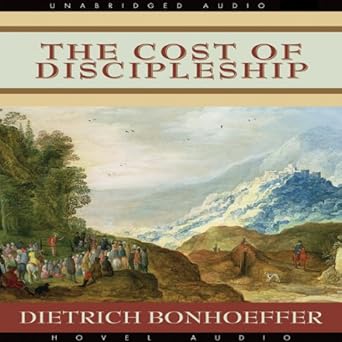 Drawing on the Sermon on the Mount, Dietrich Bonhoeffer answers timeless questions by providing a seminal reading of the dichotomy between "cheap grace" and "costly grace."
John White, The Cost of Commitment
 "The way of the cross is a magnificent obsession with a heavenly pearl, beside which everything else in life has no value." Following Christ, says John White, is not cheap.
Thomas A. Tarrants
Thomas A. Tarrants is President Emeritus of the C.S. Lewis Institute. After serving twelve years as president and nine years as vice President, he retired from his position as Vice President for Ministry and Director, Washington Area Fellows Program, with CSLI in June 2019. He holds a Master's of Divinity Degree, as well as a Doctor of Ministry Degree in Christian Spirituality. Tom is an ordained minister in the Evangelical Church Alliance and a member of the Evangelical Theological Society. Tom is the author of Consumed by Hate, Redeemed by Love, published by Thomas Nelson Publishers and Following Jesus Christ. He spends his time writing, mentoring, consulting and traveling.
