



Back to series


CHAPTER 15
Experiencing Life in the Spirit
But you will receive power when the Holy Spirit has come upon you,
and you will be my witnesses in Jerusalem and in all Judea and Samaria,
and to the end of the earth.
Acts 1:8
The outpouring of the Holy Spirit and new birth marks only the beginning of the Spirit’s work in a believer. New life from the Spirit brings power for new obedience, imparts gifts for ministry, and leads us into mission. And throughout our lives, the Spirit works to bring us to increasing maturity in Christ.
All of these good things have their starting point when Jesus baptizes us in the Holy Spirit. In this chapter, we will expand on our understanding of the Holy Spirit and His work and then look at how Jesus baptizes or immerses us in the Spirit.
A Blessed Life
Wendy Hatcher, a woman I knew for many years, provides a good example of how the Holy Spirit can empower and change an ordinary person’s life. She was the wife of a circuit court judge in Cleveland, Mississippi, and a Sunday school teacher at First Presbyterian Church, where she sat under an abundance of sound teaching. But something seemed missing in her life.

Early one morning while alone and praying in the family room, she had an encounter with the Holy Spirit that made Jesus real to her, brought deep inner change, and imparted a passion to tell the world about Him. She became a committed, fearless disciple of Jesus and a lifelong student of the Bible and theology. And she shared her learning with anyone who expressed an interest.
Though she had no formal training in ministry, through her church’s prison outreach she began to volunteer at the nearby Parchman State penitentiary, said to be one of the worst in the nation. She worked tirelessly with the female prisoners. Her ministry of grace and love had such a profound effect that the prison soon hired her as their first female chaplain, and she served in that role for over thirty years. At her retirement, top prison officials recognized her for having made a major impact on the entire prison system—inmates and staff alike—through her Christlike life and ministry.
It had not been easy, of course. She had faced many hardships and challenges along the way. But God sustained her and brought her through them all. Even in retirement, she continued to share the gospel and the Scriptures with people in her church and community who sought her out for counsel and encouragement.
An important part of how God makes us like Jesus is by using us to serve Him, as He did Wendy Hatcher. Regardless of our station in life, God has things for us to do, good things that glorify Him. God calls every believer to be filled with the Holy Spirit continually so He can guide and empower them to fulfill His purposes through their life.
If that is what we desire, we will do well to study what Scripture tells us about the person and work of the Spirit and to seek to deepen our experience with Him. Whenever this happens, we become more fruitful.
Out of the Shadows
The Holy Spirit is not as prominently highlighted in the Old Testament as He is in the New Testament. But do not mistake “less prominent” for “nonexistent.” The Spirit was present and active at creation, inspired the prophets who authored much of the Old Testament, and anointed and empowered various leaders of Israel, including judges and kings, to perform specific roles and tasks. The Spirit also imparted special gifts to certain individuals such as Bezalel and Oholiab, artisans called and gifted to serve in the construction of the tabernacle (Exod. 35:30–35).
Before Jesus’ incarnation and ascension, what role did the Spirit play in the life of the ordinary Israelite living under the Old Covenant? The Bible does not give us as clear a picture as we might like, so opinions differ at points. But we know that God promised to change the hearts of believing Israelites so they and their children could know, love, and serve Him (Deut. 30:6) and that the Spirit would have been the agent of such a change. We can also say with confidence that God was present to His people in the tabernacle (and later, in the temple) through His Spirit and that the faithful could draw near to Him there (see Exod. 25:8; 1 Samuel 3). And we know that God illuminated, taught, and guided His people in daily life (Ps. 25:9; 31:3; 32:8; 37:23–24; 119:18, 33, 105, 135; Prov. 3:5–6) through His Spirit. Clearly, the Holy Spirit was with true believers in the Old Testament era, as He was with Jesus’ first disciples, but it is not clear that He dwelt in them until Pentecost (John 14:17; Ezek. 34:26).
Though the Spirit was certainly active throughout the Old Testament period, His personhood remained in the background, with His work often described in ways that might suggest impersonal divine power or agency. Despite His lower profile, however, many Jewish people looked forward to the outpouring of the Spirit in connection with the coming of the Messiah and the new age He would usher in (Isa. 11:1–2; 32:15; Joel 2:28–29). Many also longed for the new heart and transformed life the Spirit would beget in God’s people (Ezek. 36:25–27).
In the New Testament, the Holy Spirit’s person and work become increasingly visible. This begins when He brings about the miraculous conception of Jesus, the Messiah, and then later anoints and empowers Jesus for ministry (Matt. 1:20–21; Luke 1:34–35; 3:21–22). Just before His ascension, Jesus promised His disciples the Spirit’s empowerment for their mission: “Behold, I am sending the promise of my Father upon you. But stay in the city until you are clothed with power from on high” (Luke 24:49).
At Pentecost, as we considered briefly in Chapter 14, the Holy Spirit broke forth in blazing intensity, empowering, launching, and guiding the church and its mission of making disciples of all nations. Let’s look at this passage again:
When the day of Pentecost arrived, they were all together in one place. And suddenly there came from heaven a sound like a mighty rushing wind, and it filled the entire house where they were sitting. And divided tongues as of fire appeared to them and rested on each one of them. And they were all filled with the Holy Spirit and began to speak in other tongues as the Spirit gave them utterance. (Acts 2:1–4)
Peter proclaims that this mighty outpouring of the Holy Spirit inaugurated the era of the Spirit, which was prophesied centuries earlier by the prophet Joel. Peter says:
But this is what was uttered through the prophet Joel: “And in the last days it shall be, God declares, that I will pour out my Spirit on all flesh, and your sons and your daughters shall prophesy, and your young men shall see visions, and your old men shall dream dreams; even on my male servants and female servants in those days I will pour out my Spirit, and they shall prophesy. And I will show wonders in the heavens above and signs on the earth below, blood, and fire, and vapor of smoke; the sun shall be turned to darkness and the moon to blood, before the day of the Lord comes, the great and magnificent day. And it shall come to pass that everyone who calls upon the name of the Lord shall be saved.” (vv. 16–21)
From that day forward, not just leaders but all of God’s people—male and female, old and young, masters and servants—would receive the Holy Spirit’s indwelling presence, and “everyone who calls upon the name of the Lord [would] be saved” (v. 21). Through the life, death, resurrection, and ascension of the Messiah and the outpouring of the Holy Spirit at Pentecost, the new age of the Spirit’s work began, and the church was established. With the people of God guided and empowered by the Spirit dwelling within them, God’s kingdom would continue to advance.
The “ Third Person” of the Trinity
The Bible teaches us that there is one God (Deut. 6:4) in three persons: the Father, the Son, and the Holy Spirit. This terminology can be confusing, because we don’t mean that God is three “persons” in the same way that we would say “three persons remained in the room,” where each of the three human beings in question was wholly separate from the other two. Similarly, it is also customary to speak of the Father as the “first person” of the Trinity, the Son (Jesus Christ) as the “second person,” and the Holy Spirit as the “third person.” But again, the use of “first,” “second,” and “third” doesn’t indicate an ordering by rank or a hierarchy as it might in common speech regarding human beings. Rather, the three persons might be thought of like three cords braided together to make one rope. Each of the three is identifiable but is not separable from the others within the context of the rope. (The analogy is, of course, imperfect, yet some may still find it helpful.)
Jesus declared in His Upper Room discourse that the Holy Spirit, the third person of the Trinity, was a person like Himself (but without a physical body) who would take His place with the disciples. The Holy Spirit’s personhood and crucial role in discipleship and the work of the kingdom become clear in the fuller light of Jesus, the church, and the new era.
The personhood of the Spirit is also obvious in Acts, where we read that the Spirit speaks (10:19; 11:12; 13:2; 21:11), confers (15:28), forbids (16:6), and can be lied to (5:1–11). Impersonal forces do none of those things. In Paul’s epistles we read that “the Spirit intercedes for us” (Rom. 8:26) and wills/decides (1 Cor. 12:11); He can be experienced in fellowship (2 Cor. 13:14), grieved (Eph. 4:30), and quenched (1 Thess. 5:19). These are the actions of a personal being, not an impersonal force.
The Holy Spirit is divine. The Scriptures make this plain in several places, including the familiar baptismal formula of Matthew 28:19 (“baptizing them in the name of the Father and of the Son and of the Holy Spirit”) and Paul’s benediction in his second letter to the Corinthians (“The grace of the Lord Jesus Christ and the love of God and the fellowship of the Holy Spirit be with you all” [13:14]). By mentioning the Holy Spirit alongside God the Father and Jesus the Son, the Scriptures confirm that the Spirit is also God.
Discovering that the Holy Spirit is not merely an impersonal force but a divine Person dwelling within the believer has revolutionized the lives of many over the centuries. If you have an unclear or vague understanding of the Spirit, ask God to give you clarity as you read this chapter and ponder the relevant scriptures. And in prayer, ask the Holy Spirit to fill you, teach you of Himself, and let you know His indwelling presence.
The Person and Work of the Holy Spirit
When we survey the New Testament, we see that Jesus Christ secured our redemption through His life, death, resurrection, and ascension. After He finished everything the Father had given Him to do on earth, He returned to heaven and sat down at the Father’s right hand (Heb. 10:12). From there He now intercedes for us and will one day return as God’s appointed judge of all humankind and bring God’s eternal kingdom to its consummation (Acts 17:30–31; Rom. 8:34).

As we await that glorious day, Jesus continues the kingdom mission He began on earth; He does so through the Holy Spirit. The Spirit glorifies Jesus by applying in His people’s lives all the benefits He secured for them through His work on earth. Theologian Herman Ridderbos writes,
What this life by the Spirit involves further in its outworking and realization is expressed in Paul’s epistles in a great many ways and in richly shaded terminology … . From all this it is clear how great the span of the work of the Spirit is and how much Paul ascribes the whole of the new life, in its origin as well as its realization and consummation, to the Spirit, to his operations, powers and gifts.1
On the personal level, this includes drawing us to trust Christ, giving us new birth, dwelling within us, teaching us, empowering us, imparting gifts to us, transforming us, sending us out on mission, and using us to extend God’s kingdom throughout the earth—in other words, the full spectrum of our life in this world.
I have observed that many believers feel surprised when they see a list of things the Bible says the Spirit does. Here are a few examples:
-
-
- convicting unsaved individuals of sin, righteousness, and judgment (John 16:8–11)
- bringing spiritual regeneration (or new birth) to those who trust Christ (John 3:5–6)
- incorporating new believers into the body of Christ (1 Cor. 12:13)
- adopting believers into the family of God and assuring them of sonship (Rom. 8:15–16)
- dwelling within believers (John 14:16–17; Rom. 8:9ff; 1 Cor. 6:19–20; Eph. 5:18; Col. 1:27)
- giving believers a deep knowledge of Christ and His love (Eph. 3:19)
- illuminating the truth of Scripture (1 Cor. 2:6–13; Eph. 1:16–20)
- empowering believers to put to death the works of the body/ flesh (Rom. 8:13; Gal. 5:16)
- producing the character of Jesus (fruit of the Spirit) in believers’ lives (Gal. 5:22–23)
- imparting gifts for ministry (1 Cor. 12:11)
- guiding in ministry (Acts 13:1–3; 16:6–10)
- empowering God’s people to proclaim the good news about Christ (Acts 1:8; 4:31; 1 Cor. 2:1–5; 1 Thess. 1:4–5).
-
The Spirit does His work in these areas not by making Himself the center of attention, but by focusing attention on Christ and glorifying Him (John 16:13–14). The Spirit is emphatically Christ-centered in His work. From the time we are first drawn to Christ until the day we get actively engaged in kingdom ministry and beyond, the Holy Spirit works in us to make all these things happen.
Where do you see the Spirit working in your life? If you aren’t sure or just would like to learn more about the Holy Spirit, I encourage you to read Gregg R. Allison’s God, Gift and Guide: Knowing the Holy Spirit or J. I. Packer’s Keep in Step with the Spirit: Finding Fullness in Our Walk with God. For a deeper look, try the most recent scholarly treatment, Gregg R. Allison and Andreas Köstenberger’s The Holy Spirit, which is part of a series called Theology for the People of God published by B&H Academic
Baptism with the Holy Spirit
Clearly, the Holy Spirit is at the heart of the disciple’s life, start to finish. Only He can empower our transformation into Christlikeness, the goal of discipleship. And only He can supply the gifts, power, and guidance we need for fruitful ministry as disciples of Jesus.
How do we experience His life-changing work in our lives? Holy Scripture, which the Holy Spirit inspired and illuminates, shows the way and helps us interpret our experiences. This means that we must seek to understand any experiences of the Spirit we have had (or not had) through the lens of Scripture. In other words, we should not read our experiences into the Scripture but rather let the Scripture teach us the meaning of our experiences. That is what we will try to do ahead, and it will require some focused thinking.
With this in mind, let’s now look at the phrase “baptize with the Holy Spirit,” a term that has been understood in differing ways over the years by Christ-loving, Bible-believing Christians from diverse backgrounds. We start here because John the Baptist, the forerunner and herald of the Messiah, used this phrase as an overall characterization of Jesus’ ministry (see Matt. 3:11; Luke 3:16). As we proceed, it will be helpful to keep in mind a central question over which opinions have differed: Does “baptize with the Holy Spirit” refer to receiving the Holy Spirit at the beginning of the Christian life (that is, the new birth, which all true believers experience), or to an experience of the Spirit subsequent to the new birth that empowers for service and/or holy living and which only some believers enjoy? Clarity about this will strengthen the foundations of our Christian life. A brief sketch is all we can provide here, but it will lay out the basics.2
Regardless of our views on this question, we do well to start our inquiry by giving thanks and praise to God for the gift of the Holy Spirit and His empowering and transforming work in our lives. Without His work in us, we would not have been born again, nor would we be able to overcome sin, become like Jesus, serve Him in ministry to others, be His witness, or help spread His kingdom. And we also do well to give thanks for the Spirit’s empowering work in other believers, even if their experience differs from ours or if we would not explain it as they do. We are, after all, members of the same family.
In recent decades, Bible-believing scholars have made significant advances in the field of biblical studies, and this includes a refined understanding of the meaning of the phrase “baptize with the Holy Spirit.”3 I have found John Stott’s explanations in Baptism and Fullness: The Work of the Holy Spirit Today to be clear and helpful and well worth reading. Similarly, Professor Gregg Allison’s more recent discussion, quoted below, is also quite concise and illuminating:
I will use an example—water baptism—to illumine Spirit baptism. Water baptism consists of four elements; the agent who baptizes (the pastor), the one who is baptized (the new believer), the medium of baptism (water), and the purpose of baptism (e.g., association with the triune God [Matthew 28:19] … ). Baptism with the Spirit similarly consists of four elements: the agent who baptizes (Jesus Christ), the one who is baptized (the new believer), the medium of baptism (the Holy Spirit), and the purpose of baptism (incorporation into the body of Christ [1 Corinthians 12:13]) … . I define baptism with the Spirit as the work of Jesus Christ in which he pours out the Holy Spirit on new believers thereby incorporating them into his (Christ’s) body, the church.4
There are a total of seven references to “baptizing with the Holy Spirit” in the New Testament: four in the Gospels, two in the book of Acts, and one in the writings of Paul, in 1 Corinthians.5 If this is an area of Christian theology that you would like to learn more about, I recommend studying those passages in more depth while seeking out the guidance of trusted commentators and pastors.
The weight of biblical evidence does not support the view that the phrase “baptize with the Holy Spirit” refers to an experience of the Spirit subsequent to conversion, and only for some. Rather, it leans heavily in favor of understanding the phrase “baptize with the Spirit,” which the Gospels use to characterize Jesus’ ministry, as the proper term for His work of initiating the Christian life and incorporating believers into the body of Christ and God’s kingdom.
However, this does not mean that post-conversion experiences of the Spirit, sometimes powerful ones, do not occur in the lives of believers. They certainly can and do occur and should be desired and welcomed. Many believers have testified to the blessings they bring; but they are properly described as being “filled with the Spirit.” This is reinforced by the fact that Scripture nowhere commands believers to be baptized with the Holy Spirit, but it does command them to be filled with the Spirit, something which can occur on multiple occasions. One baptism, many fillings is the biblical pattern—thus, we say “yes” to a second, third, fourth, fifth blessing, and more!
A small but growing number of noted Pentecostal and Charismatic scholars (communities traditionally affiliated with the view that there is a separate experience of the Spirit post-conversion) have recognized this and concluded that the phrase “baptize with the Spirit” does indeed refer to the initial reception of the Spirit at conversion, and that “filling” is the proper term for subsequent experiences with the Spirit.6
Regardless, it is important to affirm that our discussion of differing views of this phrase is not meant to question the genuineness of any believer’s experiences of the Holy Spirit, but only to provide more accurate understanding and terminology for them and help promote greater unity in the body of Christ. It cannot be emphasized too strongly that this is a family discussion among brothers and sisters in Christ and should never be allowed to divide us: “Unity in essentials, liberty in non-essentials, and love over all” should be our guiding principle.7
It remains to ask, what signs accompany Spirit baptism? This is another significant issue where opinions of faithful believers have differed, but some signs are widely agreed upon. Certainly, empowerment for ministry is one. As noted earlier, Jesus said, “You will receive power when the Holy Spirit has come upon you and you will be my witnesses in Jerusalem and all Judea and Samaria, and to the end of the earth” (Acts 1:8, my emphasis). In other words, they would be enabled to bear witness to the life, death, and resurrection of Jesus and thus begin to fulfill the Great Commission in some measure.
Power for new obedience and holiness of life is another sign. But Luke’s primary concern in Acts is not the sanctification of the believer, but rather the missionary expansion of the church. Luke’s main purpose in writing Acts is to describe the launching of the new era of the Spirit and the progress of God’s kingdom, not the details of Christian experience. By contrast, the topic of sanctification appears more frequently in Paul’s letters to the churches, just where we would expect it to be.
Some believers hold that speaking in tongues is the sign of Spirit baptism. While it certainly was a sign for those gathered together at Pentecost (Acts 2:1–13), it is not mentioned at all regarding the three thousand people converted later that day (v. 41) or the two thousand others converted as reported in Acts 4:4 or 5:18. Neither is it mentioned in connection with the Ethiopian eunuch (Acts 8:26–40), Lydia (16:11–15), the Philippian jailer (16:25–34), or those converted on Paul’s missionary journeys (with the exception of Ephesus). We simply do not know whether others in the early church spoke in tongues when they were baptized with the Spirit. They may have, but if they did, Luke, the author of Acts, did not think it important enough to mention in every case. In light of the examples above, it is also helpful to note that the actual experience of the Spirit in individual lives varied from the highly dramatic (such as on the day of Pentecost) to the quiet and gentle (such as with Lydia, Acts 16:14).
Concerning tongues, in fairness, we should note that even if speaking in tongues is not the sign of Spirit baptism, or a prominent gift, it is listed as one of the gifts of the Spirit that was given to some but not all in the church of Corinth (1 Cor. 12:30). Further, Paul valued the gift highly in his own life. He tells the Corinthians, “I thank God that I speak in tongues more than all of you” (14:18). And he saw sufficient value in this gift to warrant saying, “I want you all to speak in tongues” and “Do not forbid speaking in tongues. But all things should be done decently and in order” (14:5, 39–40). This last sentence suggests that the exercise of tongues could get out of hand. Despite potential abuses, however, there is no suggestion that it should be banned. Whether the gift of speaking in tongues is still available is a subject of lively ongoing discussion in the Christian world. We will look at it again in the chapter on spiritual gifts below (Chapter 18).
Through the Holy Spirit’s presence and power, the church grew by leaps and bounds, even in the face of intense persecution. The Spirit enlarged the community of disciples, filling and refilling both the apostles and ordinary believers as circumstances required. These repeated fillings empowered them to endure persecution and to boldly, faithfully, and powerfully speak God’s Word and spread His kingdom.

We see the effects of this mighty movement of the Spirit throughout the book of Acts. More and more people got swept into God’s kingdom as it spread through the Roman Empire. Outside the secular West, many people today are being swept into the kingdom through the empowered ministry and witness of ordinary believers who are filled with the Holy Spirit. Every believer in the secular West needs to be likewise filled with the Spirit in order to live an empowered life that impacts the world in which they live for Christ. Are you?
Questions to Ponder
- What effect did spotlighting the personal nature of the Holy Spirit in this chapter have on you?
- Briefly comment on two or three of the listed actions of the Holy Spirit that you found most encouraging.
- How would you describe the relationship between the “baptism with the Holy Spirit” and subsequent experiences involving the Holy Spirit (such as filling, coming upon, etc.)?
- How do you respond to the thought of being personally filled with and empowered by the Spirit?
- Do you hunger for a deeper and more personal experience with the Holy Spirit? If not, are you willing to ask God to give you a desire for all that He has for you?
J.I. Packer, Keep In Step With the Spirit
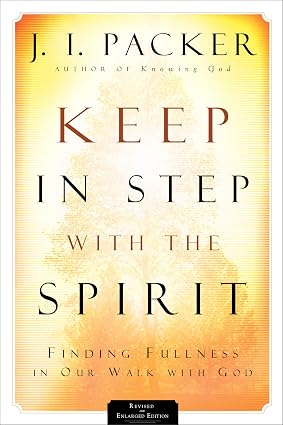 J. I. Packer's Keep in Step with the Spirit focuses on the person and ministry of the Holy Spirit.
Michael Green, I Believe in the Holy Spirit
 In this updated edition of his widely popular book, Michael Green traces the doctrine of the Holy Spirit through the Bible, discusses the baptism and gifts of the Spirit, and addresses the dynamic, ongoing work of the Spirit in today's church and world.
Thomas A. Tarrants
Thomas A. Tarrants is President Emeritus of the C.S. Lewis Institute. After serving twelve years as president and nine years as vice President, he retired from his position as Vice President for Ministry and Director, Washington Area Fellows Program, with CSLI in June 2019. He holds a Master's of Divinity Degree, as well as a Doctor of Ministry Degree in Christian Spirituality. Tom is an ordained minister in the Evangelical Church Alliance and a member of the Evangelical Theological Society. Tom is the author of Consumed by Hate, Redeemed by Love, published by Thomas Nelson Publishers and Following Jesus Christ. He spends his time writing, mentoring, consulting and traveling.
