



Back to series



CHAPTER 18
Manifesting the Spirit’s Gifts
To each is given the manifestation of the Spirit
for the common good.
1 Corinthians 12:7
Charles Spurgeon, arguably the greatest preacher in all of Victorian England, was an English Baptist. Christians from various denominations still highly respect him and read his sermons. In his autobiography, Spurgeon, who was a cessationist,1 relates an interesting story:
While preaching in the hall on one occasion, I deliberately pointed to a man in the midst of the crowd and said, “There is a man sitting there who is a shoemaker; he keeps his shop open on Sundays, it was last Sabbath morning, he took nine pence, and there was four pence profit out of it; his soul is sold to Satan for four pence.2
Sometime later, this man described the event and its impact on him:
I went to the music hall and took a seat in the middle of the place. Mr. Spurgeon looked at me as if he knew me, and in his sermon pointed to me and told the congregation that I was a shoemaker, and that I kept my shop open on Sundays; and I did, sir. I should not have minded that; but he also said that I took nine pence the Sunday before, and that there was a four pence profit; but how he should know that I could not tell. Then it struck me that it was God who had spoken to my soul through him, so I shut up my shop until the next Sunday. At first, I was afraid to go again to hear him; but afterwards I went, and the Lord met with me, and saved my soul.3
Spurgeon added:
I could tell as many as a dozen similar cases in which I pointed at somebody in the hall without having the slightest knowledge of the person, or any idea that what I said was right, except that I believed I was moved by the Spirit to say it; and so strikingly has been my description, that the persons have gone away and said to their friends, “Come see a man who told me all things that ever I did; beyond a doubt, he must have been sent by God to my soul or else he could not have described me so exactly.”4

A story like this raises a number of questions about the gifts of the Holy Spirit, questions many believers wonder about. What is a spiritual gift? What are some examples of spiritual gifts? What purpose do spiritual gifts serve? How many spiritual gifts are there? Can I choose the spiritual gift(s) I want? How can I discover my spiritual gift(s)? How do I use my spiritual gift(s)? Can I ask God for additional gifts? Do one’s spiritual gifts indicate one’s spiritual maturity? What do spiritual gifts look like in action? Where are the gifts of the Spirit listed in the New Testament? Are all the gifts mentioned in the New Testament still available today, or only some This chapter will look at what Scripture says about these questions. It will conclude with some perspectives on spiritual gifts and give time-tested suggestions for discovering your own spiritual gifts.
What Is a Spiritual Gift?
A spiritual gift is a special manifestation or enablement given by the Holy Spirit to each believer to perform a particular function in the body of Christ, typically in the form of words, actions, or abilities. A spiritual gift is not a natural ability, like being intelligent or athletic or artistically gifted, though God can take a natural ability and use it for spiritual purposes.
In the New Testament, spiritual gifts range from relatively unspectacular ones such as serving, teaching, exhorting, giving, leading, and mercy (Rom. 12:7–8) to the more striking and dramatic gifts such as prophecy, healing, working of miracles, and speaking in tongues (1 Cor. 12:9–10). The Bible also describes people as gifts of God’s grace to the church: “And he gave the apostles, the prophets, the evangelists, the shepherds and teachers, to equip the saints for the work of ministry, for building up the body of Christ” (Eph. 4:11–12).
What Is the Purpose of Spiritual Gifts?
In his first letter to the Corinthians, Paul says, “To each is given the manifestation of the Spirit for the common good” (1 Cor. 12:7). In other words, the Holy Spirit manifests Himself through each believer in a specific way (a gift) to benefit others and to glorify Christ. His gracious gifts enable us to serve others through love (Gal. 5:13) and help build up the congregation. In some instances, spiritual gifts can also be used to bless nonbelievers.
How Many Spiritual Gifts Are There?
Overlapping lists in the New Testament mention at least eighteen spiritual gifts,5 but we have no indication that these lists are exhaustive. There may be other spiritual gifts not listed in the Bible. Below we will review some of the key passages that give lists of gifts.
Are All the Gifts Available Today?
Christians in the evangelical world agree that most spiritual gifts named in Scripture are available today. However, opinions differ about what some believers call the so-called “sign gifts”—tongues, prophecy, miracles, and healing. Four main groups of opinions have emerged concerning these gifts that typically confirmed either an apostle’s authenticity or the truth of his message.
Traditional cessationists believe that the so-called “sign gifts” were necessary to establish the church in a hostile culture but faded out after the death of the apostles and the establishment of the canon of Scripture. They hold that history did not see such gifts after the apostles except in unorthodox groups, and that Christians today should not desire or expect these gifts. While cessationists do not believe individual believers receive sign gifts today, they do believe that in His sovereign will, God may do miracles and grant healing today.
Soft cessationists, whose views are often influenced by reports from the mission field today, believe that God may indeed sometimes grant the sign gifts in hostile cultures where the gospel is preached amid intense opposition or when it is being preached for the first time. Essentially, they hold a similar view to traditional cessationists, but they believe that God sometimes chooses to bestow the sign gifts in a limited range of circumstances.
Continuationists differ from cessationists in that they believe all of the gifts in the New Testament remain available today and are needed and available until Jesus returns. They point out that the Scripture nowhere suggests that any of the gifts will be withdrawn, and that Paul specifically encourages the gift of prophecy and says, “Do not forbid speaking in tongues” (1 Cor. 14:39; see 14:1). They also note that in 1 Corinthians 14:18, Paul says he practices tongues more than any of the Corinthians. Continuationists also point out that examples of the so-called sign gifts have been identified at various points in church history and thus did not altogether disappear after the apostles died. They attribute the infrequency of such gifts after the time of the apostles to the increasing institutionalization of the church and the rise of heresies such as the Montanist movement, which overemphasized charismatic gifts and brought them into disrepute.
A fourth group, describing themselves as cautiously open, has emerged in recent decades. Its adherents say they are “cautiously open” to the continuationist position, meaning that they are open to the idea of apostolic gifts operating today, provided they are exercised with discernment and adherence to biblical guidelines.
Adherents of all of these viewpoints are Bible-believing, earnest seekers after truth, and each side raises significant issues that need to be addressed and resolved in the pursuit of correct biblical understanding. Toward that end, good and godly scholars representing different perspectives on spiritual gifts periodically discuss these matters in an irenic spirit and desire for unity. For brief representative views on both sides, see Spiritual Gifts: What They Are and Why They Matter by Thomas Schreiner, which presents a cessationist perspective. For a continuationist view, see God, Gift and Guide: Knowing the Holy Spirit by Gregg Allison. Both hold to Reformed theology and are highly respected scholars. As Christian scholars continue to study and to come together in humility and prayerful, friendly dialogue, there is good reason to expect that greater agreement will emerge. May the same be true as ordinary believers study and discuss these matters with one another. Angry, bitter and acrimonious argument, which has sometimes erupted in discussions about the Holy Spirit and His gifts, delights the devil, dishonors God, and has no place among God’s children.6 We should judge the views of fellow believers with charity and assume that their intentions are good. This means that we judge their positions by their strongest arguments, not their weakest, and their exemplars when they are at their best, not their worst.
Now is a good time to note that a fringe movement known as “the prosperity gospel” has become popular today in some circles. Unbiblical teaching about healing and prosperity characterizes this movement and misleads its adherents, often producing serious spiritual harm. One notable example of harm occurs when people abandon their faith after their prayers for healing, financial prosperity, or other blessings are not answered. This movement is an aberrant outgrowth of the Pentecostal and Charismatic movements. But classical Pentecostals, such as the Assembly of God, and most charismatics, distance themselves from it. We should pray for God to send His light to those involved and to bring them to an understanding of the truth.7
Can I Choose the Spiritual Gift I Want?
No. The Holy Spirit knows how He intends to use each believer and sovereignly determines who is given which gifts. This does not mean you can’t ask God for additional gifts. In fact, Paul encouraged the Corinthian church to seek additional gifts, especially those that would most help the broader congregation (see 1 Cor. 12:31). We have no guarantee that the Lord will give us the specific gift(s) we desire, but Paul still encourages us to ask. Perhaps the best way forward is to express your preference, but then to ask the Lord to give you which ever additional gift(s) He wants you to have and to help you use them effectively to serve others.
How Can I Discover My Spiritual Gift(s)?
Many believers today use a spiritual gift survey to identify their gifting. This can be instructive, but it is not necessary. Since the days of the early church, believers have discovered their gifts simply by serving in the congregation and noticing which of their efforts the Holy Spirit blessed. Fruitfulness in a particular area likely indicates giftedness. Members of the congregation will recognize this fruitfulness and can confirm the gift. Thus, the person who finds pleasure and special satisfaction in serving others (who report being blessed by their efforts) would appear to have a gift of serving. Or the person who reads and studies Scripture and likes to present teaching in the church would seem to have a gift of teaching—again, provided that people learn and are edified by their efforts. And so on, with other gifts.
Ideally, spiritually alert people in the church will recognize a member’s gift and bring it to that person’s attention, but there are certainly cases where this doesn’t happen. Once you become aware of a possible gift, ask some Christian friends who know you well what they think about your idea and whether they can confidently confirm it. If they do, look for opportunities to exercise it, and see if there is fruit. Or if you are unaware of any potential gift, ask Christian friends to help you see what you might be missing and to pray for the Spirit to help you recognize your gifting. In addition, once you know your gifting, you can assist others in discerning their gifts when you observe and appreciate the Spirit’s work through them.
How Do I Use My Spiritual Gift(s)?
Ultimately, using our spiritual gifts is simply a matter of walking in and by the Holy Spirit, who gave them to us. So, using our spiritual gifts doesn’t mean trying harder or seeking to achieve something in our own strength. Knowing how to use our spiritual gifts begins with prayer, listening to the Spirit’s leading through God’s Word, and seeking to serve. An attitude of love—seeking the good of the other person—provides the foundation for properly exercising a spiritual gift. Paul makes this clear when he says:
If I speak in the tongues of men and of angels, but have not love, I am a noisy gong or a clanging cymbal. And if I have prophetic powers, and understand all mysteries and all knowledge, and if I have all faith, so as to remove mountains, but have not love, I am nothing. If I give away all I have, and if I deliver up my body to be burned, but have not love, I gain nothing. (1 Cor. 13:1–3)
The love Paul speaks of here reveals itself through humble servanthood (vv. 4–7). This is how God uses spiritual gifts to build up the church, the body of Christ.
Do Spiritual Gifts Indicate Spiritual Maturity?
The answer is obviously no. The Corinthians were “not lacking in any gift” (1 Cor. 1:7), but they were hardly mature. The church suffered from a partisan spirit and internal divisions (3:1–9), shocking sexual immorality (5:1–2), pride (8:1–3), lawsuits against one another (6:1–8), and drunkenness and other abuses at the Lord’s Supper (11:17–34), along with misuse of their spiritual gifts (14:1–25).
Paul inserted his comments on love in the middle of his discussion of spiritual gifts precisely to challenge the fleshly, immature Corinthians to grow up spiritually. And he was concerned that, if they did not mature, he “may have to mourn over many of those who sinned earlier and have not repented of the impurity, sexual immorality, and sensuality that they have practiced” (2 Cor. 12:1).
Where Does the New Testament Discuss Spiritual Gifts?
In addition to writing about spiritual gifts in 1 Corinthians 12–14 and Ephesians 4:11, Paul says in Romans:
For as in one body we have many members, and the members do not all have the same function, so we, though many, are one body in Christ, and individually members one of another. Having gifts that differ according to the grace given to us, let us use them: if prophecy, in proportion to our faith; if service, in our serving; the one who teaches, in his teaching; the one who exhorts, in his exhortation; the one who contributes, in generosity; the one who leads, with zeal; the one who does acts of mercy, with cheerfulness. (12:4–8)
The apostle Peter also speaks about spiritual gifts:
As each has received a gift, use it to serve one another, as good stewards of God’s varied grace: whoever speaks, as one who speaks oracles of God; whoever serves, as one who serves by the strength that God supplies—in order that in everything God may be glorified through Jesus Christ. To him belong glory and dominion forever and ever. Amen. (1 Pet. 4:10–11)
Peter echoes Paul: both connect spiritual gifts with serving others for God’s glory. Rather than listing individual gifts, Peter divides the gifts into two broad categories: speaking and serving.
What Do Various Spiritual Gifts Look Like in Action?
Many gifts are fairly straightforward, such as serving, teaching, exhorting, giving, leading, helping, and mercy (Rom. 12:4–8). Others, however, seem less clear about what is expected. Since we have limited evidence, and the Bible doesn’t specify, we cannot be sure exactly what several of the gifts looked like in the early church.
A brief sampling shows how challenging a definition can be in some cases. First Corinthians 12:8 names “the utterance of wisdom” as a spiritual gift. Is this “utterance” (or “word”) an instance of spontaneous supernatural wisdom given to address a particular problem or issue, as continuationists believe? Or is it the result of studying God’s Word and seeing its application in a given situation, as cessationists believe? Is the slightly different “utterance of knowledge” (also mentioned in verse 8) a spontaneous supernatural insight into a person or situation (continuationists), or is it the knowledge gained from study and meditation on God’s Word (cessationists)?

What about the gift of faith (v. 9)? Is saving faith in view? Or is this possibly the faith to “move mountains” (1 Cor. 13:2; see Matt. 17:20)? Many commentators think the reference is not to saving faith but to a surge of confidence from God to trust Him for a specific outcome in a particular situation. One writer described it as an “indomitable assurance that God can overcome any difficulties and meet any emergencies.”8 Such experiences have been reported by missionaries past and present. But they can also occur in the lives of ordinary believers who are not involved in full-time ministry.
Supernatural healings were common in the early church. But are “gifts of healing” (1 Cor. 12:9) instances of supernatural healing that the gifted person can impart at will and see people healed? Or do they come to the recipient only at God’s sovereign pleasure in specific situations? And does the plural “gifts” indicate that “each occurrence is a gift in its own right”?9
Many mainstream Bible translations use the phrase “working of miracles” in 1 Corinthians 12:10, but the Greek word for “working” is plural. What form did these powerful supernatural works take? We don’t know for sure. Probably a range of supernatural acts in addition to healings are in view.
What about “prophecy” (v. 10)? Is it revelation from God like we find in the prophetic literature of the Old Testament, or is it a message inspired by God and spoken by someone in the church to address the needs of a person or a situation in the congregation a message that needs to be weighed, as 1 Corinthians 14:29 suggests? Were the messages that Charles Spurgeon gave to various people in his church, reported at the beginning of this chapter, instances of such prophecy? Most evangelical, Pentecostal, and charismatic Christians would deny that this kind of prophecy is revelation on par with Old Testament prophecy or has the same authority as Scripture. But there is no clear agreement on exactly how to understand it or what role it plays in the life of a disciple of Christ.
The ability to “distinguish between spirits” (1 Cor. 12:10) seems a bit clearer in scope. Broadly, it likely refers to the ability to recognize whether an activity, prophecy, or other utterance comes from the Spirit of God, from the human spirit, or from a demonic spirit.
Is speaking in “tongues” (v. 10) giving a message in an unlearned human language, as we see in Acts 2? Or could it be speaking the language of angels (1 Cor. 13:1)? Or ecstatic speech (1 Cor. 14:2)? Opinions are mixed. The “interpretation of tongues” mentioned in 1 Corinthians 12:10 seems clear enough: the translation of a message given in tongues so that the congregation can understand it.
Because even leading Bible-believing scholars have different opinions on some of these questions, it is wise to tread cautiously, humbly, and prayerfully as we seek to discern truth and to be open to whatever gift(s) the Holy Spirit wants to give and manifest through us. As we do, we can be confident that He will give us whatever He wants us to have, regardless of whether we understand it or not, as the case of Charles Spurgeon illustrates. Professor Millard Erickson puts it well: “Each of us is to aspire to giving the Holy Spirit full control of his or her life. When that happens, our lives will manifest whatever gifts God intends for us to have, along with the fruit and acts of empowering that he wishes to display through us.”10
A Few Cautionary Notes
Spiritual gifts are vital for a healthy church, and, in humility, we should be open to and desire whatever gifts the Spirit wishes to give us. But as we see in the church at Corinth, believers can become preoccupied with spiritual gifts, and this can subtly devolve into a preoccupation with “self,” particularly when it comes to gifts of a more spectacular sort. While spiritual gifts have an important place in the church, we must beware of churches like Corinth that focus too much on gifts and too little on character, reveling in a climate of fleshly excitement and sensationalism. When gifts, especially the more extraordinary ones, become the focus in a church or in our lives, the concern for sound teaching of the Word and for holiness of life easily can, and often does, retreat to the margins of consciousness. Attention shifts to anticipating the next exciting manifestation of the Spirit. And church leaders can easily fall into the trap of trying to produce such things in the flesh. If our focus is more on the gifts than the Giver, we know we are on the wrong path.
Early in my Christian life, I was often invited to share my testimony in churches of various denominations. Once I spoke in a Pentecostal church and heard the pastor say something that put the manifestation of spiritual gifts in proper perspective for me. He said, “It’s not how high you jump that matters most, but how straight you walk when you hit the ground.”
The Holy Spirit, who is sometimes called the “shy” member of the Trinity because He seems to act in the background, neither glorifies nor calls attention to Himself. Nor does He seek to entertain people or stir up excitement. Rather, He glorifies Christ by filling Jesus’ followers, helping them become holy and empowering them for gospel ministry. He convicts unbelievers of their sins and draws them to Christ. He distributes spiritual gifts to enable believers to glorify Christ through serving others in love.

We must strive to keep the main focus in the church on worshiping God “in spirit and truth” (John 4:24). This requires prayerful, Spirit-anointed preaching and teaching of God’s Word, with a primary and balanced focus on God the Father, Jesus Christ, and the Holy Spirit. This ministry of the Word should include practical application for Christ-centered, Spirit-empowered living in daily life. At the same time, Jesus’ disciples must also exercise whatever spiritual gifts they have been given in humble service to one another. This “makes the body grow so that it builds itself up in love” (Eph. 4:16).
The noted British pastor and scholar David Watson said it well:
“All word and no Spirit, we dry up; all Spirit and no word, we blow up; both word and Spirit, and we grow up.”11
Questions to Ponder
- When Christians talk about “spiritual gifts,” what do they mean? How are spiritual gifts different from natural gifts?
- After reading this chapter, what would you say is the purpose of spiritual gifts?
- How can you best discover your spiritual gift(s)?
- Ask the Holy Spirit to help you recognized the gift(s) He has given you and how to use them for the good of others and for God’s glory.
- How does Paul’s teaching on love in 1 Corinthians 13 relate to the use of spiritual gifts?
- Name some dangers of ignoring the Bible’s instructions on the use of spiritual gifts.
D.A. Carson, Showing the Spirit: A Theological Exposition
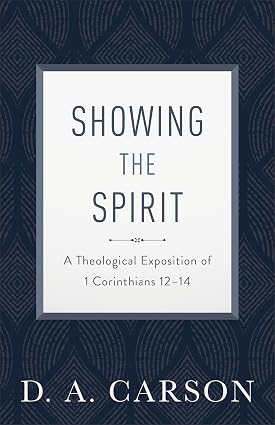 Bible scholar D. A. Carson explores the controversial subject of the role of the Holy Spirit in the life of a believer and in the life of the church. Unpacking 1 Corinthians 12-14, as well as touching on relevant passages in Acts.
Craig Keener, Gift Giver: The Holy Spirit for Today
 In Gift and Giver, leading New Testament scholar Craig Keener takes a probing look at the various evangelical understandings of the role of the Holy Spirit in the church.
Thomas A. Tarrants
Thomas A. Tarrants is President Emeritus of the C.S. Lewis Institute. After serving twelve years as president and nine years as vice President, he retired from his position as Vice President for Ministry and Director, Washington Area Fellows Program, with CSLI in June 2019. He holds a Master's of Divinity Degree, as well as a Doctor of Ministry Degree in Christian Spirituality. Tom is an ordained minister in the Evangelical Church Alliance and a member of the Evangelical Theological Society. Tom is the author of Consumed by Hate, Redeemed by Love, published by Thomas Nelson Publishers and Following Jesus Christ. He spends his time writing, mentoring, consulting and traveling.
