



Back to series



CHAPTER 12
Becoming a Disciple-Maker
Go therefore and make disciples of all nations, baptizing them in the name of
the Father and of the Son and of the Holy Spirit, teaching them to observe
all that I have commanded you. And behold, I am with you always,
to the end of the age.
Matthew 28:19–20
A major part of Jesus’ work on earth was to make disciples and train them to carry on His work of making disciples and spreading God’s kingdom. At the threshold of His departure from this world:
Jesus came and said to them, “All authority in heaven and on earth has been given to me. Go therefore and make disciples of all nations, baptizing them in the name of the Father and of the Son and of the Holy Spirit, teaching them to observe all that I have commanded you. And behold, I am with you always, to the end of the age.” (Matt. 28:18–20)
The disciples took Jesus’ words to heart. As they went to the ends of the earth, they knew He was with them and was empowering them by His Spirit to have an extraordinary impact on the world of their day.
History records other people who were called to serve Christ in distant lands and saw extraordinary fruit in making disciples. Few know John Geddie today, but God used him in a remarkable way with dangerous islanders in the South Seas in the 1800s. A memorial raised in his honor reads: “In memory of Rev. John Geddie, D.D., born in Scotland 1815, minister in Prince Edward Island for seven years, missionary sent from Nova Scotia to Aneiteum for twenty-four years. When he landed in 1848, there were no Christians here, and when he left in 1872 there were no heathen.”1

Even as He has called his church to spread the gospel to all nations, God calls relatively few of His children to serve Christ in faraway missions posts as these individuals did. Rather, He calls the vast majority of us to serve and glorify Him in the families, workplaces, and communities where we already live. But this requires the same obedience we see in those who are called to distant places, and it may require the same sacrifice.
One example of sacrifice from the last century is John Harper (1872–1912), a Scottish evangelist who sadly died in the sinking of the Titanic on April 15, 1912. Harper had been invited to serve as a guest preacher at The Moody Church in Chicago, Illinois, but did not survive the journey from Scotland. Erwin Lutzer, pastor emeritus of The Moody Church, gives the following account of Harper’s final moments:
John Harper, his sister, and his six-year-old daughter (his wife had died) found themselves on the great ship, the Titanic. Survivors later reported that as Titanic began to sink, Harper admonished people to be prepared to die. He made sure his sister and daughter were in a lifeboat even as he continued to share the Gospel with whoever would listen. And when he found himself in the icy water with a life jacket, floating near another man, Harper asked, “Are you saved?”
“No, I’m not saved!” the desperate man replied.
“Believe on the Lord Jesus Christ and you will be saved!” Harper shouted. One report says Harper, knowing he could not survive long in the icy water, took off his life jacket and threw it to another person with the words, “You need this more than I do!” Moments later, Harper disappeared beneath the water.2
A more recent extraordinary example of making disciples in the process of glorifying God in family, work, and community appears in the lives of “James” and “Cindy,” a quiet, humble, unassuming couple. We met many years ago through a discipleship program at the C. S. Lewis Institute. James and Cindy were clearly a team; they loved each other and served God wherever they went. For James, that included a twenty-year career in the armed forces, followed by teaching at the United States Naval Academy, then cofounding and helping build a large, successful business; and for Cindy, a career in elementary education and raising four children who know and love the Lord, and nurturing all of her grandchildren, who have also grown up to know and love the Lord. All of this along with teaching women’s Bible study groups.
Throughout their long marriage, James and Cindy have sought to serve others and help them grow as disciples of Jesus, through Officers’ Christian Fellowship, local churches, and the C. S. Lewis Institute. As retirement age approached, they built a very large home on the family farm (comfortably accommodating thirty people) as a gathering place for their scattered children and grandchildren, and also as a retreat center for pastors and ministry leaders. Now in their eighties, they both lead weekly discipleship groups, James with men and Cindy with women from around the local area. They have always been generous stewards of God’s blessings, and recently they placed their farm into an irrevocable trust and provided finances to ensure its continued use for family and for making disciples—even as they continue to carefully disperse their remaining assets to trusted ministries that are bearing fruit in God’s kingdom. James and Cindy provide a good example of making disciples in the course of everyday work and family life.
Most Bible-believing Christians hold dear the command to “go … and make disciples of all nations” (Matt. 28:19), whether or not we personally travel to other nations. Most of us also assume that we understand what it means. But after many years of life in the church and in ministry, I have concluded that while some do, many do not. As we explore the two phrases “go and make disciples” and “all nations,” you can determine for yourself how well you grasp the full scope of their meaning.
Making Disciples
In the American evangelical church, the command to “go and make disciples” has for many decades been understood to mean “go and make converts.” In other words, go out to evangelize nonbelievers and help them come to faith in Jesus Christ. Gospel proclamation is the primary focus.
This understanding is good, so far as it goes. We definitely need to “go” and evangelize nonbelievers. Clearly, we must share the gospel message with the lost and help them come to faith in Christ. And clearly, we must encourage them to publicly affirm their faith by being baptized into the fellowship of the church.
But that isn’t the end of the matter; in fact, it is just the beginning. The Great Commission doesn’t stop with the command “Go therefore and make disciples …, baptizing them.” It includes gospel transformation when it adds: “teaching them to observe [that is, to obey] all that I have commanded you.”
Let’s look at the Great Commission again. The Greek word we translate “disciple” is mathetes, which in Jesus’ day meant a learner and adherent—that is, one who accepts the teaching of a master and follows him in daily life. It is the root of the main verb, matheteuo, which means “to make disciples,” and appears as an imperative, a command. The three supporting participles—going, baptizing, and teaching—have imperative force and indicate different aspects of the multifaceted process of making disciples. “Going” indicates going out into one’s world with the intention of sharing the gospel message with nonbelievers. “Baptizing” refers to baptizing those who profess faith in Christ into the community of disciples—the fellowship of the church. “Teaching” refers to the last and longest part of the discipleship process, teaching believers by word and deed to obey Jesus’ teachings.
Thus, the phrase “teaching them to observe [obey] all that I have commanded you” expands the focus from gospel proclamation and membership in the community to gospel transformation, which lasts a lifetime! But unfortunately, this is where things often break down.
For various reasons, many churches and believers have neglected this part of Jesus’ commission or have refocused the command from teaching disciples to obey the specific teachings of Jesus to general Christian education. To be sure, some in history have understood the command accurately and taken it seriously; but in many settings, it remains largely neglected or misapplied. When this happens, believers are not grounded in all that Jesus instructed as He taught His disciples how to obey and be transformed into Christlikeness. We lack basic training. As a result, many of us fare poorly in our battle with the world, the flesh, and the devil, like soldiers who have never received combat training.
“Wait,” you say. “My church has a six-week new-member class and also a class on the basics of the faith.” That’s certainly helpful! But do these alone encompass what Jesus meant by “teach them to observe [obey] all that I have commanded you”? That is the question.
Discipleship for the Ages
Let’s look at what Jesus meant by all that I have commanded you, as well as the outcome He intends from our obeying this command. Our Lord does not leave us to figure this out for ourselves.
We find all that He commanded in the Gospels—beginning with Matthew, which has five major teaching sections. As we noted in Chapter 4, Matthew actually appears to have been designed as a discipleship manual. In fact, from the early second century, “among all the New Testament writings and especially among the Gospels, Matthew seems to have been the only one to have had a normative role and to have created the climate of Christianity at large.” And “it is a fact that mainstream Christianity was, from the early second century on, to a great extent Matthean Christianity.”3 So we should make Matthew one of our main resources for Jesus’ teachings, and it is a good starting place as well.
We should not, however, limit “all that I commanded you” to Jesus’ specific commands in Matthew, even though that is the primary context of the words of the Great Commission. The verb “commanded” (entellomai) in this context “has a more all-inclusive sense. Jesus is not pointing to particular commands but rather to the full explication of His life and ministry for disciples. All that Jesus commanded by word of mouth is included in His commands, whether they are teachings, proverbs, blessings, parables or prophecies. Indeed, all of Jesus’ life is included.”4 Thus, when Jesus refers to “all I have commanded,” He has in mind not just the Gospel of Matthew, but everything He taught during the three years He was with the disciples in person. For us today, that means His teachings as recorded in Matthew and the other Gospels, as well as His life.
It is important to note that while the learners in view here are typically assumed to be new believers, the command applies to more mature believers as well, for we never learn all that there is to know about Jesus. And in any event, spiritual growth is not linear; throughout life, we need to circle back to certain things and learn them again at a deeper level. We never graduate from Jesus’ school of discipleship; there is always more to learn and the potential for more growth.
Further, the learning Jesus commends is not simply a matter of mastering of facts, though surely that must happen. Rather, as we learn what Jesus taught, we must go on to internalize and put it into practice, for in biblical thinking, what we do is the real measure of what we know. Jesus’ moral and ethical instructions, as well as His example, must become a practical guide to living, creating a life that bears fruit and glorifies God. Giving priority to the teaching of Jesus certainly does not minimize other parts of the Bible. In fact, it will send us back to the Old Testament, which He frequently quoted, and push us forward elsewhere in the New Testament as we seek further understanding. Only as we see the rest of the Bible through the lens of Jesus and His teaching can we read it aright.
How do we help other believers learn what Jesus taught? Jesus demonstrates the basic approach. He began by creating a community in the form of twelve disciples who wanted to follow and learn from Him. He initiated a process of discipleship with them that included large group teaching, small group processing, one-on-one counsel and guidance, and supervised on-the-job training in how to practice what they were learning in their daily lives. We can adapt these elements—some or all—into effective discipleship training programs today.
What goal or outcome did Jesus intend for this process? In a word, transformation. He wanted His followers to become like Him. “A disciple is not above his teacher, nor a servant above his master,” He said. “It is enough for the disciple to be like his teacher and the servant like his master” (Matt. 10:24–25). As the disciples saw Jesus’ example each day, grew to know and love Him increasingly and began to more fully understand and obey His teachings, they would become more like Him. But not instantly—it took time, and they made mistakes along the way. For them, discipleship was the work of a lifetime. And so it will be for us. A few weeks in a Christian basics class can provide a helpful start to this journey, but this is only a start).
One of Jesus’ most noteworthy disciples, the apostle Paul, made Christ-centered transformation his lifelong work (though he never used the word “disciple”). “For no one can lay a foundation other than that which is laid, which is Jesus Christ” (1 Cor. 3:11). “Him we proclaim,” he wrote of Jesus, “warning everyone and teaching everyone with all wisdom, that we may present everyone mature in Christ. For this I toil, struggling with all his energy that he powerfully works within me” (Col. 1:28–29). Paul was passionately devoted to discipling believers! To this end, Paul patiently labored with the Galatians “until Christ be formed in you,” (Gal. 4:19). And as part of this process, the apostle frequently said to believers in his churches, “I urge you, then, to be imitators of me” (1 Cor. 4:16), and “be imitators of me, as I am of Christ” (1 Cor. 11:1), and “join in imitating me, and keep your eyes on those who walk according to the example you have in us” (Phil. 4:16). Paul urged people to follow him as he followed Christ. And he said this not because he was a narcissist, but because he knew from Jesus the importance of personal example in changing character. This is just as true today as it was then, which underscores our need to have faithful disciples of Jesus in our lives who reflect Him and influence us to become more like Him. Although he overstated his case, Albert Schweitzer made an important point when he said, “Example is not the main thing in influencing others. It is the only thing.”5 Though not the only thing, it is certainly a major thing, because becoming like Jesus is caught as well as taught.
Observing the disciple-making practices of Jesus and Paul can give us insight in how to develop disciples. In the church today, growing as a disciple requires regular Bible teaching from the pulpit and in the classroom. Biblical preaching, teaching, and pastoral counseling are major elements of the process of making disciples. But there is more, and that is the relational element. Learning in relationship involves meeting with a small group of other believers to develop friendships and to discuss and process the lessons taught. In addition, it requires more mature believers (disciplers) and less mature believers (disciples) to develop Christ-centered, growth-oriented friendships. In such a friendship, the less mature believer is mentored and coached about how to understand and apply the teachings of Jesus in his or her daily life.6
The maturation process begins with learning the teachings of Jesus, but it doesn’t end there. It comes to fruition in practical application—when the truths learned by instruction become a part of the disciple’s lived experience. The disciple becomes “a doer of the word, and not a hearer only” (James 1:22). And thus, little by little he or she becomes more like Jesus and eventually begins to disciple others as well.
In the early stage of the process, the discipler will take the disciple with him or her to observe ministry firsthand. In the next stage, the discipler will have the disciple help in the ministry. Then the roles switch, and the disciple take the lead, and the discipler will help. With continued growth, the disciple will be ready to go out on a mission taking the lead role while the discipler observes. The discipler must see this process as a labor of love, recognizing that it takes commitment and time. And the learning often goes both ways: the more mature believer may gain fresh perspective from listening to and teaching someone who is younger in the faith. Ongoing progress depends on a desire to grow, a teachable spirit, and a willingness to obey. This methodology can be used in a wide spectrum of activities, ranging from cleaning toilets and floors in the church building to personal witnessing to sharing the gospel in public venues and more.

Because of the time commitment, larger churches sometimes see this approach to disciple-making as impossible to provide. And they would be right, if it were only the pastor’s job to work at making disciples. But if a pastor will start small, disciple a core of capable disciple-makers (ideally the elders and other church leaders), and then commission and coach them to disciple others in the congregation, who in turn make other disciples, over time even a large church can develop a culture of disciple-making. I know of several that are doing this, and Perimeter Church in the Atlanta area, which has about five thousand parishioners, is a good example. Such discipleship transforms everything it touches. But it cannot be done overnight. It takes time, and many pastors do not have a vision for the longer-term effort that is required. Hopefully, that will change.
The failure of many churches to teach, train, and nurture their members to maturity in Christ helps to explain why so many believers today seem so spiritually childish, entangled in the sins of the flesh, immersed in worldliness, and not much different from nonbelievers. Is it any wonder that the church appears neither credible nor attractive to the watching world? Surely this grieves God.
But just as surely, God will enable and empower any person or church that elevates disciple-making to the priority He gives it. He has already shown us the way in Scripture.
Of All Nations
Another phrase we must explore for disciple-making is “of all nations.” This phrase spells out the scope of the disciple-making mandate. The English words “all nations” are a translation of the Greek phrase panta ta ethne. That last word, ethne, provides the root of the English word “ethnic.” The idea here is of ethnic or people groups.
The Bible doesn’t speak in terms of “races,” because from the biblical perspective only one race exists: the human race. The Scriptures teach that all human beings originated from one couple, making them all part of the single human race. They have, however, differentiated into various ethnic groups (Gen. 1:26–28; Acts 17:26). Thus, when Jesus says “all nations,” this means, “Make disciples from among all ethnic groups”— whether Africans, Asians, Caucasians, Latinos, or whatever other subgroups may exist. This vastly expands His earlier commission to go only “to the lost sheep of the house of Israel” (Matt. 10:6).
This all-inclusive command further fulfills God’s promise to Abraham that “in you all families of the earth shall be blessed” (Gen. 12:3). The Jews of Jesus’ day found this expansion to “all nations” very difficult to accept. They saw themselves as God’s chosen people, which indeed they were, but unfortunately, they also looked down on all non-Jews. They typically despised and avoided Gentiles—especially Samaritans, who were of ethnically mixed ancestry and held heterodox beliefs.
Although Jesus focused His ministry almost exclusively on Jews, He did give hints of the coming commission to all ethnic groups through His interactions with Samaritans. For instance, on one occasion He rebuked James and John when they wanted to call down fire upon the Samaritans (Luke 9:51–56). On another, He confronted the Jews (and His disciples) with their own religious and ethnic pride by making the Good Samaritan the hero in His teaching about loving one’s neighbor (Luke 10:25–37). He sent a clear message: Do not hate and try to destroy Samaritans, but rather love and win them! As recorded in John 4, Jesus also foreshadowed the coming Gentile mission by deliberately engaging a Samaritan woman in conversation and leading her to faith in Him as the Messiah.
How did the commission to make disciples from all ethnic groups unfold once Jesus returned to heaven? In the book of Acts, Jesus says, “But you will receive power when the Holy Spirit has come upon you, and you will be my witnesses in Jerusalem and in all Judea and Samaria, and to the end of the earth” (1:8). This is exactly what happens throughout Acts.
Peter, John, Stephen, and others preached the gospel around Jerusalem (Acts 2–7). Philip went to Samaria, where he preached Christ and saw many come to faith (8:4–8). An angel then sent him to explain the gospel to a high-ranking Ethiopian court official who was on his way back home after a visit to Jerusalem (8:26–38). That official carried the faith with him to Africa. From Acts 13 to the end of the book, we see Paul preaching the gospel to people of various ethnicities in the Roman world, from Antioch, through Asia Minor, to Greece and Rome.
Peter had a more difficult time grasping what seemed so clear to Paul. Even though Peter had received the Great Commission directly from the lips of Jesus, and even though he served as the leader of the apostles, he remained blind in certain areas. He felt comfortable taking the gospel to the Jewish people, but it required a supernatural vision from God, followed by a supernatural confirmation, to free him from his blindness and prejudice toward the Gentiles. That story takes up the entire tenth chapter of Acts, which is worth reading in full.
One might think that after this clear revelation from God, Peter would have grasped the point of God’s acceptance of those from every ethnic group on equal terms with Jews—but old thinking and patterns of behavior sometimes take time to change. This became evident when Peter came to Antioch, where Paul ministered to a mixed congregation of Jews and Gentiles. Paul describes how Peter reverted to his Jewish elitist mentality in Galatians 2:11–14.
This sobering story challenges us today to examine ourselves and see if we harbor prejudice against people of any ethnic group. Do we behave hypocritically by not warmly embracing them in love as fellow heirs of the grace of God through faith in Christ?
Paul clearly explained how the work of Jesus the Messiah destroyed the wall of separation between Jews and Gentiles. To the Gentile church in Ephesus, he wrote:
Therefore remember that at one time you Gentiles in the flesh, called “the uncircumcision” by what is called the circumcision, which is made in the flesh by hands—remember that you were at that time separated from Christ, alienated from the commonwealth of Israel and strangers to the covenants of promise, having no hope and without God in the world. But now in Christ Jesus you who once were far off have been brought near by the blood of Christ. For he himself is our peace, who has made us both one and has broken down in his flesh the dividing wall of hostility by abolishing the law of commandments expressed in ordinances, that he might create in himself one new man in place of the two, so making peace, and might reconcile us both to God in one body through the cross, thereby killing the hostility. And he came and preached peace to you who were far off and peace to those who were near. For through him we both have access in one Spirit to the Father. (Eph. 2:11–18)
Christ’s revolutionary dismantling of the wall of separation between Jews and Gentiles was intended to abolish the divisions that fractured and fragmented human relationships and community in that time. Paul made this clear, not just to the Ephesian believers, but everywhere he ministered.
To the church in Galatia, he wrote, “For as many of you as were baptized into Christ have put on Christ. There is neither Jew nor Greek, there is neither slave nor free, there is no male and female, for you are all one in Christ Jesus” (Gal. 3:27–28). Similarly, he assured the church in Colossae that “here there is not Greek and Jew, circumcised and uncircumcised, barbarian, Scythian, slave, free; but Christ is all, and in all” (Col. 3:11). Our new identity in Christ supersedes all these identity markers in the natural world. In God’s kingdom, we are bound together in a new humanity with all other believers, through Christ, regardless of ethnicity.
This multiethnic evangelizing and disciple-making, and the multiethnic congregations that resulted after the church broke out of its Jewish cocoon, show us the outworking of the Great Commission in New Testament times (and for some time afterward). These churches help explain why the early Christian movement grew so quickly and became so strong. Empowered by the Holy Spirit, churches became communities of love in which the barriers of ethnicity, social class, economic status, and literacy (which normally divide people) had been transcended. And that love spilled over to their nonbelieving neighbors in the form of caring for the sick, feeding the hungry, rescuing abandoned infants, and many other ways. Such things were unheard of and stimulated widespread curiosity and openness to explore what lay behind such amazing behavior. In addition, physical healings and deliverances from demonic spirits experienced by nonbelievers who sought help from the Christian God served to fuel the growth.7
In today’s world of strife, hatred, division, and widespread movement of people around the globe, Jesus’ command and commission to make disciples from people of all ethnic groups is just as important now as it was in the early days of the church. When the world sees communities of Christians living as the new humanity and loving one another across the barriers that normally separate people, it takes notice (see Matt. 5:14–16; John 13:34–35). Opportunities to explain the reason for that love will open up, and we can share the message of Christ’s redeeming love, highlighting the wonderful destiny of all who trust and follow Christ. Outsiders can share in that destiny, becoming a part of that great multitude clothed in white robes that no one can number, from every nation, from all tribes and peoples and languages, standing before the throne and before the Lamb. Waving palm branches in their hands, they will cry out, “Salvation belongs to our God who sits on the throne, and to the Lamb!” (Rev. 7:9–10).
Your Personal Response?
How can you personally respond to this call to make disciples? The first step is to become a growing disciple yourself. You must be a disciple in order to make a disciple.
As we consider what it means to be Jesus’ disciple and to raise up other disciples, ideally our local church will hold together gospel proclamation and gospel transformation so that those led to faith in Christ also receive help to grow into the likeness of Christ. We must find our specific role within that context, which we probably best discern in a disciple-making team of several people. While we must remain ready for whatever opportunities God brings to us, some of us will gravitate more to proclamation, and others to transformation. Some of us may more naturally serve in support roles such as prayer or hospitality rather than in frontline engagement. Whatever our role may be, we must remember that, like all other believers, we are witnesses of the Risen Jesus.
Commit yourself to sharing the gospel with anyone and everyone regardless of ethnicity and to helping them grow in Christlikeness. Many people get stuck right here. Because they do not have the gift of evangelism or an outgoing personality, they imagine they cannot lead others to Christ. But while God calls relatively few to be evangelists, He calls every believer to be a witness for Christ. Jesus said, “You will receive power when the Holy Spirit comes upon you, and you will be my witnesses” (Acts 1:8). That simply means you and I are to be filled with the Spirit daily and share what Christ has done for us and what He means to us, which should include the foundation of our faith, the gospel message. Our motivation to share will be helped if we remind ourselves that the nonbeliever with whom we speak (family, friends, coworkers, neighbors, strangers) will spend eternity in either heaven or hell—and that God is “not wishing that any perish, but that all should reach repentance” (2 Pet. 3:9).
Other people get stuck when they think about helping new believers grow, since they lack seminary training. But such training has never been a requirement. People with little or no education have been making disciples since the first century, and well before that among the people of God in the Old Testament era! Truth gained from oral instruction and committed to memory can give anyone a sound foundation for him- or herself as well as for others. Thus, any believer with a grasp of key biblical truths and a healthy (not perfect) Christian life can share with interested individuals about the teachings of Jesus and how to follow Him—providing, of course, that they are doing so themselves.
If you have no experience, start small. Pray for God to bring you one person and simply do whatever you can. Remember the story of the woman who anointed Jesus with a very costly ointment just before He was crucified. His disciples scolded her for the waste of such a valuable resource, but Jesus commended her. He said, “She has done what she could” (Mark 14:8). That is what we should do.
And do not feel discouraged if you are working with only one person. There is wisdom in the old saying, “Each one reach one, and each one teach one, until all are taught.” What if every believer took up this call and worked with just one other person? The impact for God’s kingdom would be staggering.
Take encouragement from the well-known story of the boy and the starfish. As an older man walked along the seashore in the early morning mist, a boy was picking up starfish and gently throwing them back into the ocean. The man came near and asked, “Son, what are you doing?” The boy said, “Throwing starfish back into the ocean. The surf is up, and the tide is going out. If I don’t throw them back, they’ll die.” The man replied, “There are miles of beach and hundreds of starfish. You can’t make any difference.” The boy picked up another starfish and threw it into the sea and said, “I made a difference to that one!”
So it is with us. Many believers are in desperate need of discipling. Disciples are made one by one. Each is precious in the eyes of God, and our investment in their lives, small or large, makes a real difference!
Does this commission still sound daunting to you? If so, take comfort. It felt daunting to Jesus’ original disciples too! And take even more comfort in His promise to them, which applies equally to us: “I am with you always, to the end of the age” (Matt. 28:20).
He is with us through the Holy Spirit, who is the Spirit of Christ. And He will be with us every step of the way. Now is the time to step out in reliance on Him!

Questions to Ponder
- What is the difference between interpreting the Great Commission (Matt. 28:16–20) as a command to make converts and interpreting it as a command to make disciples? How does the second perspective change the way we go about fulfilling the Great Commission?
- What three actions does the Great Commission mention, and why are they all important for experiencing transformation? How do these three work together in the life of a disciple of Christ?
- In addition to biblical teaching, what other contexts has God designed to facilitate personal and corporate transformation into the image of Christ? Where do you see this happening in your local church or context?
- Why is it important to recognize the scope (“all nations,” Matt. 28:19) of Christ’s commission? How has that scope been interpreted in biblical times and today?
- What is the significance of Jesus’ promise, “Behold, I am with you always, to the end of the age” (Matt. 28:20)? What difference does this make for how you respond to His command?
Greg Ogden, Transforming Discipleship
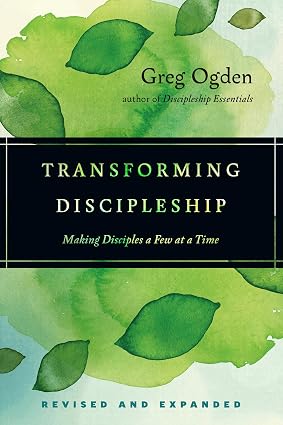 In Transforming Discipleship Greg Ogden introduces his vision for discipleship, emphasizing that solutions will not be found in large-scale, finely-tuned, resource-heavy programs.
Michael J. Wilkins, Reflecting Christ in Everyday Life
 As Wilkins points out, even the first followers of Jesus had a hard time grasping what it meant to be His disciples.
Thomas A. Tarrants
Thomas A. Tarrants is President Emeritus of the C.S. Lewis Institute. After serving twelve years as president and nine years as vice President, he retired from his position as Vice President for Ministry and Director, Washington Area Fellows Program, with CSLI in June 2019. He holds a Master's of Divinity Degree, as well as a Doctor of Ministry Degree in Christian Spirituality. Tom is an ordained minister in the Evangelical Church Alliance and a member of the Evangelical Theological Society. Tom is the author of Consumed by Hate, Redeemed by Love, published by Thomas Nelson Publishers and Following Jesus Christ. He spends his time writing, mentoring, consulting and traveling.
