Back to series

Catching the Cosmic Symphony: Rev. Dr. Ryan David Hawk on C.S. Lewis and the Dawn Chorus

To the modern mind, the universe is often viewed as a vast, silent, and indifferent expanse of cold matter moving through empty space. We look up at the stars and see beautiful, yet ultimately mechanical, balls of gas burning out in a dark void.

But it wasn’t always this way.

To the medieval mind, the cosmos was a magnificent, harmonious masterpiece—a tiered cathedral ringing with music, meaning, and divine purpose. C.S. Lewis famously mapped out this worldview in his final academic book, The Discarded Image.

In an illuminating presentation hosted by the C.S. Lewis Institute, Rev. Dr. Ryan David Hawk explores C.S. Lewis, cosmic order, and eschatology. By drawing a brilliant literary parallel between Lewis and the great Elizabethan poet Edmund Spenser, Dr. Hawk demonstrates how restoring a proper view of the universe transforms how we understand the final chapters of our own story.

Here are three key takeaways from the presentation on how a proper view of the universe changes how we understand the final chapters of our own story.

1. The Living Symphony: Spenser and the Medieval Model

Dr. Hawk begins by exploring Lewis’s deep academic love for Edmund Spenser’s The Faerie Queene. Spenser stood at a historical crossroads, writing at a time when the old medieval model of the universe was slowly giving way to modern, mechanized science.

Like Spenser, Lewis recognized that the older cosmic model possessed an immense imaginative power. In this “discarded” view, everything from the rotation of the planets to the behavior of earthly animals was interconnected under divine governance. It wasn’t an accidental universe; it was an ordered, intentional landscape where the physical and the spiritual were seamlessly intertwined.

2. Cosmic Decay and the Stability of God

A core theme in both Spenser’s poetry and Lewis’s fiction is the tension between earthly change and eternal permanence. Dr. Hawk points to Spenser’s famous Mutabilitie Cantos, where the titaness Mutability claims dominion over everything in the universe, pointing to the constant decay, death, and shifting of seasons as proof that chaos rules.

However, Spenser’s ultimate answer—and Lewis’s core theological anchor—is that this constant change is not chaotic; it is a progressive movement toward a final rest. The shifting seasons of earth are not a meaningless loop. They are heading somewhere. The decay we witness in the physical world is merely a temporary labor pain preceding a grand, permanent restoration.

3. The Grand Restoration of the Cosmos

Ultimately, Dr. Hawk maps this cosmic worldview directly onto the shocking ending of The Last Battle. When Father Time blows his horn and the old Narnia is brought to an end, it looks on the surface like an act of pure destruction. The sun is squeezed out, and the landscape is flooded.

But Lewis’s eschatology is never merely destructive; it is redemptive. As the characters pass through the stable door, they discover that the cosmic order hasn’t been obliterated—it has been unveiled. The hierarchy, the beauty, and the hidden order of the universe are finally made visible. For Lewis, the end of history is not the dissolution of matter into nothingness, but the moment the entire cosmos is finally brought into perfect tune with its Maker.

The Takeaway: Our view of the universe dictates our view of the future. If we view the world as a mechanical accident, its end is an existential tragedy. But if we recover the cosmic order that C.S. Lewis championed, we see that history is a beautifully orchestrated symphony heading toward its final, glorious crescendo.

About the Speaker

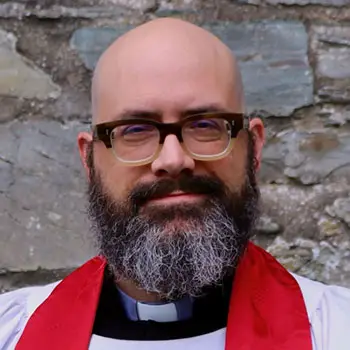
Rev. Dr. Ryan David Hawk is an independent scholar, theologian, and minister whose work uniquely brings together theology, literature, music, and the artistic imagination. His research explores how the stories of C. S. Lewis, especially their musical and imaginative dimensions, can open fresh ways of considering Christian hope, eschatology, and the shape of the last things. David splits his time between Belfast, Nashville, and Denver.

Print your tickets