



Back to series


CHAPTER 9
Forgiving Others
Forgive us our debts, as we also have forgiven our debtors.
Matthew 6:12
Immediately after the Lord’s (or Disciples’) Prayer, Jesus gives an addendum of sorts on forgiveness. His selecting this one theme out of the entire prayer sends a significant message. As if to underline His teaching in red, He says, “For if you forgive others their trespasses, your heavenly Father will also forgive you, but if you do not forgive others their trespasses, neither will your Father forgive your trespasses” (Matt. 6:14–15).
What strong words! They signal that forgiveness will be a major issue for us in our lives of discipleship.

If it were possible, Jesus later uses even stronger words. In response to Peter’s question about how often believers must forgive other believers (Matt. 18:21–35), Jesus tells a story of a servant who was forgiven an enormous debt by his master. That servant, however, refused to forgive a fellow servant who owed him a small amount by comparison. Jesus continues:
[The servant’s] master summoned him and said to him, “You wicked servant! I forgave you all that debt because you pleaded with me. And should not you have had mercy on your fellow servant, as I had mercy on you?” And in anger his master delivered him to the jailers, until he should pay all his debt. So also my heavenly Father will do to every one of you, if you do not forgive your brother from your heart. (Matt. 18:32–35, my emphasis)
This is a very sobering statement, and all the more so because the context is a relationship with a fellow believer (vv. 21–22). Being delivered to the jailers is a terrifying prospect in view of the fact that the Greek word means “torturers.”1 The idea is that God will impose severe discipline on any believer who refuses to forgive another believer from his or her heart. The inner torment of a bitter, unforgiving heart, which grieves the Holy Spirit, is a common example of such discipline and is a heavy burden to bear. Whatever form God’s discipline takes, we must remember that it is corrective and redemptive, intended to bring the sinner back to God.
At first glance, this severe discipline may seem draconian. But consider: to offer forgiveness seems relatively painless when it involves a minor offense—but a major offense can be a very different story. Forgiveness of a spouse who commits adultery or of a rapist who violated a woman2 or of a close friend who has betrayed us is really difficult. Deep wounds feel much more difficult to deal with and often take longer to resolve. Sooner or later, a deep wound may come our way, and it is essential to know that refusing to forgive is not an option.
For instance, a pastor I know discovered that his wife, the mother of their four children, was having an affair. The news devastated him and left him disoriented. Despite his pleas to repent, she continued the affair.
The pastor’s spiritual mentor urged him to remember that, as a disciple of Jesus, he was called to forgive her and harbor no bitterness toward her. “You must not speak ill of her to your children,” the man added. The pastor found none of this easy, but by God’s grace he did forgive her and refused to harbor any ill will toward her—initially, as a sheer act of the will. God blessed his obedience and sustained him and his children through the ordeal and blessed their lives in the years following, though his wife refused to repent, and they divorced. This betrayal was indeed a major offense, and the process of forgiving was painful.
One of the most powerful stories of forgiveness I have ever heard came from Corrie ten Boom, a follower of Jesus who endured the horrors of World War II. She and her godly family lived in Holland and, despite the Nazi occupation, sought to hide Jewish people. The Gestapo discovered their activities, arrested them, and sent them all to concentration camps. All died there, except for Corrie. Her story of forgiveness, hard as it was, demonstrates the main lessons we all need to learn if we are to deal with the difficult issues of forgiveness we face.
The story is found in her book, The Hiding Place, in which Corrie ten Boom recounted her agonizing struggle to forgive a guard who worked at the concentration camp where she was imprisoned and her sister, Betsie, died.3
It was in a church in Munich that I saw him, a balding heavyset man in a gray overcoat, a brown felt hat clutched between his hands. People were filing out of the basement room where I had just spoken, moving along the rows of wooden chairs to the door at the rear. It was 1947 and I had come from Holland to defeated Germany with the message that God forgives.
It was the truth they needed most to hear in that bitter, bombed-out land, and I gave them my favorite mental picture. Maybe because the sea is never far from a Hollander’s mind, I liked to think that that’s where forgiven sins were thrown.
“When we confess our sins,” I said, “God casts them into the deepest ocean, gone forever.”
The solemn faces stared back at me, not quite daring to believe. There were never questions after a talk in Germany in 1947. People stood up in silence, in silence collected their wraps, in silence left the room.
And that’s when I saw him, working his way forward against the others. One moment I saw the overcoat and the brown hat; the next, a blue uniform and a visored cap with its skull and crossbones.
It came back with a rush: the huge room with its harsh overhead lights, the pathetic pile of dresses and shoes in the center of the floor, the shame of walking naked past this man. I could see my sister’s frail form ahead of me, ribs sharp beneath the parchment skin. Betsie, how thin you were!
Betsie and I had been arrested for concealing Jews in our home during the Nazi occupation of Holland; this man had been a guard at Ravensbrück concentration camp where we were sent.
Now he was in front of me, hand thrust out: “A fine message, fräulein! How good it is to know that, as you say, all our sins are at the bottom of the sea!”
And I, who had spoken so glibly of forgiveness, fumbled in my pocketbook rather than take that hand. He would not remember me, of course—how could he remember one prisoner among those thousands of women?
But I remembered him and the leather crop swinging from his belt. It was the first time since my release that I had been face to face with one of my captors, and my blood seemed to freeze. “You mentioned Ravensbrück in your talk,” he was saying. “I was a guard in there.” No, he did not remember me.
“But since that time,” he went on, “I have become a Christian. I know that God has forgiven me for the cruel things I did there, but I would like to hear it from your lips as well. Fräulein”—again the hand came out—“will you forgive me?”
And I stood there—I whose sins had every day to be forgiven—and could not. Betsie had died in that place—could he erase her slow, terrible death simply for the asking?
It could not have been many seconds that he stood there, hand held out, but to me it seemed hours as I wrestled with the most difficult thing I had ever had to do.
For I had to do it—I knew that. The message that God forgives has a prior condition: that we forgive those who have injured us. “If you do not forgive men their trespasses,” Jesus says, “neither will your Father in heaven forgive your trespasses.”
I knew it not only as a commandment of God, but as a daily experience. Since the end of the war, I had had a home in Holland for victims of Nazi brutality.
Those who were able to forgive their former enemies were able also to return to the outside world and rebuild their lives, no matter what the physical scars. Those who nursed their bitterness remained invalids. It was as simple and as horrible as that.
And still I stood there with the coldness clutching my heart. But forgiveness is not an emotion—I knew that too. Forgiveness is an act of the will, and the will can function regardless of the temperature of the heart. “Jesus, help me!” I prayed silently. “I can lift my hand. I can do that much. You supply the feeling.”

And so woodenly, mechanically, I thrust my hand into the one stretched out to me. And as I did, an incredible thing took place. The current started in my shoulder, raced down my arm, sprang into our joined hands. And then this healing warmth seemed to flood my whole being, bringing tears to my eyes. “I forgive you, brother!” I cried. “With all my heart!”
For a long moment we grasped each other’s hands, the former guard and the former prisoner. I had never known God’s love so intensely as I did then.
And having thus learned to forgive in this hardest of situations, I never again had difficulty in forgiving: I wish I could say it! I wish I could say that merciful and charitable thoughts just naturally flowed from me from then on. But they didn’t.
If there’s one thing I’ve learned at 80 years of age, it’s that I can’t store up good feelings and behavior—but only draw them fresh from God each day. Maybe I’m glad it’s that way. For every time I go to Him, He teaches me something else. I recall the time, some 15 years ago, when some Christian friends whom I loved and trusted did something which hurt me.
You would have thought that, having forgiven the Nazi guard, this would have been child’s play. It wasn’t. For weeks I seethed inside. But at last I asked God again to work His miracle in me. And again it happened: first the cold-blooded decision, then the flood of joy and peace.
I had forgiven my friends; I was restored to my Father. Then, why was I suddenly awake in the middle of the night, hashing over the whole affair again? My friends! I thought. People I loved! If it had been strangers, I wouldn’t have minded so. I sat up and switched on the light. “Father, I thought it was all forgiven! Please help me do it!” But the next night I woke up again. They’d talked so sweetly too! Never a hint of what they were planning. “Father!” I cried in alarm. “Help me!” His help came in the form of a kindly Lutheran pastor to whom I confessed my failure after two sleepless weeks.
“Up in that church tower,” he said, nodding out the window, “is a bell which is rung by pulling on a rope. But you know what? After the sexton lets go of the rope, the bell keeps on swinging. First ding then dong. Slower and slower until there’s a final dong and it stops. “I believe the same thing is true of forgiveness. When we forgive someone, we take our hand off the rope. But if we’ve been tugging at our grievances for a long time, we mustn’t be surprised if the old angry thoughts keep coming for a while. They’re just the ding-dongs of the old bell slowing down.”
And so it proved to be. There were a few more midnight reverberations, a couple of dings when the subject came up in my conversation. But the force—which was my willingness in the matter—had gone out of them. They came less and less often and at last stopped altogether. And so I discovered another secret of forgiveness: that we can trust God not only above our emotions, but also above our thoughts. And still He had more to teach me, even in this single episode. Because many years later, in 1970, an American with whom I had shared the ding-dong principle came to visit me in Holland and met the people involved. “Aren’t those the friends who let you down?” he asked as they left my apartment.
“Yes,” I said a little smugly. “You can see it’s all forgiven.” “By you, yes,” he said. “But what about them? Have they accepted your forgiveness?” “They say there’s nothing to forgive! They deny it ever happened. But I can prove it!” I went eagerly to my desk. “I have it in black and white! I saved all their letters and I can show you where”
“Corrie!” My friend slipped his arm through mine and gently closed the drawer. “Aren’t you the one whose sins are at the bottom of the sea? And are the sins of your friends etched in black and white?” For an anguishing moment I could not find my voice. “Lord Jesus,” I whispered at last, “who takes all my sins away, forgive me for preserving all these years the evidence against others! Give me grace to burn all the blacks and whites as a sweet-smelling sacrifice to Your glory.” I did not go to sleep that night until I had gone through my desk and pulled out those letters—curling now with age—and fed them all into my little coal-burning grate. As the flames leaped and glowed, so did my heart.
“Forgive us our trespasses,” Jesus taught us to pray, “as we forgive those who trespass against us.” In the ashes of those letters I was seeing yet another facet of His mercy. What more He would teach me about forgiveness in the days ahead I didn’t know, but tonight’s was good news enough. When we bring our sins to Jesus, He not only forgives them, He makes them as if they had never been.
Corrie ten Boom is a powerful example of a disciple of Jesus Christ who paid a high price for her faithfulness to Him and later went on to have a fruitful worldwide ministry. Forgiveness was essential to her experiencing God’s blessing in such a remarkable way. And it is essential for you and me if we are to experience all that God has for us. Her book, The Hiding Place, and the 1975 movie by the same title (directed by James F. Collier) will inspire and encourage anyone wanting to follow Jesus.

Questions to Ponder
- Why do you think Jesus placed so much emphasis on forgiving others when they wrong us?
- What is the relationship between God’s forgiveness of us and our forgiveness of others?
- How do you react to the story about the pastor forgiving his wife? To the Corrie ten Boom story?
- As you were reading this chapter or spending time with God in prayer, did someone come to mind whom you need to forgive? If so, what action will you take?
- Do you know someone who is struggling to forgive an offense? How can you support that person in seeking to forgive?
Timothy Keller, Forgive: Why Should I and How Can I?
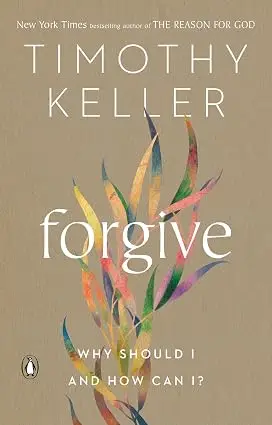 Timothy Keller passionately defends the central role forgiveness has to play in our lives, and shows readers how and why forgiveness is the only way forward in an imperfect world.
Thomas A. Tarrants
Thomas A. Tarrants is President Emeritus of the C.S. Lewis Institute. After serving twelve years as president and nine years as vice President, he retired from his position as Vice President for Ministry and Director, Washington Area Fellows Program, with CSLI in June 2019. He holds a Master's of Divinity Degree, as well as a Doctor of Ministry Degree in Christian Spirituality. Tom is an ordained minister in the Evangelical Church Alliance and a member of the Evangelical Theological Society. Tom is the author of Consumed by Hate, Redeemed by Love, published by Thomas Nelson Publishers and Following Jesus Christ. He spends his time writing, mentoring, consulting and traveling.
