



Back to series


CHAPTER 4
Living in God’s Kingdom
But seek first the kingdom of God and his righteousness.
Matthew 6:33
As we have seen, Jesus made the kingdom of God (or kingdom of heaven) the central theme of His ministry and the centerpiece of His plan for the world. If we wish to fully embrace Jesus’ work, along with the life and mission to which He calls us as His disciples—to fulfill His purposes for our lives—we will gain much from learning more about His kingdom and kingship.
Old Testament and New
Although the exact phrase “kingdom of God” does not appear in the Old Testament, God is often depicted there as king over His creation and over His people, Israel. Many Bible passages describe God as king:
Yours, O Lord, is the greatness and the power and the glory and the victory and the majesty, for all that is in the heavens and in the earth is yours. Yours is the kingdom, O Lord, and you are exalted as head above all. (1 Chron. 29:11)
The Lord is king forever and ever. (Ps. 10:16)
For God is the King of all the earth; sing praises with a psalm! (Ps. 47:7)
The Lord has established his throne in the heavens, and his kingdom rules over all. (Ps. 103:19)
Your kingdom is an everlasting kingdom, and your dominion endures throughout all generations. (Ps. 145:13)
Then, in the New Testament—especially in the Gospels—the phrase “kingdom of God” moves to the forefront. This phrase points to God’s kingship over His creation, yet it also has a special focus on God’s reign in the lives of His people in this world and in the glorious world to come.
God’s people experience His kingdom today through Jesus, the appointed King who comes to rule and reign in their lives through the Holy Spirit (Eph. 5:18–6:20; Gal. 5:22–23). They experience this reign most fully in the church, the body of Christ (Col. 1:24), which is a colony of heaven. God’s reign reveals itself as the church operates under the lordship of Christ, with members wholeheartedly committed to Jesus and the Father and rejecting conformity to the values and behaviors of the fallen world. When the church is truly being the church, it is not simply a religious institution but a countercultural society, a society in which the values of the kingdom are displayed in the lives of God’s people: a foretaste of heaven on earth.
Jesus the King
The coming-to-earth of Jesus, the Son of God and promised Messiah, marked a new stage in the spread of God’s reign. The true King of Israel had come to dwell for a time among His people. Yet Jesus came without the regal trappings and fanfare of popular expectations. Rather, He was born in a stable to poor parents. And, as we noted earlier, He lived and worked in obscurity as a humble tradesman in a small village while preparing for His mission.

When Jesus’ preparation was complete, He began to proclaim that “the kingdom of God is at hand” (Mark 1:15) and to urge men and women to enter it while they could. Jesus Himself was the door into that kingdom (John 10:9). Anyone who recognized Him as the Messiah, the true King of Israel and the Son of God, and trusted Him in repentant faith could enter God’s kingdom.
No one expected this new stage of God’s kingdom to begin in such an insignificant and seemingly weak way. “The kingdom of God has arrived in minute [i.e., small, hidden] form. … while the mature, fruit-bearing tree of the kingdom of God has not yet come.”1 God’s kingdom was present in the person of Jesus, the King, and in the hearts of all who had entered, but absent as a visible political regime. Jesus, when “asked by the Pharisees when the kingdom of God would come,” explained it like this:
The kingdom of God is not coming in ways that can be observed, nor will they say, “Look, here it is!” or “There!” for behold, the kingdom of God is in the midst of you. (Luke 17:20–21)
Jesus also likened the kingdom to a tiny mustard seed that would grow into a huge tree over time as more and more people entered—human beings of every kind from every place on earth (Matt. 13:31–32). It would reach full fruition when He returned in power and great glory to raise the dead, judge all people, abolish evil, and establish God’s eternal reign in the new heavens and new earth. On that day it will truly be shouted, “The kingdom of the world has become the kingdom of our Lord and of his Christ, and he shall reign forever and ever” (Rev. 11:15)!
The Highest Priority in Life
Jesus frequently insisted that the highest priority in life, worth any sacrifice, is entering God’s kingdom. Listen to His teaching:
The kingdom of heaven is like treasure hidden in a field, which a man found and covered up. Then in his joy he goes and sells all that he has and buys that field. Again, the kingdom of heaven is like a merchant in search of fine pearls, who, on finding one pearl of great value, went and sold all that he had and bought it. (Matt. 13:44–46)
Although the kingdom began spreading in the world as soon as Jesus began His earthly ministry, it would not immediately come in all its fullness, as He revealed in Luke 19:11–27. Since Pentecost, when God’s Spirit was poured out on the church (Acts 2), God’s kingdom has continued to advance as more and more people come under the reign of Jesus in His church. At a time known only to God, it will reach its glorious consummation. Until then, we live in a tension often called the “already/not yet” period. The rightful King has already landed! His people rally to His side as He marches forward! But the final victory is not yet here: it lies ahead.

Theologian Oscar Cullmann likened this period to the phase of World War II in between the Allied invasion of Normandy in the summer of 1944 and the final victory over the Nazis in the autumn of 1945.2 By securing the French beachhead, the Allies assured their ultimate victory. But many more months of fierce enemy resistance would result in heavy casualties before the war finally ended. While victory was certain, it had not yet been experienced.
Our spiritual situation today parallels that wartime reality. Through His atoning death on the cross, Jesus has already won the ultimate victory. His kingdom is advancing. But the fierce cosmic warfare between God and His angels and the devil and his angels (who were cast out of heaven when they joined his rebellion, see Revelation 12:9 and Ephesians 6:12) will continue to rage until Jesus returns to bring final victory.
Jesus described this victory of God’s kingdom over the kingdom of this world in terms of a final judgment on the devil and his minions. That victory also will result in the eternal judgment of all those who had refused to accept God’s pardon and enter His kingdom (Matt. 25:31–46).
What Does It Look Like?
As we await His return, what does life in Jesus’ kingdom look like in the here and now? What does it mean to grow and mature as a disciple of Jesus and to be part of His advancing kingdom?
Jesus gave us some crucial foundational teachings to guide us, teachings essential to directing and shaping our growth and service. We find these teachings presented most fully in the Gospel of Matthew, which seems to have been designed as a handbook for discipleship.
The Gospel of Matthew deeply shaped the post-apostolic church: “It was to Matthew’s Gospel that the Christians of the first two centuries automatically turned for the essential data about Jesus.”3 During this formative period in church history, Matthew was considered “the Gospel par excellence”4; it has been described as “the Gospel in the form of a catechetical manual” and “a first textbook for congregational teachers.”5 And it still has much to teach us today.
The core of Jesus’ teaching about kingdom life is contained in the Sermon on the Mount (Matthew 5–7), the first and longest of the five teaching blocks in Matthew. The other sections also have important kingdom teaching, but the Sermon on the Mount is the foundation and starting place for learning about life in a kingdom that upends the values and behaviors of the fallen world. As Michael Wilkins has written, “The kind of kingdom life elucidated in the [Sermon on the Mount] is the foundation for each Christian’s personal discipleship to Jesus … . From the biblical point of view, all Christians are disciples, so the teaching of the [Sermon] is not for a few more-committed believers. This is the heart of Jesus’ teaching for all Christians.”6
In my decades of discipling, spiritual direction, and pastoral counseling, it has amazed me how few believers have awareness of these basic truths. In some cases, they have received no instruction about them at all; in others, they feel overwhelmed simply by reading them and cannot imagine how in their weakness they could possibly live such a life. Yet others cannot imagine how such truths could be applied in today’s world. If you haven’t done so lately, I encourage you to read Matthew 5–7 again now. This sermon gives us remarkable insight into who Jesus is and what following Him looks like.
Jesus addressed the Sermon on the Mount primarily to His disciples, though others listened in. His frequent reference to “your Father” in speaking to His disciples confirms that by this point they were children of God and already in the kingdom. Therefore, Jesus’ teaching here is not a rigorous program by which one earns admission to the kingdom, nor a set of impossibly high ethical standards that expose our sins and force us in desperation to turn to Christ with repentant faith. Neither do His statements present a set of guidelines intended for a future life in the millennium. Rather, in this sermon Jesus teaches about life in God’s kingdom here and now—about how God’s children are to conduct themselves in this present world. Or, to put it differently, Jesus presents to us the family code of conduct—a code that doesn’t merely address our external behavior but actually changes us from within. He can give us this code (and the power to live it) because He is God’s Son and we share in His sonship.
As J. I. Packer points out, three all-embracing principles frame Jesus’ description of kingdom life in this sermon: imitating the Father (Matt. 5:43–45, 48), glorifying the Father (v. 16), and pleasing the Father (6:17–18).7
In the context of these principles, Jesus gives a variety of important instructions about the life of grace to which He calls us as sons and daughters of God—a life that is countercultural in relation to the fallen world around us (and also, in many cases, to the culturally Christian world). Jesus does not give a detailed, comprehensive set of laws, but rather provides guidance on key life issues from which we can make inferences, draw conclusions, and learn to make applications to other issues. We could also describe this sermon as a collection of basic principles of discipleship essential for every believer to know and live by To be sure, the way of life Jesus calls us to adopt is challenging! Some have considered it impossible—and it is impossible in merely human strength. But it is possible through God’s grace and the empowering of the Holy Spirit, which Jesus pours out on all His followers.
A key point to bear in mind in reading and studying the Sermon on the Mount is that Jesus consistently emphasizes that our God is a loving Father. In fact, Jesus refers to God as “Father” seventeen times in the three chapters that comprise the sermon. The most notable of these we find in His pattern-prayer for us, which He begins with, “Our Father in heaven,” an affirmation of our sonship and the joyful reality that our God is not distant and impersonal.
Jesus weaves into His teaching some of the important ways we are to imitate, please, and glorify the Father. He addresses a range of essential matters in an understandable, down-to-earth way that anyone can readily grasp, easily memorize, and regularly meditate upon to transform the heart and guide daily life. “The emphasis in the [Sermon on the Mount] will be on inside-out transformation,” Wilkins writes. “Jesus will continually go to inner motivation, not external performance. The inner life will naturally transform the outer life. The heart that treasures the kingdom of heaven above all else will be the starting point for transformation of the entire life.” 8
A Quick Overview
The Sermon on the Mount begins with the Beatitudes, which describe the blessed life to which God calls all His children (Matt. 5:2–12). It then gives much-needed comfort and encouragement, speaking of disciples as salt and light in this world’s darkness (vv. 13–16), people whose lives are to glorify God.
Then we see Jesus’ supreme devotion and total commitment to God’s Word and to fulfilling it in His life. Likewise, He proclaims the blessedness of disciples who love God’s Word and reject the legalistic externalism of the Pharisees, instead living in true righteousness, rooted in grace and producing works of love (vv. 17–20). Jesus follows this by addressing common problems such as anger, lust, divorce, making oaths, revenge, and loving one’s enemies (vv. 21–48).
Drawing a stark contrast to the attention-seeking Pharisees, Jesus next describes the proper approach to private devotional practices such as giving to the poor, prayer, and fasting, which are intended to nurture the soul’s intimacy with the Father. These practices please the Father, Jesus tells us, and He rewards them when they are done with right motivation, in agreement with His will, and in secrecy (6:1–18).
Jesus goes on to teach that disciples must forsake the idolatrous pursuit of money and possessions, a great snare to the soul. Instead, they should make their love for the Father supreme, seeking first His kingdom and righteousness, trusting Him to provide for their needs and free them from anxiety (6:19–34).
Jesus condemns judgmental self-righteousness and encourages self-examination as an antidote (7:1–6). He then returns to prayer, instructing us to keep on asking, seeking, and knocking (7:7–11). Jesus thus emphasizes the importance of persevering in prayer, essential for life in the kingdom.
The summit and heart of the Sermon focuses on loving our neighbor and treating him as we would want him to treat us (7:12).
Jesus begins to conclude His sermon by calling all His listeners to reject the popular and much-traveled road of easy religion. Rather, they must enter God’s kingdom by the narrow gate and hard way that leads to eternal life. He warns that as we travel the road to eternal life, we will encounter false prophets and false believers, and then He gives us instructions about how to recognize them (7:13–23).
Jesus completes His sermon by highlighting the profound importance of hearing and obeying His words:
Everyone then who hears these words of mine and does them will be like a wise man who built his house on the rock. And the rain fell, and the floods came, and the winds blew and beat on that house, but it did not fall, because it had been founded on the rock. And everyone who hears these words of mine and does not do them will be like a foolish man who built his house on the sand. And the rain fell, and the floods came, and the winds blew and beat against that house, and it fell, and great was the fall of it. (Matt. 7:24–27)
Obedience to Jesus’ words—that is, to God’s words stripped clean of the Pharisees’ distortions—will ground His disciples in truth and wisdom that will sustain them in the challenges they will inevitably encounter on the road that leads to eternal life. Disobedience to His Word is folly and leads to eternal ruin.
Start Where They Did
If we want to follow Jesus, we need to begin where the first disciples did. We must begin as truly converted disciples and learners, committed to Jesus and seeking to understand and to put into practice Jesus’ teaching about life in God’s kingdom. Gratitude to the Father, who has touched our hearts with His grace and love, prompts such a response, which the Holy Spirit empowers.
Questions to Ponder
- How does Jesus’ announcement that “the kingdom of God is at hand” (Mark 1:15) relate to the depictions of God as King in the Old Testament?
- To what does Jesus compare the kingdom of God? What do those comparisons teach us?
- Taking the Sermon on the Mount in Matthew 5–7 as a whole, what stands out to you about Jesus’ teaching? Which sections do you find particularly challenging or compelling?
- Throughout His sermon, Jesus contrasts the Pharisees’ religiosity with the true nature of Christian discipleship. How would you describe this contrast in your own words?
- What is the significance of Jesus’ referring to God as “Father” or “our Father” in the Sermon on the Mount? What does this indicate about God and about those who are in His kingdom?
Michael W. Goheen & Craig G. Bartholomew, True Story of the Whole World
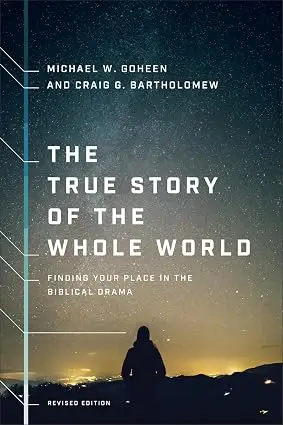 This book provides an overview of the grand narrative of the Bible, showing how God's action in the world gives meaning to our lives and provides us with a foundation for our actions.
Living in the Kingdom of God: A Biblical Theology for the Life of the Church
 Sigurd Grindheim explains the whole Bible's teaching on the kingdom of God, discussing its implications for the Christian, the church, and politics.
Thomas A. Tarrants
Thomas A. Tarrants is President Emeritus of the C.S. Lewis Institute. After serving twelve years as president and nine years as vice President, he retired from his position as Vice President for Ministry and Director, Washington Area Fellows Program, with CSLI in June 2019. He holds a Master's of Divinity Degree, as well as a Doctor of Ministry Degree in Christian Spirituality. Tom is an ordained minister in the Evangelical Church Alliance and a member of the Evangelical Theological Society. Tom is the author of Consumed by Hate, Redeemed by Love, published by Thomas Nelson Publishers and Following Jesus Christ. He spends his time writing, mentoring, consulting and traveling.
