



Back to series


CHAPTER 14
Living in the Spirit-Filled Community
I will build my church, and the gates of hell shall not prevail against it.
Matthew 16:18
In his action-packed story of the early church, Luke introduces his second biblical book (The Acts of the Apostles) by saying that in his first book (the Gospel of Luke) he dealt with “all that Jesus began to do and teach” from the beginning up to His return to heaven (Acts 1:1; my emphasis). He implies that Jesus now continued to do His work of making disciples in the early church, through the Holy Spirit.
The episodes in Acts take us back to the roots of the church and call all believers to join in the disciple-making, kingdom-spreading work Jesus has continued to do through the centuries and is still doing now. To gain renewed vision and encouragement for that work, in this chapter we will focus our attention on the church of Acts and on how the broader church developed during the three centuries that followed and beyond. Our aim? To recover the apostolic vision that has inspired many hungry souls and renewal movements since the days when Jesus walked the earth.
The Great Commission
After His resurrection, Jesus gave His eleven disciples a charge; we call it “the Great Commission” (Matt. 28:18–20). The eleven were first Jesus’ disciples, but He also had designated them as apostles (Luke 6:12–16)—that is, disciples sent out on a special mission (the Greek term apostoloi literally means “sent ones”). These men became the church’s first leaders, and they carried forward on a global scale the work that Jesus had begun in Israel. Jesus instructed them to make disciples not just of Jews, but of all ethnic groups around the globe. He wanted them to spread God’s kingdom to the ends of the earth (see Acts 1:8).
Their earlier training as disciples and “fishers of men” (Matt. 4:19; Mark 1:17) had laid the foundation for this additional role. In that period, Jesus had sent them out to proclaim the kingdom of heaven to the lost sheep of Israel (Matt. 10:5–6), an exciting but potentially dangerous assignment. Later, He commissioned seventy-two others for the same task (Luke 10:1–12). But now, speaking to them in His final moments on earth, He enlarged the scope of their mission field to reach out to all people, not just Jews.

We must remember that Jesus did not call perfect men, but flawed, broken people (like us) still plagued by areas of ignorance, blindness, and prejudice. Pastor and author Greg Ogden makes this point in a somewhat humorous but telling way. It takes the form of a memorandum to Jesus from Jordan Management Consultants:
Dear Sir,
Thank you for submitting the resumes of the twelve men you have picked for management positions in your new organization. All of them have now taken our battery of tests; we have not only run the results through our own computer but also arranged personal interviews for each of them with our psychologist and vocational aptitude consultant.
It is the staff opinion that most of your nominees are lacking in background, education, and vocational aptitude for the type of enterprise you are undertaking. They do not have the team concept. We would recommend that you continue your search for persons of experience in managerial ability and proven capability.
Simon Peter is emotionally unstable and given to fits of temper. Andrew has absolutely no qualities of leadership. The two brothers, James and John, the sons of Zebedee, place personal interest above company loyalty. Thomas demonstrates a questioning attitude that would tend to undermine morale.
We feel that it is our duty to tell you that Matthew has been blacklisted by the Greater Jerusalem Better Business Bureau. James, the son of Alphaeus, and Thaddaeus definitely have radical leanings, and they both registered high on the manic-depressive scale.
One of the candidates, however, shows great potential. He is a man of ability and resourcefulness, meets people well, has a keen business mind, and has contacts in high places. He is highly motivated, ambitious, and responsible. We recommend Judas Iscariot as your controller and right-hand man. All of the other profiles are self-explanatory. We wish you every success in your new venture.1
Isn’t this fictional memo an excellent reminder that God sees the hearts of people? As God said to Samuel, “The Lord sees not as man sees: man looks on the outward appearance, but the Lord looks on the heart” (1 Sam. 16:7). Jesus saw their hearts and didn’t wait until these men were perfect before He called and commissioned them. He would need to work on their sins and flaws, but He took them as He found them, “warts and all,” as people say, and the disciples devoted themselves to Jesus and committed to serving Him. They illustrate for us what we see all through the Bible: God builds His kingdom using broken tools.
Before the apostles could take up their work, however, they needed power for the enormous and dangerous task ahead. Thus, Jesus commanded them to remain in Jerusalem until the Father had poured out the promised Holy Spirit upon on them (Acts 1:4–5). During this time, He continued to teach them about God’s kingdom and the crucial role of the Holy Spirit in the advance of that kingdom.
The apostles felt eager for the kingdom to come and asked if it would arrive soon (Acts 1:6). They had in mind the restoration of Israel’s political kingdom. They still had not fully grasped that God’s kingdom, first, means His rule and reign in the lives of His people, not an earthly regime. Jesus deflected their question and reminded them of their chief priority, which was to fulfill the Great Commission: “You will receive power when the Holy Spirit has come upon you, and you will be my witnesses in Jerusalem and in all Judea and Samaria, and to the end of the earth” (Acts 1:8). As they (and those who came after them) focused on faithfully bearing witness to Jesus in the Spirit’s power and making disciples of all nations, they could do so with divine assurance that many souls would enter God’s kingdom and that the final, cataclysmic in-breaking of the kingdom in its fullness would come … in God’s appointed time (Acts 1:7).
The Birth of the Church
Acts 2 tells the electrifying story of the Spirit’s birthing of the church. At the end of Acts 1, we learn that the apostles and many other disciples, about 120 in all, had devoted themselves to prayer in a spirit of unity (vv. 12–15). When the Day of Pentecost arrived, Peter explained that Jesus, having received the promise of the Father, has poured out the Holy Spirit on them with extraordinary power and remarkable signs, such as a mighty rushing wind, tongues of fire resting on each one of them, and speaking in unlearned human languages. This miracle attracted a large crowd of bewildered Jews from all over the Roman Empire who had gathered in Jerusalem for the feast of Pentecost (see Acts 2:1–13, 33).
Peter, who not long before had denied that he even knew Jesus (Matt. 26:69–75), suddenly became as bold as a lion and preached fearlessly to the crowd, some of whom may have joined in condemning Jesus. In a passionate sermon, Peter recounted the life, death, and resurrection of Jesus and confronted the crowd for the sin of crucifying Him (Acts 2:14–36). Many believed the message, were convicted and repented of their sins, and were baptized. Three thousand people became disciples of Jesus that day, the first recorded fruit of the Great Commission (vv. 37–41).
Believing the good news about Christ, repenting of their sins, getting baptized into the fellowship of the church, and receiving the Spirit marked the beginning of these new converts’ discipleship (and all others in Acts). Now they would need to learn all that Jesus taught His original disciples, including how to “observe all that [he] commanded” them (Matt. 28:19–20). Suddenly alive to God through the Spirit, they eagerly,
devoted themselves to the apostles’ teaching and the fellowship, to the breaking of bread and the prayers. And awe came upon every soul, and many wonders and signs were being done through the apostles. And all who believed were together and had all things in common. And they were selling their possessions and belongings and distributing the proceeds to all, as any had need. And day by day, attending the temple together and breaking bread in their homes, they received their food with glad and generous hearts, praising God and having favor with all the people. And the Lord added to their number day by day those who were being saved. (Acts 2:42–47)
If we and our churches are to experience all that God calls us to be, and to do all that He has for us to do, we need to follow the example of these first believers.
Devotion to the four Spirit-inspired practices for growing in grace discussed above shaped and propelled these new Christians’ personal and community formation as disciples and was crucial to their abiding in Christ. This, in turn, formed the church into a critical mass that radiated spiritual light and power for all to see. The result? Extraordinary love and generosity in their corporate life, which proved both attractive and contagious. As these new disciples of Jesus became more like Him, growing in visible love for one another, outsiders were drawn to Him.
This is the purpose of the church. As C. S. Lewis said, the churches “exists for nothing else but to draw men into Christ, to make them little Christs. If they are not doing that, all the cathedrals, clergy, missions, sermons, even the Bible itself are simply a waste of time. God became man for no other purpose.”2
Let’s look together at these four foundational practices and how we can live them out today.
Four Foundational Practices
As we saw above, Acts 2:42 tells us that in the early days, Jesus’ disciples “devoted themselves” to four things. The Greek word used here for “devoted,” proskartereo, means more than casual involvement; it means steadfast commitment and faithfulness. Devotees are persistent and tenacious; they persevere and do not slack off. This high level of intensity governs each of the four practices described in Acts 2:42.
They devoted themselves “to the apostles’ teaching.”
Disciples are learners; that’s one of their main characteristics. These new believers devoted themselves to learning all that the apostles could teach them about Jesus, including all that Jesus had taught them by word and action (these are the teachings recorded for us in the Gospels). Central are Jesus’ teachings from the Sermon on the Mount and the Upper Room, as well as the significance of His life, death, and resurrection. In many instances, Jesus’ lessons pointed them back to the Old Testament, so their study would have encompassed all of Scripture.
They devoted themselves to “the fellowship.”
The word translated as “fellowship” here is the Greek term koinonia, from which English words such as “communion” or “common” are derived. In the context of Acts 2, “the fellowship” referred to how believers shared the overflow of the new life they experienced in Christ, manifested in close involvement with, support of, and care for one another—in other words, in community. “Fellowship” meant love in practical terms, including the sharing of material resources when needed (vv. 44–45). This common bond in the Spirit was obviously much deeper and stronger than what we typically understand as “fellowship” in most of our churches today, which often indicates something more like “greeting one another” or “having a casual conversation with acquaintances.” It is vital that we recover the original sense and experience of Spirit-led “fellowship” in all of its richness and depth.
They devoted themselves to “the breaking of bread.”
People who are close to one another frequently express their koinonia by sharing a meal. In these early days, the church celebrated the Lord’s Supper in conjunction with a community meal, similar to the first one celebrated by Jesus and the Twelve (Luke 22:14-23). Some scholars thus understand the phrase “breaking of bread” to mean a meal only, while others believe it refers to a meal plus Communion, or even to Communion alone. The fact that Luke lists it along with teaching, fellowship, and prayer lends credence to the latter two viewpoints.3
These Christians gathered to carry out the Lord’s commands, including His command to “do this in remembrance of me” (Luke 22:19).
They devoted themselves to “the prayers.”
Whether this refers to the formal prayers offered at set times during the day at the Temple or to informal prayers in home groups, we see here a praying church! Prayer made up a major part of their personal lives and of their corporate life. The book of Acts vividly describes how God regularly and powerfully answered their prayers.
A Paradigm for the Church
The life of the early church and the practices which shaped it were not simply the religious components of otherwise busy lives. Church historian Gerald Bray notes that in the early decades after Christ’s resurrection, “Churchgoing was not just one activity among many others but an essential part of the identity of individual Christians. The church was their primary community, in which all the serious business of life was conducted. Joining it was almost like moving to another country, so different from the wider world was it and so demanding were its norms.”4
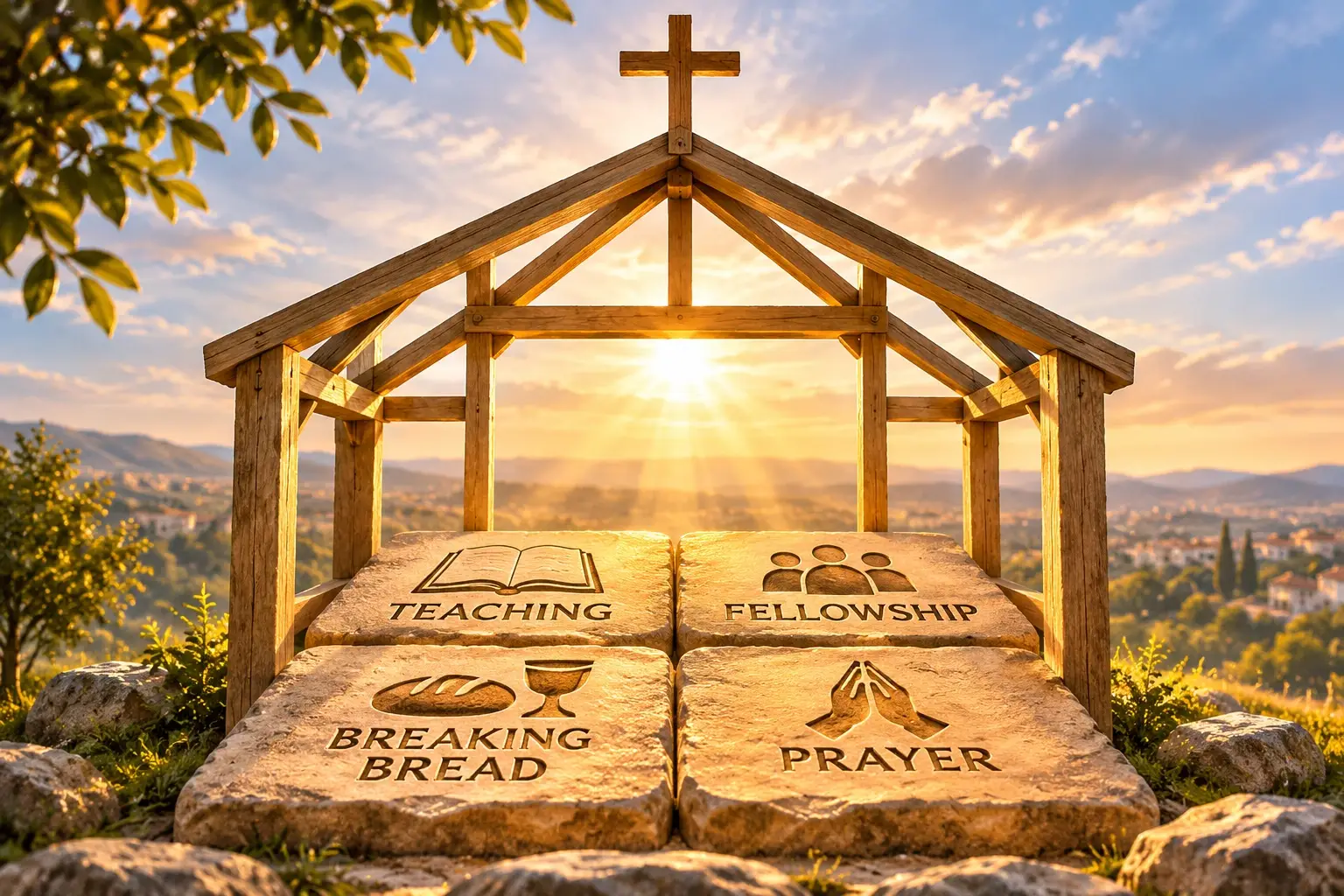
The dramatic launch of the church as a Spirit-filled community of Jesus’ disciples, all of them devoted to these four foundational practices and committed to spreading God’s kingdom, provides the basic paradigm for the life of the church in all generations.
As is obvious here, the essence of the New Testament church is not a building. Nowhere in the New Testament is the church described as a building. Nor is it an institution. Rather, the church’s essence is that it is a community of the King—a group of people whom the Spirit has drawn out of the fallen world to salvation in Christ through the gospel and into life together in God’s kingdom. In the New Testament, such groups are described with the term ekklesia, that is, a local congregation or gathering of disciples in a given area, or all such groups in that area.5
As these early believers embarked on this new life of discipleship—of denying self, taking up their cross, and following Jesus daily in costly obedience—they soon discovered that “through many tribulations we must enter the kingdom of God” (Acts 14:22). Thus, another mark of the church, as Luther would later say, was suffering.6
Ignorance of these foundational truths and their implications is one of the main reasons for the weak and anemic spiritual lives of many Christians today, and a major reason we need to recover our identity as disciples of Jesus.
What Was the Church Like in the Apostolic Era?
After Jesus’ resurrection, the disciples met together in the temple precincts and in homes (Acts 2:46). Tensions with Jewish authorities, however, quickly rendered them personae non gratae on the temple grounds, forcing them to meet only in homes.
In Rome, Priscilla and Aquila hosted a church in their house (Rom. 16:3–5), just as they did earlier when they lived in Corinth (1 Cor. 16:19). In Colossae, the church met in Nympha’s home (Col. 4:15), and Philemon also hosted a church in his home (Philem. 2–3). As in Jerusalem, “Most likely, only ten to a dozen believers, plus children, met in typical households like that of Priscilla and Aquila.”7 The larger homes of more affluent believers could accommodate several such groups, perhaps forty or so.8 They may have met in the early morning or after dark. We might consider this the original “house church movement”! Churches met in private homes into the fourth century. These small venues encouraged the development of close relationships and community among believers.
What kind of ethnic composition did these gatherings have? In Jerusalem, they consisted predominantly of Jews. But at the cross, Christ had “broken down in his flesh the dividing wall of hostility” between Jew and Gentile (Eph. 2:14). In the church, everyone’s fundamental identity had changed through faith in Jesus; they had become children of God and disciples of Christ. As the gospel spread to Samaria and then to the wider Greco-Roman world, Gentiles of every description trusted in Christ and entered the church. This family had “no Greek and Jew, circumcised and uncircumcised, barbarian, Scythian, slave, free; but Christ is all and in all” (Col. 3:11). Thus, the word “catholic,” in the sense of “universal,” would become one of the marks of the church.
In his letters to these house churches, Paul often used the descriptive term “the body of Christ,” that is, a living organism headed by Christ Himself (Eph. 1:22–23; Col. 1:18). This metaphor reinforces the idea of the church as a group of people who have come to faith in Christ and who relate to one another like various parts of a body, over which Jesus is the head and rules through His Spirit. In its local manifestations, the church is to visibly express His example of truth, grace, and love in its internal relationships and operations and to carry out His mission to the world. Daily filling with the Holy Spirit made this beautiful supernatural life possible.
But there’s more. Paul also referred to the church in terms of a family—“the household of God” (Eph. 2:19) and “the household of faith” (Gal. 6:10)—and reinforced this with warm relational words such as “brothers,” “sisters,” fathers,” “mothers,” “children of God,” and “household.” The image of a family suggests love, peace, warmth, and care for one another.
The content of Paul’s epistles, however, shows that these images of “the body of Christ” and “family of God” did not mean local churches were always grace-filled, loving, peaceful communities active in mission and free of doctrinal aberrations. In fact, none of them were perfect. Each had its own set of problems; some major (Corinth), others relatively minor (Philippi). The church as Christ’s body and God’s family is the place where God’s glory is to be manifested concretely in the darkness of this fallen world, which explains why it is the prime target of the devil’s relentless attacks.
Nor did Paul’s images mean that everyone in an assembled congregation was truly born again. No doubt most were when he planted a church, but not necessarily all. In fact, Paul urges the Corinthians, “Examine yourselves, to see whether you are in the faith. Test yourselves” (2 Cor. 13:5). This reality eventually led to the recognition of a distinction between the visible church (all who verbally profess faith) and the invisible church (those in the visible church, known only to God, who are truly regenerate).
Seven Features of the Church
The example of the Spirit’s work in the early church raises an obvious and important question. How do we recognize a faithful church, a church true to the apostolic faith and practice? We can start by asking what features the worldwide church shares across the centuries. The description found in the Nicene Creed, an early summary of essential doctrine, helps us here: the church of Christ as a whole is one, holy, catholic, and apostolic. Very briefly;
One refers to the unity of one body (Eph. 4:4ff.).
Holy refers to the church as a holy nation (1 Pet. 2:9).
Catholic refers to universality of peoples in the church (Gal. 3:28).
Apostolic refers to faithfulness to the teaching of the apostles (2 Tim. 1:13).
In his book Christian Basics: An Invitation to Discipleship, John Stott describes how the whole church is connected:
In one sense the church is not divided and cannot be. Even our outward divisions do not tear it asunder, since the one Spirit indwells it. Piers in a harbor may divide it into sections, so that boats are cut off from each other, but the same sea flows and swells underneath. Our man-made denominations also separate us outwardly and visibly, but inwardly and invisibly the tide of the Spirit unites us.9
He goes on to define the four features of the church mentioned in the Nicene Creed in this succinct summary:
The Nicene Creed characterizes the church as “one, holy, catholic and apostolic,” which are the four classical “marks” or “notes” of the church. And they are true. The church is both one and holy because the Holy Spirit has united and sanctified it, setting it apart to belong to God, even though in practice it is often disunited and unholy. The church is also catholic (embracing all believers and all truth) and apostolic (affirming the teaching of the apostles and engaging in mission), even though in practice it often denies the faith it should profess and the mission it should pursue.10
Appreciating these aspects of the church is a good starting place for understanding what a faithful church looks like.
In addition to these four common attributes articulated by the ancient church (the Nicene Creed was formally recognized by the church in the fourth century), church leaders during the Protestant Reformation (sixteenth century) regarded three more as noteworthy. Theologian Edmund Clowney observes, “The Reformation made the gospel, not ecclesiastical organization, the test of the true church … . Three marks were defined in distinguishing a true church of Christ: true preaching of the word, proper observance of the sacraments; and faithful exercise of church discipline.”11
Does the local church you attend exhibit the seven marks of a faithful church? If so, how does your involvement in that church help you to follow Christ more fully and love Him more deeply? If not, can you do something to help make things better?
Always a Remnant
When we get discouraged about the state of the church, it is sometimes helpful to remind ourselves that the church exists in a fallen world whose seductive culture is a source of constant temptation to believers; the devil exploits this to ensnare our flesh. In this battle, the church goes through cycles of advance and decline that stretch as far back as Old Testament times, when Canaanite Baal worship was the great snare.
But despite bleak, even seemingly faithless epochs in church history, God has always preserved a remnant of His people, even in the worst of times. In one of the darkest periods of Israel’s history, God gave the discouraged prophet Elijah a reason to hope, promising that “I will leave seven thousand in Israel, all the knees that have not bowed to Baal, and every mouth that has not kissed him” (1 Kings 19:18). Though we may not immediately see His hand at work in challenging times, God does not abandon His people or His plans.
We need to remind ourselves that such bleak times are temporary. In due course, God will come in fresh power to restore His church. Throughout history, He has poured out His Spirit in periodic renewals and revivals to save unconverted church members, cleanse and empower true believers, draw them back to the fundamentals of the apostolic church and sound doctrine, fuel missions, and advance His kingdom of love.12 How glorious such advances are when they come!
We can see such renewal in the impact of Augustine’s work as the Roman Empire crumbled around him; Benedict of Nursia and the Benedictine movement; the Irish missionary monks; Francis of Assisi and the Franciscan movement; Bernard of Clairvaux and the Cistercian reform movement; Thomas à Kempis and the Devotio Moderna; John Wycliffe, the morning star of the Reformation; William Tyndale, father of the English Bible; the magisterial Reformers (Martin Luther, Huldrych Zwingli, and John Calvin); John Knox; Thomas Cranmer; and many others up to our own day. None was perfect, and none had perfect doctrine, but all were devoted to Christ and His kingdom, and He used them to build His church despite their sins, flaws, and errors—as He does us today.
Yet the efforts of these groups and individuals eventually faded. Why do such revivals not last? There are several reasons.
First, as church historian Richard Lovelace explains, the flesh and the world always introduce distortions and confusion.13 And simultaneously, sustained demonic opposition also arises to meet revivals, introducing doctrinal errors, excesses, confusion, division, and other aberrations.14 In addition, a common cycle recurs: after a season of revival in which the church grows stronger and spreads, new converts become more honest, responsible, hardworking, and prosperous; then, worldliness begins to increase, the fires eventually grow cold, and the church again becomes weak and in need of fresh revival. Along with this, many of those converted do not adequately disciple their children into the faith, if they do it at all. A couple of generations of such decline takes a big toll on the church, as the ranks of truly converted and committed believers dwindle. At that point, revival is needed again.
Cotton Mather, the leading clergyman in the American colonies, summed up the decline of true religion in America from its founding in the early 1600s to 1699 by observing that “piety begat prosperity, and the daughter consumed the mother.”15 Near the end of his life, John Wesley made a similar observation about the Methodist movement:
Wherever riches have increased, the essence of religion has decreased in the same proportion. Therefore I do not see how it is possible in the nature of things for any revival of religion to continue long. For religion must necessarily produce both industry and frugality, and these cannot but produce riches. But as riches increase, so will pride, anger, and love of the world in all its branches.
How then is it possible that Methodism, that is, a religion of the heart, though it flourishes now as the green bay tree, should continue in this state? For the Methodists in every place grow diligent and frugal: consequently, they increase in goods. Hence, they proportionately increase in pride, in anger, in the desire of the flesh, the desire of the eyes, and the pride of life. So, although the form of religion remains, the spirit is swiftly vanishing away. Is there no way to prevent … this continual decay of pure religion?16
By the early 1700s, the churches of New England had become dry and rife with formalism and were being challenged by the rationalism of the Enlightenment. Times were bleak. But several decades later, in response to prayer for revival, God responded to this dismal situation by sending the Great Awakening, a mighty outpouring of the Holy Spirit that brought many into God’s kingdom. This cycle of advance and decline goes all the way back to the period of the judges in the book of Joshua.
We can see the same pattern of spiritual decline today in rapidly secularizing Europe, Canada, and America—a sad decline of church and culture from a more faithful and fruitful era. Spirit-led revival and reform of the church is the greatest need of the hour in these lands, and earnest intercessory prayer is our only hope. At the same time, we can feel encouraged over the thrilling work of the Spirit in kingdom advances now taking place in Asia, Africa, and South America, despite persecution.
Looking further back, we see that the Holy Spirit had been deeply grieved by the church’s steep spiritual decline from the fourteenth to the sixteenth century. This was due to a number of factors, including worldliness, widespread corruption, internal political strife, uneducated and morally corrupt clergy, the sale of indulgences, and resistance to reform. Although the Spirit was at work in lay movements like the Devotio Moderna, corruption in the church hierarchy was too deeply entrenched for the few reform-minded cardinals to effect change.
The Protestant Reformation took a great step forward, beginning in 1517 when Martin Luther nailed his 95 Theses to the door of Wittenberg Chapel, a major advance in restoring the church to its apostolic foundations. These foundations were understood not as the apostolic succession of clergy but apostolic teaching of the Bible. Edmund Clowney observed that “above all, the Reformers emphasized the meaning of apostolicity. To be apostolic, the church must be built on the doctrine of the apostles.”17 And apostolic doctrine clearly taught that salvation was by grace alone, through faith alone, in Christ alone, and not earned through good works. Along with Scripture alone and to God’s glory alone, these became known as the “Five Solas”18 and were core principles of the Reformation.
Neither Luther nor Calvin wanted to split from the Roman Catholic Church. They wanted to correct abuses and reform the church in areas where it had seriously strayed from apostolic teaching and life. Sadly, that didn’t happen. Luther was declared a heretic and excommunicated from the church. And the unintended consequence of the Reformation was that the church split into smaller groups such as denominations. The Reformation did, however, bring much-needed reform in both doctrine and practice. Salvation and all its blessings again were understood to come, as Paul had taught, by grace alone, through faith alone in the finished work of Christ alone—and not by works (Eph. 2:8–9)—but also not without works, which are the fruit of true saving faith (v. 10).
Despite these and many other doctrinal and structural reforms, Luther, Calvin, and other Reformers lamented that the church experienced so little reformation of life among its people, and so little true personal revival. In time, it came to be understood that the church is always in need of reform: ecclesia reformata, semper reformanda, “the church reformed, always reforming.”
What To Do Now?
In light of all this, how do we make sense of the church today? We must always remember that Jesus said, “I will build my church, and the gates of hell shall not prevail against it” (Matt. 16:18). Jesus also prayed for His disciples “that they may all be one … that the world may believe that you have sent me” (John 17:21). Jesus works through the Holy Spirit to bring these things to pass, and the Spirit works through us.

We might find these realities hard to imagine due to the church’s fragmentation into such a great variety of denominational forms (for example, Eastern Orthodox, Roman Catholic, Lutheran, Reformed, Anabaptist, Anglican, Baptist, Methodist, Pentecostal, nondenominational). But though the forms of worship and certain doctrinal beliefs might differ, Jesus has continued to build His church in congregations that welcome Him and hold fast to His Word. And one day, all true believers will unite again in truth and love in the world to come, and possibly sooner on earth, though it may take the fires of tribulation and persecution to bring that about!
Paul proclaimed, “Christ is the head of the church, his body, and is himself its Savior … . [He] gave himself up for her, that he might sanctify her, having cleansed her by the washing of water with the word, so that he might present the church to himself in splendor, without spot or wrinkle or any such thing, that she might be holy and without blemish” (Eph. 5:23, 25–27). This, too, we may find difficult to imagine, given the present moral and theological compromise in many contemporary churches. But it will definitely come to pass! For nothing is impossible with God (Matt. 19:26; Luke 1:37), and the fires of revival and persecution can have a powerful purifying effect on the church.
Truth is perpetually under assault as the devil and his minions work through false teachers and heresies, seeking to deceive even the elect, if that were possible (Matt. 24:24). But Luther said it well in the hymn “A Mighty Fortress Is Our God”: “And though this world, with devils filled, should threaten to undo us, we will not fear, for God hath willed his truth to triumph through us.”19
If we are disciples of Jesus, who “loved us and gave himself up for us” (Eph. 5:2), we will believe what He taught, love what He loves, and stay committed to His church in every circumstance. We will stay in the battle, even when it gets hard. This means loving and staying committed to a theologically sound local church despite its imperfections and, through all its ups and downs, actively seeking its health and flourishing, supporting the leadership, faithfully praying for its revival and reform, and using our spiritual and material gifts to advance its life and mission of glorifying Christ by making disciples and spreading the kingdom of God. Faithfulness can also, of course, mean leaving a church or denomination that has abandoned orthodox belief.
As we press on, we can take encouragement from the words of another great hymn:
Though with a scornful wonder men see her sore oppressed, By schisms rent asunder, by heresies distressed, Yet saints their watch are keeping, their cry goes up, “how long?” And soon the night of weeping shall be the morn of song. ‘Mid toil and tribulation and tumult of her war, She waits the consummation of peace forevermore; Till with the vision glorious her longing eyes are blest and the great church victorious shall be the church at rest.”20
Let’s pray for God’s blessing, not only on our own local church, but also on other faithful churches, and for the continuing advance of God’s kingdom as we await the return of Jesus and the consummation of all things. Jesus promised that He would build His church (Matt. 16:18), and He is doing so even now.
Questions to Ponder
- Considering the early disciples’ devotion to the four foundational practices mentioned in Acts 2:42, how would you evaluate your experience in the contemporary church? Which of these are most visible, and which less so?
- After reading about the ongoing work of the Holy Spirit in lives of early disciples, what characteristics of the early church stand out to you?
- Name the four marks of a faithful church that are stated in the Nicene Creed. To what extent does the church you attend exhibit these marks?
- What are the three additional marks noted by the leaders of the Protestant Reformation? Which of these is most and least familiar based on your experiences in local churches?
- As a faithful follower of Christ, name some reasons why it is important to stay connected to a local church.
Gordon Fee, Paul, the Spirit, and the People of God
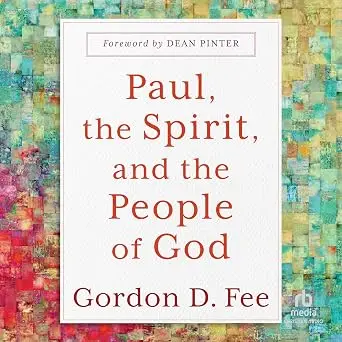 This contemporary classic by renowned scholar Gordon Fee explores the Spirit's significant role in Pauline life and thought.
Michael Green, I Believe in the Holy Spirit
 In this updated edition of his widely popular book, Michael Green traces the doctrine of the Holy Spirit through the Bible, discusses the baptism and gifts of the Spirit, and addresses the dynamic, ongoing work of the Spirit in today's church and world.
Thomas A. Tarrants
Thomas A. Tarrants is President Emeritus of the C.S. Lewis Institute. After serving twelve years as president and nine years as vice President, he retired from his position as Vice President for Ministry and Director, Washington Area Fellows Program, with CSLI in June 2019. He holds a Master's of Divinity Degree, as well as a Doctor of Ministry Degree in Christian Spirituality. Tom is an ordained minister in the Evangelical Church Alliance and a member of the Evangelical Theological Society. Tom is the author of Consumed by Hate, Redeemed by Love, published by Thomas Nelson Publishers and Following Jesus Christ. He spends his time writing, mentoring, consulting and traveling.
