



Back to series
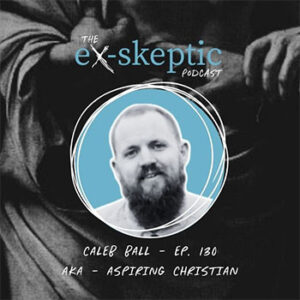
Episode #130: Seeing Through Atheism - Caleb Ball’s (aka Aspiring Christian) Story
Resources Mentioned:
- Book: Believing is Seeing, Michael Guillen
-
Author: John Lennox
-
Book: More than a Carpenter, Josh and Sean McDowell
-
MIT Professor: Rosalind Picard
What happens when the “certainty” of atheism collides with evidence pointing to something more?
Caleb Ball’s (YouTube’s Aspiring Christian Channel) story begins in small-town Pennsylvania, where childhood faith gave way to mocking Christianity and embracing naturalism. For six years, he lived as a convinced atheist, creating YouTube content ridiculing God, convinced that science had all the answers. But one book, on quantum physics and consciousness, began to dismantle his worldview, forcing him to ask deeper questions about truth, meaning, and the existence of God.
Resources Mentioned:
-
America’s Christian Credit Union (ACCU): AmericasChristianCU.com/Jana
-
YouTube: Aspiring Christian
-
Substack: https://substack.com/@aspiringchristian
-
Quantum Physics, Near Death Experiences, Eternal Consciousness, Religion, and the Human Soul by William Joseph Bray.
- Book: Ecclesiastes (from the Bible)
-
Book: A Grief Observed, C.S. Lewis
-
YouTube: Daily Dose of Wisdom
-
YouTube: Sean McDowell
Listen to more stories from skeptics and atheists who investigated Christianity.
Brought to you by the C.S. Lewis Institute and eX-skeptic.
Transcript
Welcome to eX-skeptic, where we share unlikely stories of belief—true accounts of those who once walked away from God but found compelling reasons to believe again. I’m your host, Jana Harmon, and this podcast is for both the curious skeptic who wonders if there’s more to life than naturalistic explanations and the thoughtful Christian who wants to better understand and engage with those who doubt.
Today’s guest, also known as Aspiring Christian, takes us on a winding road from an early faith to passionate atheism, from ridicule of Christianity to reasoned conviction that Christianity is true. Along the way, Caleb’s story confronts the big questions about science, meaning, and truth, and challenges us all to examine the foundations of what we believe. I hope you’ll come along.
Welcome to eX-skeptic. Caleb, it’s great to have you with me today.
Caleb Ball
It is great to be with you here, Jana. Thanks for inviting me on.
Jana Harmon
Oh, you’re so welcome. I’m very excited about this conversation today. You and I know each other through your YouTube channel. As we’re getting started, why don’t you tell me a little bit about who you are, your YouTube channel, and the things that you’re passionate about.
Caleb Ball
My name is Caleb, and I’ve been doing a testimony series on atheist converts to Christianity. I think these stories of atheists converting to Christianity are very important. I work in a sales capacity and, you know, one thing I’ve learned over time is that stories sell, so to speak. Stories have a deep impact on the human heart and the human mind.
I graduated from college, got a degree in history, had no idea what I was going to do, and so then I jumped into sales from there. Recently I applied and am now enrolled to get a master’s in Biblical Studies at Colorado Christian University. And so I’m really looking forward to that and looking forward to the rest of this conversation.
Jana Harmon
Yeah, so am I. I’m just really interested to hear your story because stories are impactful—they’re incredibly meaningful. And you and I have a similar heart about that. But I’m really, really interested to hear your story because I know you’ve gone on a long and winding road from Christianity to atheism and back again in a very passionate way. So let’s start with your story, Caleb, and talk with us about the way you were raised, where you were raised, and whether or not religion or anything like that had a place in your home.
Caleb Ball
So I was raised in a Christian environment, a Christian atmosphere. I was raised in small-town Pennsylvania. I was raised in a home where my dad was very zealous for God. My mom might have been less so.
Some of the things that impacted me the most through my childhood—I remember there was a time when my brothers and I were in church, and these youth leaders were teaching us one Sunday. We were kind of asking the question or thinking about why God created Adam and Eve. God being all-knowing, knowing that they would sin, why did He create them?
And I don’t feel like we got answers from the teens there—although not necessarily that you’d expect them to have a good answer or be ready for an apologetics answer. And then we asked our parents, and they seemed almost kind of put off that we would ask the question. They didn’t really give a good response. I think there’s plenty of good responses to that question, by the way. All parents know that their children are going to disobey them at one point or another. That doesn’t change or prevent them from wanting to have a relationship with their children and to have children in the first place.
Jana Harmon
Questions like that—did that start to plant some seeds of doubt in you with regard to your Christian faith?
Caleb Ball
That did not necessarily plant too much doubt, except in that I didn’t feel like it was okay to question things. And it did plant a huge doubt that my parents would have any ability to answer hard questions about faith.
It also made me really uncomfortable if I ever encountered somebody who was skeptical of Christianity. And I feel like most people were Christian where I grew up—or at least if someone were to ask them, “Are you a Christian?” I think most people would have said yes. Doesn’t mean they were really devout followers of the Lord. It was just kind of in the atmosphere, in the culture. But I don’t think I grew up with the ability to have a reasoned defense for my faith. And so I think that had a pretty big impact on things later on. I remember the very few instances where I encountered somebody who said something negative about Christianity—I didn’t really know what to say.
Jana Harmon
Yeah, that’s hard. And especially, I imagine, based on some of your experience there, that there may not be answers or people are defensive about asking the questions. Perhaps you thought maybe the answers weren’t there.
Caleb Ball
Yeah, I think part of me did sense that there weren’t necessarily answers to these questions. Not that I thought that then meant Christianity wasn’t valid—just that there are some questions we just don’t have answers to with our faith and it’s all blind faith. And so I think those were some seeds that were in me that sprouted later on.
Jana Harmon
So when did some of those seeds of doubt start to blossom into more full-fledged questioning of whether or not Christianity was for you?
Caleb Ball
It was when I was about 18 or 19 years old. I didn’t have a plan for after high school, so I spent my first year after that not going to college. And very early on within that year, I just had a sense that I wanted to know—be certain—of whether or not God existed.
So I hopped on YouTube, which was a very different place in 2011–2012 than it is today on the front of questions about God. If someone were searching the questions I was searching about God now on YouTube, I think they would likely see a lot of good videos by a lot of awesome Christian apologists—John Lennox or whoever else. But back then, not so much. A lot of amateur content.
I was looking into proof God exists, proof God doesn’t exist—basic things along those lines. And I came across several atheist videos. I believe the ones that started to pull me away the most from my faith were a video by Thunderf00t replying to the design argument for God. I just thought the way he made the design argument seem absurd pulled me away quickly.
But I also think there were a lot of worldly interests I held at the time that made it easy for my Christianity to be taken away quickly. And I don’t think I was well-rooted in the faith. There were opportunities earlier in my life—I blame myself a lot for why I stepped away from the faith. While my parents didn’t provide a lot of good answers, there were plenty of apologetics books, and the questions I had were answered in books. I just wasn’t a diligent enough student.
So for that reason I came away from the faith because I took these answers that atheists had and I didn’t critically examine them. I don’t know if I knew how to do that, but I didn’t critically examine their answers or even think about the underpinning foundations of naturalistic ideas. There’s a lot of absurdity there when you try to get deeper and deeper and find the ground floor. But I didn’t think about any of that at the time.
I just quickly accepted atheism and naturalism as my view. Then I started diving into videos by Richard Dawkins, Religulous by Bill Maher—just a lot of that stuff that was going around at the time. Even the Jesus-mythicism videos, which of course are very absurd (which I know now but did not know then). So I kind of accepted this idea that maybe Jesus didn’t even exist at all—maybe He did, maybe He didn’t, we just don’t really know—which historians would of course laugh at. I was very easily influenced by a lot of ideas at the time. I don’t think I was a good enough student, honestly.
Jana Harmon
Well, I think at that time the New Atheist rhetoric was very strong and very persuasive. You’re a young adult trying to make your way, and that particular rhetoric seemed very compelling. There might have been apologetics there, but they were a little harder to find if you’re not really looking for them. So you fell into this worldview that you called naturalism. For those who aren’t familiar with that term, can you explain what naturalism is and perhaps why atheists would say they believe in naturalism as a worldview?
Caleb Ball
Yeah, so naturalism—I’m not a scholar, I got my bachelor’s in history, so I don’t know if I can explain it too well. Naturalism is just the idea that everything that exists has natural causes and not supernatural causes. There are no gods, there are no ghosts, there are no demons, there is no magic—nothing supernatural of any sort. Everything can or will eventually be explained by naturalistic methods, scientific tools of measurement.
People once said thunder was because of the gods, and now we know there’s a scientific explanation. So anything that doesn’t yet have a scientific explanation likely one day will. There’s no reason to believe God created everything. Scientists have sufficiently answered the main and biggest questions—which is all a lie, but that’s what I believed.
I believed there were natural explanations for everything. I believed there is no such thing as the soul—that’s important, by the way. No spirits, none of that. I was fully convinced of naturalism, and I actually found it pretty absurd when I occasionally ran into an atheist who yet believed in ghosts. How do you line that up? Yeah, I was pretty convinced that the scientists had all the answers—all the important answers—and there wasn’t anything that wasn’t sufficiently explained by them. I don’t think I knew the questions to ask to see why that was wrong, but that’s what I believed.
Jana Harmon
So did you consider yourself an atheist along with that New Atheist movement?
Caleb Ball
Absolutely, yeah. I was a pretty die-hard atheist. Just to give you an example: when I was in college—my first year I didn’t really socially interact, I was pretty much a recluse—but by my second year when I was starting to be more social, there was a campus preacher. So I went to the spot where he preached when he wasn’t there once, and I went up and talked about “Pixie the Pony.” I invented this little script for a fake religion: Pixie the Pony would bring you salvation and you would forever live in the Amazon rainforest if you drank enough green tea. So I was actively mocking Christianity at that point, acting like it was the most silly, absurd thing—even though just a few years prior I would have called myself a Christian. That’s how convinced I was that atheism was true: I was actively mocking God and inventing things to mock Christianity.
Jana Harmon
Yeah, it seems like in many cases there’s this sense in which you know what you don’t believe, and you mock it and ridicule it and dismiss it and don’t take the arguments seriously. That’s one thing. It’s another thing to actually live within a naturalistic, atheistic worldview and really look at: well, what does it mean that nature is all that exists? What does that mean for me as a person? Did you think deeply about any of that? What was your life like as an atheist? Did it give you that sense of liberation and freedom—“I’m the captain of my own ship”?
Caleb Ball
Yeah, that’s a great question. I wouldn’t have characterized myself this way then, but now looking back I would characterize the way I lived and what I was as a hedonist—just pursuing pleasure. So a lot of alcohol consumption, hanging out with girls. I was not a good guy by any means. I had a group of friends in college—you drank with them a lot. I drank to blackout; whenever I was drinking, the purpose was to black out. There were times I had fun, but I never thought about the implications of naturalism. In fact, for several years in college I was a political activist—first for left-wing causes and then eventually for libertarian causes.
But I never thought about the implications of naturalism and how absurd it was that I was so passionate about politics. Because whether one is working for the left or the right, they’re pursuing a sense of justice—they are pursuing a way the world should be. If you consider David Hume—and “there are no moral oughts”—that’s pretty solid philosophy. No atheist can really provide good reasons for why things are to be one way rather than another. Why is David Hume wrong if there is no God? I never thought that deeply about any of this when I was an atheist.
But I did act passionately for a sense of justice—as if there is this transcendent truth that there is a way things are to be and that I should pursue this ultimate justice—even though I had no foundational axiom for it, no way to rationalize it. No one ever pressed me on this question. There were a lot of atheist professors pursuing justice in one way or another who probably don’t really think about their foundational axiom for why this matters or why there is a set reality that should exist. Why are cultures overseas that behead people based on religious beliefs or sexuality definitively wrong—and why is that more than just my opinion? Atheism provides no foundation for why that’s more than anyone’s opinion or a few people’s opinions.
Jana Harmon
So how long did you live as an atheist—thinking as an atheist, identifying as an atheist?
Caleb Ball
It was a period of six years where, if someone asked me, “Do you believe in God?” the answer would have been no. The first few years of that I was really passionate about it. Eventually I saw all this culture-of-personality infighting, people accepting a lot of other views that don’t relate to God without much evidence. Atheists weren’t really the adults in the room that they claimed to be.
If I watched a debate between John Lennox and Richard Dawkins, I don’t think you need to be a Christian to say the adult in the room—the one who’s more mature—is certainly John Lennox. The behavior I saw by atheists online made me think, “Okay, well, maybe these guys aren’t as smart as they tell everyone they are.”
So I just kind of lost interest eventually in the topic of faith. However, I did have a gap year in college—two years enrolled, but one gap year. While I worked at a call center that year, I started talking to a Christian there. I brought up that I was an atheist, and he had a great demeanor—thoughtful in his approach to faith, clearly pretty intelligent. He didn’t lead me to Christianity, but it did plant a seed.
This whole narrative that I had accepted on faith—that Christians hadn’t thought considerably deeply about their worldview, that Christians weren’t intelligent, they didn’t use their mind—I had accepted all these things on faith, no foundation for those beliefs. But then I encountered a Christian who had critically examined his worldview, had thoughtful answers and responses to my questions. Even though I was trying to pick apart all his answers, it planted a seed that, hey, I’ve kind of been lied to by other atheists, and I’ve accepted on faith what they said.
Jana Harmon
So that conversation and meeting that Christian broke down some negative stereotypes you might have had of Christians or Christianity—that there really is something much more substantive behind the door, some answers to be given. It sounds like it piqued your curiosity. Did you start really looking behind the door based on those conversations?
Caleb Ball
I wish I had taken our conversations and really thought through them. My focus then was on drinking bottles of liquor and vodka. I was just hedonistic—I didn’t really want to explore these ideas that deeply. But what it did do is break down some of those walls. That allowed some things to open up later to make me entertain faith again.
I was no longer a passionate atheist. I would have still called myself an atheist, but I wasn’t actively going out to mock Christians anymore. It just became one of those things where I thought reasonable people can disagree on the truth—reasonable people can be Christians and reasonable people can be atheists. That’s where I found myself. I was much more interested not only in the bottle but also in politics—I was pretty obsessed with politics, which again I don’t think is consistent with naturalism when you really think about it.
Jana Harmon
So how long did you stay in that space, and what might have piqued your curiosity to actually take another look at Christianity?
Caleb Ball
That’s where it gets interesting. An organization I led—a campus organization I had started, a political organization—was ultimately my road back to faith. I started the chapter of Young Americans for Liberty, an offshoot of Ron Paul’s Youth for Ron Paul campaign. The first year wasn’t too successful, but the second year we had some good meetings—it was one of the more successful chapters in the state.
The gentleman who motivated me to restart the organization and who I let be president (because I didn’t want to haul around all these promotional materials and books anymore) had a father who was a psychology professor. His father gave him this book which he shared with me: Quantum Physics, Near-Death Experiences, Eternal Consciousness, Religion and the Human Soul.
It teaches the subject of quantum physics to the lay reader in math and terminology that is simple to understand, describes how and why this universe is interdependent with consciousness in order to exist (as defined by the founders of quantum physics over half a century ago), describes the mechanism in detail—how we interact with, manipulate, and define this finite universe—and presents a working definition for consciousness suitable to the formal definitions of quantum physics as well as the philosophies and religions of man.
Whenever I started to open this book up and started to read it, I just knew I was wrong about atheism and I knew I was wrong about faith. I knew that consciousness must predate the material world, and I just knew what I was reading was true. That’s what drew me back. But if I hadn’t started this political organization, I wouldn’t have run into the man who showed me this book. It’s as if my interests were guided so that I would come back to God.
Jana Harmon
It seems like once you read that book—that consciousness or a conscious mind precedes matter—it was this aha moment. You thought, “Okay, I need to move back and take another look at God and Christianity.” Did you talk with people about it? Was your path sudden or gradual?
Caleb Ball
I was so eccentric at the time and so excited about this passage. I was nearing the end of my college years, didn’t have a definitive plan for afterwards, but I was a very passionate advocate for this book and what was written in it. I would show people the passages. We were going to a state chapter conference, and on that ride I was talking to the other guys and reading passages from this book because they knew me as an atheist—pretty certain in my atheism. And now I’m like, “Guys, I believe in God now.”
The text does place an emphasis on Jesus but also kind of leaves the door open that other philosophies and religions may contain truth. So I even read some of the Quran and looked into some other religious things at the time. It took me a long time to really start studying the Bible again and to say Christianity is exclusively the truth—that Jesus Christ is Lord. That took a very long time.
The road was windy, and I was still holding on to a lot of my really bad habits that I formed as an atheist—like drinking way too much. I was a little bit all over the place, to be honest. But I was just really excited that this God who I was certain did not exist definitely does—and not only that, but that He knows me.
Jana Harmon
Those are two very different realities: the God of creation in all His grandeur and power, yet He knows you. How did you come to that place where He’s not only grand but also incredibly intimate and personal?
Caleb Ball
Through reading the Bible. If you’re accepting that multiple religions may have a claim to truth and then you start studying the New Testament, it’s pretty clear that Christianity is not leaving you the door open to say other religions can be true. If you’re saying Islam is true and Christianity is true—well, Jesus either died on the cross and was resurrected (as Christianity says) or He was only made to appear that He died on a cross (like Islam says). Both of those things can’t be true. So I landed on Christianity because God pulled me there. I don’t know what else to say.
Jana Harmon
No, that’s beautiful—because at the end of the day your change of heart and mind, if God exists, is a work of God. He helps you see, He draws you to Himself. That book was very powerful in your life, and God used it to illuminate your mind to what is true and real. Once you accepted and embraced that, how did moving back to Christianity affect your life, your views? Moving from staunch, militaristic atheism back to Christianity is quite a transformation.
Caleb Ball
Well, I’m a slow learner. While I had this incredible experience toward the end of college, I fell into a deep depressive spell due to feeling like all the work I did through college was for naught because I didn’t have a plan after I graduated. The first job I had out of college was at a call center—a job I could have had with just a high-school education. There was some backsliding. Eventually I got a job at a logistics company in Pittsburgh, making enough money to do my own thing, and I had a backsliding that lasted nearly two years—not backsliding in that I would have said God didn’t exist, but I acted for nearly two years like He didn’t.
Then I had a colleague, a young woman named Brittany, who was very helpful. She went on a kayaking trip close to the end of these two years (I was starting to think about God again). She went over a dam and died. This wrecked me. A little bit before her dying I had a really dark dream with her in it. Those two things lining up had a pretty deep impact on me. I also really admired the way she was living more adventurously than I was.
So then I started hiking a lot, sitting down with young vagrants going through Pittsburgh and talking to homeless people. I wanted to do what they did—I spent six months homeless and then got back on my feet. I blamed God for the hole I dug for myself and the instability and uncertainty in my life. I didn’t want to follow Him for a while.
Jana Harmon
Yeah, it’s easy to blame God for our poor decisions.
Caleb Ball
I wasn’t thinking about God at all—I just felt everything was really depressing. I dealt with deep depression and suicidal ideation. But I met my wife back in 2018 and found the job I’m working at now in 2019. We got married in October 2020. Her dad and mom were diagnosed with cancer months later—her dad with stage-four.
My wife and I flew out to him, and I talked to him about Jesus because at our wedding my dad and I were really into Jesus—we were talking about Him. Her dad had texted her at one point saying he was an atheist and had a shirt that said “Don’t pray for me, sinners.” I talked to him about Ecclesiastes—how life without God has no meaning, no purpose. He subscribed to my YouTube channel and was watching all these testimony videos. While I was out there he downloaded a Bible app because I got him interested in Ecclesiastes. My wife mentioned at one point, “Hey, he keeps saying the word Ecclesiastes.” He did eventually read it.
I also gave my wife a book to give him: C.S. Lewis’s A Grief Observed, the book he wrote about his wife’s passing. There are a lot of quotes in that book that, while they don’t heal you, help you think about some pretty dark times. Since I’ve been turned back to Christ and really passionate about it in 2020, I volunteer in tech at church—hitting the buttons while I go weekly. I enjoy small groups, have a better sense of community, I’m better grounded. I quit alcohol, I quit pot—all those things are out of my life. It took a long time—I’m a slow learner—but eventually I did it, and I just live a much more fulfilling life now. Married, have a mortgage. I’m not living in the miserable position I was as an atheist, not a hedonist anymore.
I don’t go to people I disagree with on politics or religion and call them stupid for holding a different view. I might try to point out the absurdity of atheism and how it has no philosophical underpinnings and how atheists aren’t acting consistently with naturalism—but I never say they’re idiots, just that it’s not philosophically consistent. So by every measure I’m a better person—although no one is good but God.
Jana Harmon
There are some things within naturalism that are difficult not only to believe but also to live. Just for clarification: when you realized God exists—there has to be a transcendent source, a conscious mind outside of matter—what did you do with all the other arguments as an atheist? Did they all collapse like a Jenga tower once you realized there had to be a God?
Caleb Ball
You say a house of cards—I think my atheism was like a Jenga tower, and God had been pulling out pieces one by one over time (to my lack of knowledge that He was doing so). The idea that reasonable and rational people can’t be Christians, that Christians haven’t critically examined their faith, that intelligent Christians put their mind in a box when it comes to faith—all those little pieces had already been pulled. I already thought atheists can be just as absurd as Christians. So when I opened that book, the miracle God worked in my heart—giving me the ability to recognize He exists and that I’m a sinner—it was pretty instantaneous once I was reviewing this book. It was an overnight thing for me.
Knowing God exists now and knowing Christianity is true just took a lot of reading, thinking, and a plethora of YouTube videos by a wide range of apologists. By 2018–2019 there were some better apologetics videos (and even better ones now). Daily Dose of Wisdom is doing an incredible job. My move to God was pretty quick, but the whole tower had started to collapse before that.
Jana Harmon
It usually is a process over time—a realization, changing your mind about things—and then all of a sudden there’s an aha moment you can’t deny. If there’s somebody out there kind of like you who’s going, “Well, I don’t know that what I’ve been told within atheism is as solid as I thought, and maybe Christianity is not as thoughtless or irrational as I thought”—what would be a good next step for someone like that?
Caleb Ball
I would first have them critically examine their own life. Do they really live as a naturalist? Are they in some way fighting for truth, human dignity, and justice—which from a Christian worldview makes sense (it’s put on our hearts) but from a naturalist worldview doesn’t? Stephen Hawking wrote in The Grand Design that it’s hard to imagine how free will can exist if our thoughts are just the result of a chemical process. Atheism and naturalism necessarily lead to determinism.
Where I would recommend they go: I honestly love Dr. Guillermo “Yol” Gonzalez’s work—his book Believing Is Seeing. He has PhDs in physics, mathematics, and astronomy; was a physics professor at Harvard for a time; science editor for ABC. Your conversation with him was great—just type his name into YouTube.
Daily Dose of Wisdom, my collection of atheist converts to Christianity (many were scientists), John Lennox, Sean and Josh McDowell—Christians have given sufficient answers to objections atheists raise, and atheists haven’t provided sufficient reasoning that accounts for their axioms. Their axioms are faith-based. So even as an atheist you have to understand you’re using faith in a lot of areas already. Why not extend it to an arena that will ultimately provide answers to a wider range of questions? You don’t have to check your brain at the door to be a Christian—Christians have sufficiently revealed this in plenty of ways.
Jana Harmon
There are some amazing thinkers who have really given good reason to believe that God exists and Christianity is true. We’ll put all those resources in the show notes. When I think of your story, there’s the young man you worked with before you were ready to believe again—he broke down negative stereotypes and made you rethink what you thought about Christians and Christianity, just as an embodied example of someone thoughtful, kind, normal. How can we be more like that young man—or like you now—just as a thoughtful ambassador who portrays Christianity in a positive, winsome, thoughtful way? What would you recommend for the Christian?
Caleb Ball
I’ve been doing this for about two years: I have a lot of copies of More Than a Carpenter by Josh and Sean McDowell—a succinct apologetics work. I like to leave copies on park benches along with church invitations. But what we should try to do—and what I should try to do more—is get out of the holy huddles, be open to speaking to people who disagree with us, and try to be friendly about it.
Jana Harmon
It’s an interesting journey, isn’t it? You’ve been in very different places of belief—starting in Christianity, rejecting it altogether, being a very strong atheist—and now you’re very passionate about your belief, so much so that you’ve moved from a YouTube atheist to using your channel to show how atheists are coming to Christ. You have a huge platform to do that. You’ve definitely gotten out of your holy huddle in a very virtual way to demonstrate that this is worth believing—that God exists, Jesus is real, and He knows you personally.
I appreciate your story so much. I hope anybody listening can be encouraged on both sides: it’s always good to question your own worldview, no matter where you find yourself on the spectrum. Be honest enough with ourselves and our beliefs to actually look at them and ask if there’s good reason for why we believe what we believe—because it really does make a difference. It changes everything.
Thanks so much, Caleb, for coming on today and telling your story.
Caleb Ball
Thanks again for having me. That was a fun conversation.
Jana Harmon
If you want to stay in the loop on new episodes, events, or updates from the eX-skeptic community, take a moment to sign up for our email list. Just visit exskeptic.org and click “Join the eX-skeptic Email Community.” Caleb’s journey reminds us that our worldview shapes how we see everything and that it’s worth the courage to question it. For him, the certainty of atheism gave way to a deeper, more satisfying reality in Jesus Christ. His transformation didn’t come from checking his brain at the door but from opening his mind to evidence, reason, and the God who knows him personally.
If you’re wrestling with doubt or curious about faith, keep searching. Ask the hard questions, explore the best answers, and don’t settle until you’ve considered the whole story. And if you’re a Christian, I hope Caleb’s story encourages you to be ready—thoughtful and winsome—in your conversations with those who don’t believe.
Thank you for listening to eX-skeptic, part of the C.S. Lewis Institute Podcast Network and produced with the help of our amazing producer, Ashley Kilfer. For more stories like Caleb’s, visit exskeptic.org and explore our curated playlists. Subscribe on your favorite platform. If this encouraged you, please rate, review, and share it so others can join the conversation. We hope to see you next time for another unlikely story of belief.
 COPYRIGHT: This publication is published by C.S. Lewis Institute; 8001 Braddock Road, Suite 301; Springfield, VA 22151. Portions of the publication may be reproduced for noncommercial, local church or ministry use without prior permission. Electronic copies of the PDF files may be duplicated and transmitted via e-mail for personal and church use. Articles may not be modified without prior written permission of the Institute. For questions, contact the Institute: 703.914.5602 or email us.
-
Recent Podcasts
From New Age Seeker to Encountering Jesus – Robert Hotchkin’s Story
by Robert Hotchkin on October 23, 2026Raised in a loving but largely non-religious home,...Read More
-
After Theory by Terry Eagleton
by Jerry Root, Aimee Riegert on October 16, 2026
-
Almost Heretical – Deconstructing Christian Finds His Way Back – Nate Hanson’s Story
by Nate Hanson on October 9, 2026
-
Recent Publications
Is It Really That Important to Pay Attention to Others?
by Thiago M. Silva on October 1, 2026The Gospels paint a vivid picture of Jesus...Read More
-
Should My Children Have Robot Friends?
by Cameron McAllister on September 1, 2026
-
Stranded in Space, Grounded in Faith
by Barry Wilmore on August 12, 2026
0
All Booked
0.00
All Booked
0.00
All Booked
29802
Heart and Mind Discipleship Live Online Small Group
https://www.cslewisinstitute.org/?event=heart-and-mind-discipleship-live-online-small-group-las-vegas-nairobi-philippines&event_date=2026-11-06®=1
https://www.paypal.com/cgi-bin/webscr
2026-11-06
Next coming event
Days
Hours
Minutes
Seconds
Heart and Mind Discipleship Live Online Small Group
On November 6, 2026 at 8:00 pmCategories
Speakers

Jana Harmon
Senior Fellow For Christian Apologetics, CSLI
Caleb Ball
Podcast Guest
Team Members

Jana Harmon
Senior Fellow For Christian Apologetics, CSLIJana Harmon, Ph.D, is the Senior Fellow For Christian Apologetics for the C.S. Lewis Institute and a Teaching Fellow for C.S. Lewis Institute Atlanta. She serves on the Atlanta Advisory Board and as an Adjunct Professor of Cultural Apologetics at Biola University. Her doctoral research studied the religious conversion of atheists to Christianity looking at the perspectives and stories of 50 former Atheists. She views apologetics through a practical, evangelistic lens. She is the host of the podcast eX-skeptic for the C.S. Lewis Institute. Jana received her PhD from the University of Birmingham, England.

Team Members
Caleb Ball
Podcast GuestCaleb Ball is a former atheist turned passionate Christian communicator. Once a vocal critic of Christianity, known online as “Crazy Caleb” during his atheist YouTube years, he now uses his platform to share testimonies of skeptics who found faith in Jesus. Through his YouTube channel Aspiring Christian, he curates conversion stories and apologetics content to help others wrestle honestly with life’s biggest questions. Caleb holds a degree in history and is pursuing a Master’s in Biblical Studies at Colorado Christian University. He and his wife live in Montana, where they are active in their local church and community.