



Back to series

Recommended Reading:

Are you a Christian or a Disciple?
Click here to open a Print - Friendly PDF
| There is considerable confusion among God’s people about a very important question: does Jesus Christ offer two acceptable standards for living the Christian life—a less demanding one for “ordinary Christians” and an optional, more challenging version for those who commit themselves to be “disciples”? The way we answer this question is vitally important; it shapes our identity, the way we live, our witness to the watching world, and our rewards in the life to come.
Fortunately this is not an abstract theological issue that is beyond our reach. For the most part, the confusion is rooted in a failure to understand the meaning and use of the words Christian and disciple in the New Testament. This is actually good news, because the definition of these words can be readily determined and their use in the Bible easily observed. However, most of us have not delved into this deeply. We have absorbed the ideas of a denomination, congregation, pastor, parachurch group, or individual; then we have read these two words through that lens. I encourage you to approach this subject with a commitment to seek truth, whether or not it conforms to your current views. We should all be like the Jews in Berea, who listened to Paul carefully then searched the Scriptures to see if what he said was true (Acts 17:11). Origin and Meaning of the Word ChristianLet’s begin by looking at the origin and meaning of the word Christian and observe how it is used in the New Testament. Given the fact that it designates the Christian’s identity, you may be surprised that this word occurs only three times in the New Testament. But those three are sufficient to tell us what we need to know. In Greek, Christian (Christianos, Christianoi) means “adherents or followers of Christ,”1 that is, “those who belong to Him,”2 or “men of Christ.”3 The word emerged in the pagan city of Syrian Antioch, but how is unclear. It could have been a term devised by the Gentile believers to distinguish themselves from the local Jews. The renowned New Testament scholar F.F. Bruce recognizes the possibility “that it was the disciples who first began to call themselves Christians, meaning thereby ‘servants of Christ’.”4 However, he also suggests, as John Stott and many others do, that the name may have been the natural outgrowth of the believers speaking so much about Christ that Gentiles began to describe them as “the Christ-people, or Christians.”5 Stott sees this as positive, since “it marked out the disciples as being, above all, the people, the followers, the servants of Christ.”6 C.K. Barrett comments, “the new designation was probably needed when it first became apparent that the believers, who had left their old Gentile way of life, were no more Jews than heathens—in fact, a third race, Christians.”7 Others have suggested that Christian was a term of derision bestowed by nonbelievers, that the term stuck and was subsequently embraced with honor, as were the names Puritan and Methodist many centuries later. We can’t know for sure, but certainly Christian was an apt term. And it was probably a welcome development to distinguish the disciples of Jesus (who had recently fled the rampant persecution in Jerusalem8) from the Jewish community in Antioch, which was greatly disliked by the contemporary Greeks. So intensely were the Jews hated that, in AD 40, Gentile mobs killed many of them and destroyed their synagogues.9 What we do know about the word Christian is that sometime about AD 44–47 in Syria it became a term to refer to the growing number of people who were becoming followers of Jesus Christ. This appears to have been providential, inasmuch as it freed the disciples of Jesus from being seen as Jews and allowed them to carry on the Great Commission. Three New Testament Occurrences
|
|||
| Notes: 1. Horst Balz and Gerhard Schneider, ed., Exegetical Dictionary of the New Testament (Grand Rapids: Eerdmans, 1993), 477–78. 2. G. Kittel, G. Friedrich, and G.W. Bromiley, Theological Dictionary of the New Testament, vol. 9 (Grand Rapids: Eerdmans, 1964), 534. 3. W.H.C. Frend, The Rise of Christianity (Philadelphia: Fortress, 1984), 89. 4. F.F. Bruce, The Book of the Acts, New International Commentary of the New Testament (Grand Rapids: Eerdmans, 1979), 242, n. 26, drawing on an essay by E.J Bickerman in Harvard Theological Review. 5. John Stott, The Spirit, the Church and the World (Downers Grove, IL: InterVarsity, 1990), 205. 6. Ibid., 205. 7. C.K. Barrett, A Critical and Exegetical Commentary of the Acts of the Apostles, International Critical Commentary, vol. 1 (Edinburgh: T&T Clark, 1994), 548. 8. Acts 11:19–21. 9. James S. Jeffers, The Greco-Roman World of the New Testament Era (Downers Grove, IL: InterVarsity, 1999), 288; see also R.K. Harrison, ed. Major Cities of the Biblical World (Nashville: Thomas Nelson, 1985), 15. 10. Scripture quotations in this article are from the English Standard Version. 11. Bauer, Arndt, Gingerich, s.v. mathetes. 12. For the history, see Michael Wilkins, Discipleship in the Ancient World and Mathew’s Gospel (Grand Rapids: Baker Books, 1995). Also see Following the Master (Grand Rapids: Zondervan, 1992), 71–94. 13. Wilkins, Following the Master, XX.] 14. William L. Kynes, PhD, New Testament scholar, pastor, and currently moderator of the Evangelical Free Church of America, in private correspondence with author. 15. Donald A. Hagner, Word Biblical Commentary, Matthew 14-28, v.2 (Dallas, Texas: Word Books, 1995), 886; See also, Michael J. Wilkins, The NIV Application Commentary: Matthew (Grand Rapids, MI: Zondervan, 2004), 951 16. Darrell Bock, A Theology of Luke-Acts (Grand Rapids: Zondervan, 2012), 323. 17. Ibid., 323–30. 18. Ibid., 323–24. 19. Wilkins, Following the Master, 249. 20. Ibid. See also Richard Longenecker, ed., Studies in Hermeneutics, Christology and Discipleship (Sheffield, England: Sheffield Phoenix Press, 2006), 248, 261–61. 21. Wilkins, Following the Master, 40. 22. See John Stott’s commentary, The Message of the Sermon on the Mount (InterVarsity Press). One of the best books of all time is Martyn Lloyd-Jones, The Sermon on the Mount (Eerdmans). 23. Helpful resources to grow in your own understanding discipleship include Michael Wilkins, In His Image (NavPress) and Greg Ogden, Transforming Discipleship (InterVarsity). You should read at least these two books before discipling someone. 24. An excellent resource guide is the workbook by Greg Ogden, Discipleship Essentials (InterVarsity). A great follow-up study is his The Essential Commandment (InterVarsity). 25. Randy Newman, Questioning Evangelism (Kregel). A very helpful little booklet to give people is Two Ways to Live (Matthias Media). 26. John R.W. Stott, “In Christ,” The Meaning and Implications of the Gospel of Jesus Christ. Address to the Leadership Luncheon, National Prayer Breakfast, Washington, DC, 1983. |
|||
 This same acceptance of the name Christian is true of Paul. In Luke’s second use of the term, King Agrippa, while listening to Paul defend himself in court (AD 57–59), said, “In a short time would you persuade me to be a Christian?” (Acts 26:28). The fact that Agrippa used this word to describe those who believed what Paul believed, and that Paul did not contest the word, suggests both its widespread use and its acceptability to Paul as a description of disciples of Jesus.
 The Sermon on the Mount is a rich place to begin exploring this life of discipleship.22 As you discover more of what is involved in being a faithful disciple, you may be surprised at what it entails, but do not become discouraged or overwhelmed.
 Thomas A. Tarrants
Thomas A. Tarrants is President Emeritus of the C.S. Lewis Institute. After serving twelve years as president and nine years as vice President, he retired from his position as Vice President for Ministry and Director, Washington Area Fellows Program, with CSLI in June 2019. He holds a Master's of Divinity Degree, as well as a Doctor of Ministry Degree in Christian Spirituality. Tom is an ordained minister in the Evangelical Church Alliance and a member of the Evangelical Theological Society. He spends his time writing, mentoring, consulting and traveling. His life story is told in Consumed by Hate, Redeemed by Love, published by Thomas Nelson Publishers.

Recommended Reading:
Transforming Discipleship: Making Disciples a Few at a Time, by Greg Ogden, IVP Books
In Transforming Discipleship Greg Ogden introduces his vision for discipleship, emphasizing that solutions will not be found in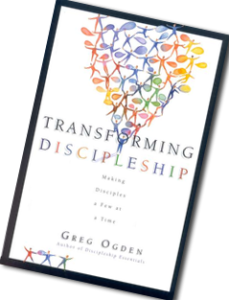 large-scale, finely-tuned, resource-heavy programs. Instead, Ogden recovers Jesus' method of accomplishing life change by investing in just a few people at a time.
And he shows how discipleship can become a self-replicating process with ongoing impact from generation to generation. Biblical, practical and tremendously effective, Transforming Discipleship provides the insights and philosophy of ministry behind Ogden's earlier work, Discipleship Essentials. Together, these ground-breaking books have the potential to transform how your church transforms the lives of its people.
 COPYRIGHT: This publication is published by C.S. Lewis Institute; 8001 Braddock Road, Suite 301; Springfield, VA 22151. Portions of the publication may be reproduced for noncommercial, local church or ministry use without prior permission. Electronic copies of the PDF files may be duplicated and transmitted via e-mail for personal and church use. Articles may not be modified without prior written permission of the Institute. For questions, contact the Institute: 703.914.5602 or email us.
-
Recent Podcasts
From New Age Seeker to Encountering Jesus – Robert Hotchkin’s Story
Raised in a loving but largely non-religious home,...Read More
- After Theory by Terry Eagleton
- Almost Heretical – Deconstructing Christian Finds His Way Back – Nate Hanson’s Story
-
Recent Publications

Is It Really That Important to Pay Attention to Others?
The Gospels paint a vivid picture of Jesus...Read More
- Should My Children Have Robot Friends?
- Stranded in Space, Grounded in Faith
Grow Your Faith with a New Online Course:
