Back to series

September 2014
There are skeptics who, after looking at the vastness of the universe, think it nonsense to believe that even if there were a God that He would choose to become a miniscule human being and live on earth - a very minor planet in a very minor solar system. The universe is too awesome and vast for God to care about this tiny planet. Lewis replies to this thinking in his book, Miracles. He writes,It is a profound mistake to imagine that Christianity ever intended to dissipate the bewilderment and even the terror, the sense of our own nothingness, which come upon us when we think about the nature of things. It comes to intensify them. Without such sensations there is no religion. Many a man, brought up in the glib profession of some shallow form of Christianity, who comes through reading Astronomy to realise for the first time how majestically indifferent most reality is to man, and who perhaps abandons his religion on that account, may at that moment be having his first genuinely religious experience.
Christianity does not involve the belief that all things were made for man. It does involve the belief that God loves man and for his sake became man and died. I have not yet succeeded in seeing how what we know (and have known since the days of Ptolemy) about the size of the universe affects the credibility of this doctrine one way or the other.
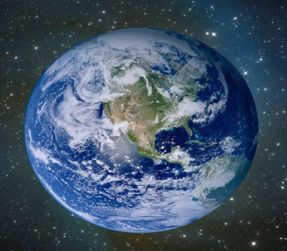 The sceptic asks how we can believe that God so 'came down' to this one tiny planet... If it is maintained that anything so small as the Earth must, in any event, be too unimportant to merit the love of the Creator, we reply that no Christian ever supposed we did merit it. Christ did not die for men because they were intrinsically worth dying for, but because He is intrinsically love, and therefore loves infinitely. And what, after all, does the size of a world or a creature tell us about its 'importance' or value?
There is no doubt that we all feel the incongruity of supposing, say, that the planet Earth might be more important than the Great Nebula in Andromeda. On the other hand, we are all equally certain that only a lunatic would think a man six-feet high necessarily more important than a man five-feet high, or a horse necessarily more important than a man, or a man's legs than his brain. In other words this supposed ratio of size to importance feels plausible only when one of the sizes involved is very great. And that betrays the true basis of this type of thought... The conclusion is inevitable: the importance we attach to great differences of size is an affair not of reason but of emotion–of that peculiar emotion which superiorities in size begin to produce in us only after a certain point of absolute size has been reached...
Medieval thinkers believed that the stars must be somehow superior to the Earth because they looked bright and it did not. Moderns think that the Galaxy ought to be more important than the Earth because it is bigger. Both states of mind can produce good poetry. Both can supply mental pictures which rouse very respectable emotions–emotions of awe, humility, or exhilaration. But taken as serious philosophical arguments both are ridiculous.
The vastness of the universe is awe-inspiring, and is too large for our finite minds to comprehend fully. And yet what is even more amazing is the fact that the Triune God of the universe loved us so much that He came down to our tiny planet and lived among us. Now that really is mind-blowing!
“For I am convinced that neither death nor life, neither angels nor demons, neither the present nor the future, nor any powers, neither height nor depth, nor anything else in all creation, will be able to separate us from the love of God that is in Christ Jesus our Lord."
ROMANS 8:38-39, (NIV)
1 C.S. Lewis. Miracles. Touchstone: New York, 1996, pp. 70-73.
 COPYRIGHT: This publication is published by C.S. Lewis Institute; 8001 Braddock Road, Suite 301; Springfield, VA 22151. Portions of the publication may be reproduced for noncommercial, local church or ministry use without prior permission. Electronic copies of the PDF files may be duplicated and transmitted via e-mail for personal and church use. Articles may not be modified without prior written permission of the Institute. For questions, contact the Institute: 703.914.5602 or email us.
-
Recent Podcasts

The Scientific Evidence He Couldn’t Ignore: Dr. Brian Miller’s Journey
Dr. Brian Miller grew up believing in God,...Read More
- Praying in the Spirit
- He Cursed God then Encountered Him – Paul Snyder’s Story
-
Recent Publications
Should My Children Have Robot Friends?
Both of my young kids know that I’m...Read More
- Stranded in Space, Grounded in Faith
- What If I Misrepresent the Gospel?
Next coming event
Days
Hours
Minutes
Seconds
STUDY PROGRAM: In the Footsteps of the Apostles (Turkey & Greece)
Grow Your Faith with a New Online Course: