Rainer Maria Rilke’s poem The Archaic Torso of Apollo is a haunting meditation on a damaged bust of Apollo. As the title suggests, all that survives of this ancient masterpiece is the torso. But throughout this short and intense poem, Rilke makes clear that the sculpture’s beauty more than transcends its defacement: “And yet his torso / is still suffused with brilliance from inside, / like a lamp, in which his gaze, now turned to low, / gleams in all its power.”
Those last two lines are eerie. Somehow, this headless statue is scrutinizing you. However, it’s the poem’s final lines that are its most famous: “for here there is no place / that does not see you. You must change your life.”
Rilke has in mind that odd sense of diminishment that accompanies experiences of intense beauty. Whether it comes through a majestic natural scene or a magnificent work of art, the very extravagance on display throws our own shortcomings into sharp relief. We don’t just feel self-conscious; we feel unworthy. My dad had this experience as he made his way through a dense redwood forest in California. In the shadow of these giants, he couldn’t simply carry on as he had before. He had to change his life.
When the train began to move, and I walked away, I felt as though I were leaving behind all the beauty and all the joy in the universe. Something of God’s universal love has rubbed off on Mother Teresa, giving her homely features a noticeable luminosity; a shining quality. She has lived so closely with her Lord that the same enchantment clings about her that sent the crowds chasing after him in Jerusalem and Galilee, and made his mere presence seem a harbinger of healing.
—Malcolm Muggeridge, Something Beautiful for God
Both Rilke and Muggeridge are pointing to the fact that beauty has an escapably prophetic dimension. In this sense, any form of goodness that’s made manifest brings both delight and a sense of judgment. Even as we celebrate the glory of a Norwegian fjord, the heartrending quality of a George Herbert poem, or the solemn grace of everyday expressions of charity, we also lament the prevailing brokenness of our world—a brokenness that includes us. We may be ravished, but we also stand condemned.
We live in a time of massive transition, and although America’s Christian heritage remains a significant social force, its cultural dominance lies decisively in the past. On a practical level, part of what this means is that there is no longer a common Christian framework to which believers may appeal when engaging those outside the Church. Christianity may not yet be a full-blown foreign language, but it’s certainly a foreign dialect. The onus is now on individual Christians to be salt and light in their communities. We can’t outsource our evangelism to “experts” who will call forth teeming masses of people at large rallies.
The world that would support such endeavors has vanished. We no longer have the luxury of curtailing our role as Christ’s ambassadors. We have to stop hiding the fact that we recognize Jesus as Lord.
Here I want to focus on the visible damage of that ancient statue of Apollo. There’s an odd resonance for those of us called to tell others about Jesus—our Lord’s broken people pointing to the perfection of His Son. Having worked in Christian ministry my entire adult life, I can safely say that the word evangelism is reliably linked to feelings of guilt and anxiety. Put simply, most of us feel that we’re not good enough at it and that we’re not doing nearly enough of it. Performance anxiety and overthinking stop many of us dead in our tracks. Evangelistic inertia is also easy to rationalize. After all, we can always be more prepared and we can always entertain thoughts like, I just don’t want to screw it up and say something stupid. I don’t want to misrepresent Christ.
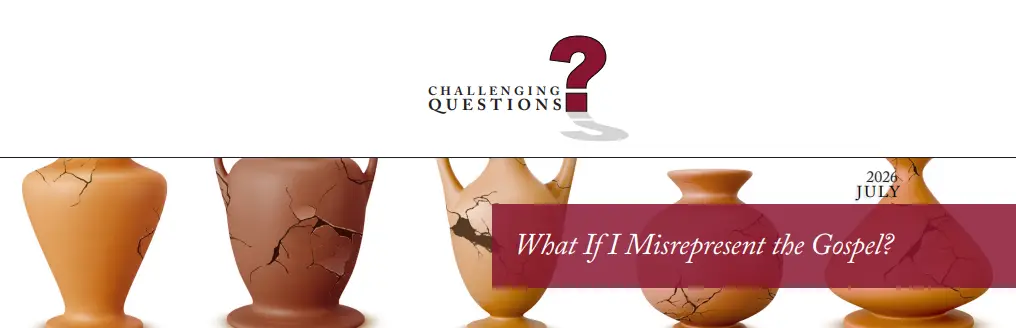
But you will and you must be imperfect in evangelism. In these moments, I risk sacrilege by thinking of the magnificent torso of a pagan god. I take it for granted that we will inevitably deface the gospel of our Lord, earthen vessels that we are. Even if we delivered the most resplendent of gospel presentations, the very shape of our lives—our broken hearts—would mar and deface it just as surely as the ravages of time do to any ancient relic. But, like the torso of which Rilke speaks, Christ’s beauty, vitality, and awful purity shine through our feeble efforts. And when our neighbors outside the church are granted ears to hear and eyes to see by the Spirit, they are confronted with that same urgent message: You must change your life.
Will you misrepresent Christ? Will you bungle the gospel? Will you say the wrong thing? Absolutely. Worse, the whole testimony of our lives makes it clear that, apart from the grace of our Lord, we stand condemned. But our Lord has also said, “All authority in heaven and on earth has been given to me. Go therefore and make disciples of all nations, baptizing them in the name of the Father and of the Son and of the Holy Spirit, teaching them to observe all that I have commanded you. And behold, I am with you always, to the end of the age” (Matthew 28:18–20, ESV).
Charged with our Lord’s authority, we are liberated to share the good news that Christ is Lord, safe in the assurance that His power is made perfect in our weakness (2 Corinthians 12:9).
Director of Apologetics, CSLICameron McAllister is Director of Apologetics for the C.S. Lewis Institute. He cofounded Thinking Out Loud, where he’s a speaker, writer and one half of the Thinking Out Loud podcast, a weekly podcast about current events and Christian hope. He and his father co-authored Faith That Lasts: A Father and Son on Cultivating Lifelong Belief. A staff writer with Christ & Pop Culture, Cameron’s writing has appeared in Christianity Today, Relevant Magazine, Think Christian, and Fathom Magazine. He holds a master’s degree in apologetics from Houston Baptist University. Cameron and his wife Heather live in the Atlanta area with their two children.
Support the ministry of Cameron with CSLI.
COPYRIGHT: This publication is published by C.S. Lewis Institute; 8001 Braddock Road, Suite 301; Springfield, VA 22151. Portions of the publication may be reproduced for noncommercial, local church or ministry use without prior permission. Electronic copies of the PDF files may be duplicated and transmitted via e-mail for personal and church use. Articles may not be modified without prior written permission of the Institute. For questions, contact the Institute: 703.914.5602 or email us.
0All Booked0.00All Booked0.00All Booked29802Heart and Mind Discipleship Live Online Small Grouphttps://www.cslewisinstitute.org/?event=heart-and-mind-discipleship-live-online-small-group-las-vegas-nairobi-philippines&event_date=2026-11-06®=1https://www.paypal.com/cgi-bin/webscr2026-11-06
Director of Apologetics, CSLICameron McAllister is Director of Apologetics for the C.S. Lewis Institute. He cofounded Thinking Out Loud, where he’s a speaker, writer and one half of the Thinking Out Loud podcast, a weekly podcast about current events and Christian hope. He and his father co-authored Faith That Lasts: A Father and Son on Cultivating Lifelong Belief. A staff writer with Christ & Pop Culture, Cameron’s writing has appeared in Christianity Today, Relevant Magazine, Think Christian, and Fathom Magazine. He holds a master’s degree in apologetics from Houston Baptist University. Cameron and his wife Heather live in the Atlanta area with their two children.
Support the ministry of Cameron with CSLI.









 COPYRIGHT: This publication is published by C.S. Lewis Institute; 8001 Braddock Road, Suite 301; Springfield, VA 22151. Portions of the publication may be reproduced for noncommercial, local church or ministry use without prior permission. Electronic copies of the PDF files may be duplicated and transmitted via e-mail for personal and church use. Articles may not be modified without prior written permission of the Institute. For questions, contact the Institute: 703.914.5602 or email us.