



Back to series




Transforming the Heart Through Meditating on the Word
MATTHEW BINGHAM, PH.D.
VICE PRESIDENT OF ACADEMIC AFFAIRS, ASSOCIATE PROFESSOR OF
CHURCH HISTORY, PHOENIX SEMINARY, SCOTTSDALE, ARIZONA
Click here to open a Print-Friendly PDF
One of the striking features of Christianity is the extent to which it concerns one’s inner world, both one’s thoughts and one’s feelings. Unlike other religions that stress what goes on externally—the pilgrimages to a specific place, the prayers facing a particular direction, the alms given in prescribed intervals—biblical Christianity is especially interested in what unfolds on the inside.
This is seen first and foremost in the Christian stress on belief. Seventeen hundred years after the Council at Nicaea (325), we remember that the Council’s most famous document begins with the Latin verb credo—“I believe”—and thus defines what it means to be a Christian in terms of the wholly interior reality of one’s inner conviction.
In addition to one’s discrete beliefs, the Bible insists that the secret affections of the heart—what one loves and desires and dwells upon—are constitutive of what one actually is. In the Old Testament we read that “man looks on the outward appearance, but the Lord looks on the heart” (1 Sam. 16:7),1 and in the New Testament we find Jesus insisting that one of the most problematic tendencies, even among the people of God, is to forget this crucial stress on interiority: “You have heard that it was said, ‘You shall not commit adultery.’ But I say to you that everyone who looks at a woman with lustful intent has already committed adultery with her in his heart” (Matt. 5:27–28).
 It’s not that Christianity doesn’t care what one actually does—one cannot read very far in the New Testament documents without being confronted with instructions on things that must be done and left undone—rather, Christianity relativizes the concern for outward conduct by recognizing that our inner world both matters to God and ultimately will decisively influence the things we do and the people we become.
As a result, it is the heart that must be carefully tended and cultivated. Drawing on the exhortation from Proverbs to “keep your heart with all vigilance” (Prov. 4:23), the Puritan John Flavel (ca. 1627–1691) insisted that keeping the heart was “the great business of a Christian’s life.”2 Heart keeping thus involves a careful, conscious attempt to think and feel in God-honoring ways. It encompasses the fight against sinful inclinations, but, more positively, it also involves the positive cultivation of godly affections—joy, peace, contentment, and a love for God and neighbor. “To keep the heart,” explained Flavel, “is carefully to preserve it from sin which disorders it; and maintain that spiritual and gracious frame, which fits it for a life of communion with God.”3
Given this concern for the state of one’s innermost person, questions immediately arise as to how one might pursue such “heart keeping.” Perhaps part of outward religion’s enduring appeal lies in its concreteness and corresponding achievability—at least in theory. If I make such-and-such oblation so many times per day, I will have done my duty and then can rest. By contrast, the vast undefined prairies of the heart seem boundless in scope and far beyond our capacity to even map out, let alone manage. Indeed, Scripture itself teaches that “the heart is deceitful above all things, and desperately sick; who can understand it?” (Jer. 17:9) Acknowledging this inherent challenge, Flavel cautioned that “the greatest difficulty after conversion is to keep the heart with God” and this constitutes “the very pinch and stress of religion.”4
And yet, despite the strain involved in doing so, Flavel, like other Puritan devotional writers, believed that it was indeed possible for Christians to “keep the heart” and cultivate a warm, God-honoring inner world. How? For Flavel and others, the primary tool to be used in this respect was what he and his contemporaries called meditation. This is not the meditation advocated by New Age gurus such as Deepak Chopra—who in a recent interview claimed to meditate for four to five hours every day.5 Rather, when the Puritans call us to “meditate,” they mean something close to what we might mean by verbs like “ponder,” “muse,” and “contemplate.” When they speak of meditation, they indicate focused reflection on God and the things of God, undertaken with an intentional eye toward rightly calibrating the heart. “Meditation,” according to the Puritan Thomas Manton (1620–1677), “is that duty or exercise of religion whereby the mind is applied to the serious and solemn contemplation of spiritual things, for practical uses and purposes.”6
There we see that meditation is a mental activity, but one which deliberately turns the mind toward “practical uses and purposes.” For Manton, those “practical uses” could include a desire to grow in one’s appreciation of aspects of God’s work and ways or an application of God’s truth to the particularities of one’s own life circumstances. In both cases, the logic is similar: intentional reflection on Christian things allows us to calibrate the heart aright. The Puritan John Ball (1585–1640) defines meditation in a similar way, stressing both the intellectual dimension of meditation and the practical end toward which it is directed:
“Meditation is a serious, earnest and purposed musing upon some point of Christian instruction, tending to lead us forward toward the Kingdome of Heaven, and serving for our daily strengthening against the flesh, the world, and the Devil.”.7
And for Puritan authors like Manton and Ball, meditation was not simply an optional add on appropriate for some Christians under certain circumstances. Rather, they and their contemporaries saw it as an indispensable component of one’s religious life. Indeed, Ball insisted that “a Christian life cannot stand without it,” and the Puritan Thomas Watson (1620–1686) described meditation as “the very heart and lifeblood of religion.”8 The reason for this emphasis was that they perceived a clear connection between the discipline of meditation and the biblical call to “keep your heart” (Prov. 4:23). Without meditation, the daily work of heart keeping amidst the challenges of life in a fallen world would be a practical impossibility. In this connection, the Puritans did not see it as coincidental that the psalter begins with a portrait of the blessed man as a person defined by “delight in the law of the Lord” on which “he meditates day and night” (Ps. 1:2).
So if Christianity is supremely concerned with the desires of the heart, and our Puritan forebears believed that meditation was the crucial instrument for keeping and cultivating the heart, let’s see if we can dig a bit deeper into the logic behind their claims. What is it about the practice of meditation that makes it such an indispensable tool for transforming one’s inner world?
Meditation Reflects Who We Are and Shapes Who We Will Become
First, meditation on God and the things of God is crucial for heart transformation because what we think deeply and regularly about both mirrors who we are and molds who we will become. It borders on tautological to state that we think most often on the things we care about most. A student anxiously obsesses over her upcoming exams. A bored office worker daydreams about his vacation to Maui. Farmers mull the upcoming harvest, and basketball players dream of making three pointers. We habitually meditate upon the objects of our desire again and again, our mental loops reflecting back to us what we care about most.
But the process also works in a forward direction. In addition to mirroring who we already are, our habitual thoughts also mold us into who we will become. We tend to become fascinated by those things to which we devote our attention. “There is no such thing on earth as an uninteresting subject,” writes G.K. Chesterton, “the only thing that can exist is an uninterested person.”9 We are made to take delight in learning, observing and pondering, and the result is that we typically become interested in that in which we take interest. Anyone who has observed the zeal of the bird-watcher, the historical reenactor, or the amateur astronomer has come face to face with this principle in action: The more you pay attention to something, the more fascinating you find it.
Given that this seems to be how God has made us, it is no surprise that the Bible repeatedly exhorts Christians to fill their minds with reflection on divine realities. Paul urges believers, “set your minds on things that are above, not on things that are on earth” (Col. 3:2) and warns that “to set the mind on the flesh is death, but to set the mind on the Spirit is life and peace” (Rom. 8:6). So believers are those whose minds are set on divine things, and that orientation of mind, in turn, leads the Christian to find greater and greater delight in meditating more and more deeply on God and the things of God. Psalm 119 is one long meditation on the beauty of meditating on God’s Word, and in it, the psalmist frequently draws a straight line between deep reflection on God’s Word and a heart alive to taking joy in the same:
In the way of your testimonies I delight as much as in all riches.
I will meditate on your precepts and fix my eyes on your ways.
I will delight in your statutes; I will not forget your word.
(Ps. 119:14–16)
Whether it is with respect to the spiritual life or to more mundane concerns, we shape our hearts through that to which we carefully attend, and so it makes sense that meditation would function as a primary catalyst for shaping our hearts.
Meditation Solves the Head-Heart Conundrum
Second, meditation is indispensable for keeping the heart in that it resolves a perceived tension between our thoughts and our feelings. One often hears that Reformed Protestantism is a religion of the head, a faith far more concerned with getting one’s doctrinal ducks properly aligned and far less concerned with establishing and maintaining a vital and lively piety. Perhaps this is because the Reformed stream of the Protestant Reformation—that stream of Christian thought and practice originating in the sixteenth-century Swiss Reformation, blossoming among the seventeenth-century English Puritans, and spreading rapidly through the eighteenth-century evangelical revivals—has always prioritized an approach to the Christian life that is highly word-centric. Every aspect of Reformed spirituality is derived from and based upon engagement with God-breathed Scripture. As the early-twentieth-century Presbyterian theologian B.B. Warfield pithily summarized, “Life close to God’s Word is life close to God.”10 As a result, many outside of this tradition—and even some within it—have assumed that by so heavily emphasizing Bible reading, Scripture memorization, and other related disciplines, Protestants are surely creating a religious life that is arid and dry, a cold, heady affair lacking real passion and fire.
Sometimes this accusation comes from those in the Roman Catholic or Eastern Orthodox tradition, two groups that have long viewed the Reformation as an overly intellectualized deviation from the sacramental and liturgical church-life celebrated by both Rome and Constantinople. Thus, for example, the Eastern Orthodox theologian Zachary Porcu associates Protestantism with completing “a set of intellectual checklists” and suggests that if one focuses too exclusively on “agreeing with doctrine or memorizing Bible verses” then the result will be “an abstracted, overly intellectualized religion.”11 As an alternative to Protestantism’s emphasis on the word, Porcu celebrates what he perceives to be the more holistic sacramental ministry of his own Eastern Orthodox church.
Closer to home, the popular and ostensibly evangelical author John Mark Comer strikes a similar chord when he describes “more Bible study” as a “losing strategy” for furthering one’s spiritual formation:
A lot of churches operate on the assumption that as a person’s knowledge of the Bible increases, their maturity will increase with it. I have been around Bible-teaching churches for my entire life, and I can assure you this is, at best, wildly insufficient.12
The reason why such an approach is doomed to failure, says Comer, is because it assumes a “thoroughly unbiblical view of the human soul as a kind of brain on legs.”13 Just like the Eastern Orthodox critique, the suggestion here is that the word-based piety championed by the Protestant Reformers fails because it feeds the head while neglecting the heart. In making this case, Comer is channeling the work of Protestant philosopher James K.A. Smith who similarly accuses “Protestant Christianity (whether liberal or conservative)” of fostering “an overly cognitivist picture of the human person” that “tends to foster an overly intellectualist account of what it means to be or become a Christian.”14
These critics are correct to note that the Protestant Reformers and their theological heirs do celebrate the word of God as the principal means through which God shapes and forms his people. In this respect, the Reformation did indeed deemphasize, though certainly did not wholly reject, the sacramental life of the church. Furthermore, they are also correct to observe, as an empirical reality, that there are people within Reformed circles who know many things about God but don’t seem to exhibit a warm-hearted devotion toward him. However, despite the truth of these observations, the conclusion that Reformation theology as such necessarily leads to underdeveloped, cold Christianity is misguided for at least three reasons.
First, every denomination, strand, and flavor of historic Christianity contains professing believers who don’t seem especially warm-hearted and fail to manifest the fruit of the Spirit. If the presence of such persons in our pews is enough to render an entire theological tradition inherently defective, then honesty will require us to conclude that every Christian tradition has failed. The reality is that the mere presence of some in Reformed circles who do fit the stereotype of the “frozen chosen” does not logically lead to the conclusion that it was deep study of Scripture and theology that led them to that place. In an address delivered in 1831, the Presbyterian minister Ashbel Green (1762–1848) made this point to the students of Princeton Seminary, a group who surely had heard this criticism many times themselves:
I am ready to admit, and do freely admit, that it is very possible a man may be frozen to the core in the ice of biblical criticism, and even of orthodox doctrine. But I deny that the truths and study of the Bible, and the orthodox faith, ever did, by their direct and proper influence, freeze any man. It was something else, or the want of something else, that froze him, if he was frozen. There Green is simply making the point that correlation does not equal causation, but he actually went a step further to add a crucial next point: “and if he was ever thawed out into spiritual life and vigour, the truths of the Bible and the orthodox faith, in the hand of the Spirit of God, were the instrument of producing this desirable change.”15 That second point completes the Protestant position: Not only is the study of God’s word not to blame for any spiritual hardening, but it actually represents the God-appointed means for transforming hearts in a godly direction.
Second, in prioritizing God’s Word, the Reformers were only following Scripture itself. If critics wish to decenter word ministry in the life of God’s people, then they will need first to explain why that same Word is celebrated in the psalter as “sweeter than honey” (Ps. 19:10), compared by Jesus (who in turn is quoting the Pentateuch) to the bread that sustains one’s very life (Matt. 4:4), and elevated by Paul to the vital center of the gospel ministry he commends to Timothy: “preach the word; be ready in season and out of season” (2 Tim. 4:2). The biblical emphasis on God’s Word as the engine of spiritual transformation is not passing or subtle, but rather persistent and emphatic. Protestantism’s emphasis on the Word is decidedly downstream from the Bible’s own commentary on itself.
Third and finally, critics suggesting that Reformed Protestant piety downplays the heart at the expense of the head have not properly appreciated how the English Puritans and others understood the spiritual discipline of meditation. For the English Puritan devotional writers, it was clear that although meditation begins as an intellectual endeavor, the act of thinking deeply on God’s truth is God’s intended means for stirring up affections and firing the heart. As the historian Charles Hambrick-Stowe explains, “The reading and study of religious texts, though an intellectual activity, did not primarily or finally have an intellectual end. The exercise of the rational faculty opened the way to a changed heart.”16 The ultimate goal of Puritan devotion is a heart that loves what God loves, but they also understood that God’s design for our spiritual formation begins with a mind fixed on God’s Word and then moves from there to the cultivation of godly affections. “I will praise you with an upright heart, when I learn your righteous rules” (Ps. 119:7, italics added).
The critiques of Reformed piety we surveyed earlier accuse Protestants of holding a reductionistic anthropology that “reduces human beings to brains-on-a-stick.”17 The irony here is that not only were the Puritans explicitly not reducing human anthropology in this way, they were actually highly sensitive to the holistic, integrated nature of the human person and were trying to do justice to the Bible’s own account of how the whole person functioned as a unity to both think and feel in a God-honoring way. Their focus on the Word was not an attempt to sideline the heart, but rather to harness God’s own established means for forming the heart, namely, meditation. To this end, they often distinguished between study and meditation:
The end of study is information, but the end of meditation is practice, or a work upon the affections . . . Study is like a winter’s sun, that shineth, but warmeth not; but meditation is like the blowing up of the fire, where we do not mind the blaze, but the heat. The fruit of study is to hoard up truth, but the fruit of meditation is to practise it. 18
If all that the Protestant tradition had to commend to us was the bare accumulation of new religious information, then the critiques of those who deride it as a “brain-on-a-stick” faith would have merit and bite. But when we consider that Reformed Protestant meditation explicitly names and repudiates such a view, taking us beyond mere study and toward something specifically intended to stir up godly affections, we can safely conclude that this criticism badly misses the mark.
Meditation Fuels Obedience to the Biblical Imperatives
A third and final reason to prize meditation as a key driver of heart transformation, is the way in which the practice of meditation stands behind and makes possible so many of the other biblical imperatives. As one works it out, it becomes clear that meditation is actually the foundation for and wellspring of almost everything else that the Bible calls us to.
If this seems overstated, think for a moment about the biblical injunction to praise God. Stated and restated throughout the Psalms and elsewhere, few biblical exhortations are more basic to the religious life of God’s people than the ever-present imperative, “Let everything that has breath praise the Lord!” (Ps. 150:6). If generous and frequent praise of the good, the true, and the beautiful is, as C.S. Lewis once memorably put it, “inner health made audible,” then praising the triune God is surely “spiritual health made audible” and the foundation of a God-honoring life: “His praise shall continually be in my mouth” (Ps. 34:1).19
 So we must praise Him, yes, but how? To praise a thing, we must first know it, understand it, and appreciate it. I cannot praise that of which I am ignorant any more than I can smell or taste a food I’ve never actually tried. So when the psalmist says that it is good “to sing praises to your name, O Most High,” he expands that by naming aspects of God’s character with which he is familiar and for which he will bless God’s name, praising the Lord for His “steadfast love in the morning” and His “faithfulness by night” (Ps. 92:1–2). Praise does not arise out of nowhere, but, rather, it comes in response to specific attributes, promises, and works: “at the works of your hands I sing for joy” (Ps. 92:4).
Thus the essential precursor to praising God is glimpsing Him as He has revealed Himself to be and then mentally taking hold of that glimpse and examining it, turning it over and delighting in its particular shape. Or, to put it another way, to praise God I must meditate upon Him as He has revealed Himself in His Word. Whether we are using the term meditation or not, it would seem that the very logic of genuinely praising God requires something very much like it as an essential prelude.
And what’s true here of praise holds true for almost every other movement of the heart to which the Scriptures call us. This is why Thomas Manton describes meditation as something of a master practice, “a necessary duty, without which all graces would languish and wither.”20 The saints are called to cultivate that “fear of the Lord,” which is the beginning of wisdom” (Prov. 9:10). And yet how do we learn this godly reverence and begin to feel its weight apart from extended meditation upon the holiness and majesty of God? Scripture urges us to “give thanks to the Lord, for he is good” (Ps. 106:1), connecting thankfulness to the knowledge of and meditation upon God’s goodness. Real trust in God arises from meditating on His promises, pondering the biblical realities of His sovereign care for us and love for us in Christ. “Our hopes arise,” writes Manton, “according to the largeness of our thoughts.”21 In all of this, whether we are being exhorted to trust, hope, love, praise, give thanks, or walk by faith, heartfelt obedience to the Bible’s imperatives presupposes a robust inner world that is being daily nourished and fed through meditation on God’s Word.
Meditation on the things of God as revealed in Scripture is a key means for heart transformation. The practice involves, as Thomas Watson put it, “a serious thinking upon God.” But while meditation is never less than that, it also never stays there either. Meditation is a “serious thinking,” yes, but it’s a thinking that goes somewhere. It involves taking divine truths, promises, and precepts and reflecting prayerfully on all the many ways in which they intersect with my life, comforting me, assuring me, challenging me, rebuking me, and equipping me for the whatever the day might have in store. As the Puritan Richard Baxter expressed it, “Meditation holds reason and faith to their work, and blows the fire till it thoroughly burns.”22
Matthew Bingham
Matthew Bingham holds a PhD from Queen’s University Belfast and is the vice president of academic affairs and associate professor of church history at Phoenix Seminary in Scottsdale, Arizona. He is the author of Orthodox Radicals: Baptist Identity in the English Revolution and has served as a pastor in the United States and Northern Ireland. He is also the author of the newly released book A Heart Aflame for God, in which Dr. Bingham details his studies of God-ordained spiritual practices modeled by the 16th- and 17th-century Reformers. Primarily drawing from Puritan tradition, he shows readers how to balance belief in salvation through faith with a responsibility for one’s personal spiritual growth.

QUESTIONS FOR REFLECTION
1. What does it mean to “keep the heart”, and why is it important?
2. After considering the article, how would you describe the kind of meditation advocated by the Puritan devotional writers? How is meditating on the Word different than reading the Bible and studying the Bible?
3. Why does meditating on the Word lead to transformation of the heart?
4. What is your own experience with meditating on the things of God as revealed in the Scripture? After considering the article, would you like to begin this practice or enhance or renew your ongoing practice? If so, what actions do you plan to take over the next week, the next month?
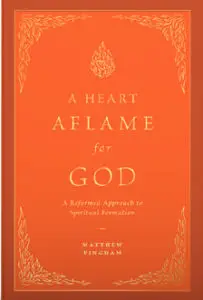
Matthew Bingham, A Heart Aflame for God: A Reformed Approach to Spiritual Formation (Crossway, 2025)
David Mathis, Habits of Grace: Enjoying Jesus Through the Spiritual Disciplines (Crossway, 2016)
Eugene Peterson, Eat This Book (Eerdmans Publishing Company, 2006)
Donald S. Whitney, Praying the Bible (Crossway, 2015)
Tom Schwanda, Soul Recreation: The Contemplative-Mystical Piety of Puritanism (Pickwick, 2012)
-
Recent Podcasts

After Theory by Terry Eagleton
Explore Terry Eagleton’s After Theory and discover a...Read More
- Almost Heretical – Deconstructing Christian Finds His Way Back – Nate Hanson’s Story
- The Faith of Malcom Muggeridge
-
Recent Publications

Is It Really That Important to Pay Attention to Others?
The Gospels paint a vivid picture of Jesus...Read More
- Should My Children Have Robot Friends?
- Stranded in Space, Grounded in Faith
Grow Your Faith with a New Online Course: