

Back to series
Cleanse Me From Secret Faults
Strange as it may seem, multitudes called Christians go through life with no effort to obtain a correct knowledge of themselves. They are contented with general and vague impressions concerning their real state; and, if they have more than this, it is merely such accidental information about themselves as the events of life force upon them. But exact systematic knowledge they have none, and do not aim at it.
[Yet] unless we have some just idea of our hearts and of sin, we can have no right idea of a Moral Governor, a Savior, or a Sanctifier that is, in professing to believe in Them, we shall be using words without attaching distinct meaning to them. Thus self-knowledge is at the root of all real religious knowledge; and it is in vain—worse than vain, it is a deceit and a mischief—to think to understand the Christian doctrines as a matter of course, merely by being taught by books, or by attending sermons, or by any outward means, however excellent, taken by themselves. For it is . . . as we search our hearts and understand our own nature that we understand what is meant by an Infinite Governor and Judge; in proportion as we comprehend the nature of disobedience and our actual sinfulness, that we feel what is the blessing of the removal of sin, redemption, pardon, sanctification, which otherwise are mere words. . .
Click here to read the full article (READ PDF).
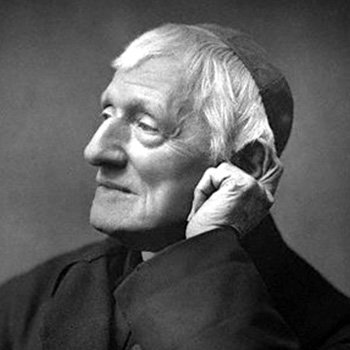
John Henry Newman
PriestJohn Henry Newman, (1801 – 1890) was a 19th-century English-speaking Catholic theologian. He was a priest, preacher, writer, and eminent theologian in both Catholic and Anglican churches. He studied at Oxford’s Trinity College, was a tutor at Oriel College, and for 17 years was vicar of the university church. John Henry Newman was ordained a Catholic priest in Rome and for seven years served as rector of the Catholic University of Ireland. Newman wrote 40 books and 21,000 letters that survive today. Most famous are his Essays on the Development of Christian Doctrine, On Consulting the Faithful in Matters of Doctrine, Apologia Pro Vita Sua—his spiritual autobiography up to 1864, and Essay on the Grammar of Assent.
Notice: This material is made available for limited use to participants of the C.S. Lewis Institute Fellows programs. Please do not reproduce any of the materials in the Fellows Resources other than for your personal use.
-
Recent Podcasts
Taking Religion Seriously – Dr. Charles Murray’s Story
by Charles Murray on July 31, 2026For decades, Charles assumed that religion belonged to...Read More
-
The Jesus Prayer
by Aimee Riegert, Bill Smith on July 24, 2026
-
Looking for a Better Life – Ellie Long’s Story
by Ellie Long on July 17, 2026
-
Recent Publications
What If I Misrepresent the Gospel?
by Cameron McAllister on July 1, 2026When the train began to move, and I...Read More
-
Transforming the Heart Through Meditating on the Word
by Matthew Bingham on June 17, 2026
-
Isn’t Christianity Just One Myth Among Many?
by Thiago M. Silva on June 1, 2026
0
All Booked
0.00
All Booked
0.00
All Booked
25547
STUDY PROGRAM: In the Footsteps of the Apostles (Turkey & Greece)
https://www.cslewisinstitute.org/?event=biblical-study-program-in-the-footsteps-of-the-apostles-turkey-greece&event_date=2026-09-12®=1
https://www.paypal.com/cgi-bin/webscr
2026-09-12
Next coming event
Days
Hours
Minutes
Seconds
STUDY PROGRAM: In the Footsteps of the Apostles (Turkey & Greece)
On September 12, 2026 at 3:00 pm at İstanbul, TürkiyeCategories
Speakers

John Henry Newman
Priest
Team Members
John Henry Newman
PriestJohn Henry Newman, (1801 – 1890) was a 19th-century English-speaking Catholic theologian. He was a priest, preacher, writer, and eminent theologian in both Catholic and Anglican churches. He studied at Oxford’s Trinity College, was a tutor at Oriel College, and for 17 years was vicar of the university church. John Henry Newman was ordained a Catholic priest in Rome and for seven years served as rector of the Catholic University of Ireland. Newman wrote 40 books and 21,000 letters that survive today. Most famous are his Essays on the Development of Christian Doctrine, On Consulting the Faithful in Matters of Doctrine, Apologia Pro Vita Sua—his spiritual autobiography up to 1864, and Essay on the Grammar of Assent.